Two-Bit Astrophotography

The Game Boy Camera is a 128×112 pixel sensor from 1998 that was probably the first digital camera in many, many homes. There’s not much you can do with it now, besides replicate old Neil Young album covers and attempting and failing to impress anyone born after the year 1995. Nevertheless, screwing around with old digital cameras is cool, so [Alex] strapped one fo these Game Boy Cameras to an old telescope.

For any astrophotography endeavor, the choice of telescope is important. For this little experiment, [Alex] used a 6” Fraunhofer telescope built in 1838 at the Old Observatory of Leiden. The Game Boy with Camera was attached to the scope using a universal cell phone adapter. Apparently the ‘universal’ in this universal cell phone adapter is accurate – the setup was easy and [Alex] quickly got an image of a clocktower on his Game Boy.

Turning to the heavens, [Alex] took a look at the most interesting objects you can see with a 6-inch telescope. Images of the moon turned out rather well, with beautiful 2-bit dithering along the terminator. Jupiter was a bright white spot in a sea of noise, but [Alex] could see four slightly brighter pixels orbiting where Stellarium predicted the Galilean moons would be.

Was this experiment a success? Between cloudy nights and a relatively small telescope, we’re saying yes. These are pretty impressive results for such a terrible digital camera.

Fixing Bugs In Ancient BASIC Games

Before everyone learned programming on Stack Exchange, things were much different. Computer magazines had BASIC programs in them, which readers would type out, line by line, and hit RUN. In theory, this is a terrible way to learn programming; it’s simply rote recitation without any insight into what the code is actually doing. Of course, copying and pasting from Stack Exchange is exactly the same thing, so maybe these magazines were ahead of the curve.

[0xA000] recently came across one of his old computer magazines containing the type-in listing for Blindganger, a game where you wander a maze blindly. When [0xA000] typed this game into his C64 back in 1988, the game didn’t work. Thirty years later, he decided to give it another go and ended up fixing bugs in an old computer game.

When [0xA000] typed this game into his computer back in 1988, the map just didn’t work, and the final screen revealed a maze where the walls were where they shouldn’t be. A quick Google turned up a disk image of the same game that had the same problem. This bug was obviously in the section of code that draws the map at the end of the game, so [0xA000] started looking there. The offending typo in the code was an $F4 instead of an $F5, or 244 instead of 255. This shifted the colors of the map by 11 positions, meaning the locations marked as visited in the final screen were wrong. Whether this bug cropped up in development or was just a simple typo when typesetting the magazine doesn’t really matter now; after 29 years, this bug is fixed.

Hackaday Prize Entry: An Internet Doorbell

The Internet of Things will kill us all and is the worst idea anyone has ever had. However, just because something could be labeled an ‘Internet of Things thing’ doesn’t mean it’s a bad idea. The Hackaday Prize’s Internet of Useful Things challenge was all about finding the Internet of Useful things, and one of these projects is so simple yet so elegant, we’re surprised no one has thought of it yet.

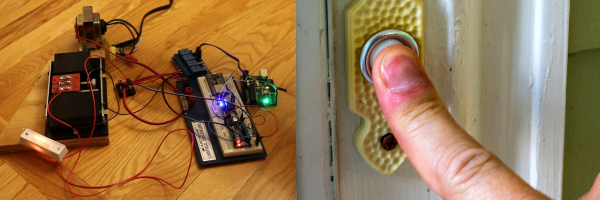
[David]’s entry to the Hackaday Prize is effectively an Internet of Things doorbell. You might think an IoT doorbell would just consist of a device sending push notifications to your phone. That’s part of the project, but it gets so much better.

The brilliant part of this build boils down to a simple relay. On command, [David] can turn his doorbell off. This means no ringing doorbell interrupting meals or naps. By sending a command to the ESP32 in this little device, [David] can enable or disable his doorbell. Of course, this doorbell also sends push notifications to his phone, so if the UPS guy throws a package at his front door and manages to hit the doorbell, [David] will still hear it even if he’s upstairs, in the garage, or in the backyard.

This is the simplest and most brilliant Internet of Things device ever created. It solves an obvious problem with surprisingly little hardware. The only data this device collects is the state of a doorbell, and even if this device was completely hacked by balaclava-wearing hackers, they still can’t F5 the doorbell. This is the best the Internet of Things has to offer, and we’re proud to have the Internet of Doorbells make it to the finals of the Hackaday Prize.

Friday Hack Chat: A Design Slam Challenge

Every Friday, the Hackaday.io community gathers ’round the fireplace and discusses the challenges facing the world. This is the Hack Chat, and in previous incarnations, we’ve talked about custom silicon, Arduinos, PCB fabrication, old technologies, and hardware manufacturing.

For this week’s Hack Chat, we’re opening up a design challenge. We’re asking the community for help on developing a wireless position sensor. This is a Design Slam Hack Chat, and we’re looking for contributors.

Our guest for this week’s Hack Chat will be [Naveen Nair], technology leader for GE Fuse. We’ll be discussing position sensors during this Hack Chat. If you’ve ever used a mouse, you’re using a position sensor, but for this Hack Chat we’re designing something a little more challenging. The Fuse group is attempting to build a low-cost, wireless position sensor with hand-held ultrasonic inspection units. Why is GE interested in this technology? Our guess is inspecting jet turbines, or something like that. That doesn’t mean low-cost wireless position sensors wouldn’t have other applications, though. Just imagine what a quadcopter could do if it could sense its position with 1mm resolution.

Won’t be able to make the Hack Chat? Don’t worry, we’ll be putting a transcript up here sometime after the event.

Here’s How To Take Part:

join-hack-chatOur Hack Chats are live community events on the Hackaday.io Hack Chat group messaging. This Hack Chat will take place at noon Pacific time on Friday, July 7th. Confused about where and when ‘noon’ is? Here’s a time and date converter!

Log into Hackaday.io, visit that page, and look for the ‘Join this Project’ Button. Once you’re part of the project, the button will change to ‘Team Messaging’, which takes you directly to the Hack Chat.

You don’t have to wait until Friday; join whenever you want and you can see what the community is talking about.

Hackaday Links: July 2, 2017

A few months ago, we had a Hack Chat with Chip Gracey, the guy behind Parallax, the Basic Stamp, the Propeller, and the upcoming Propeller II. Now we’ve finally got around to editing that transcript. There’s a lot of awesome stuff in here, from learning a Hardware Design Language to the actual costs of fabbing silicon.

Rigol, the manufacturers of every hackerspace’s favorite oscilloscope, announced a new chipset. The current lineup of Rigol scopes top out at around 1GHz. In a prototype scope based on this chipset, Rigol demonstrated 4GHz bandwidth and 20GS/s with one Billion point memory depth. What this means: Rigol will be making very powerful scopes in the near future.

Hackaday had a meetup this week in New York City. The June workshop at Fat Cat Fab Lab featured speakers involved with twitter bots, 8-bit art, one of the guys behind Beautiful Soup, and a talk on a completely self-sustainable record label. Want to attend one of these meetups? Check out the calendar.

Repairs of retrocomputers are always interesting, but usually the same. Wipe off some dust, possibly replace a cap or two, retrobrite the case, and you’re done. This is not the usual retrocomputer repair. [Drygol] found a C64 that was apparently stored in a swamp for several years. The power switch fell off when he touched it. Somehow, miraculously, the circuit worked and [Drygol] rewarded the board with a new enclosure, dyed keycaps, an SD2IEC mod, and a kernel switch mod.

Guess what’s back? A pen computer with a color sensor on one end, and an ink mixer in the other. The Scribble Pen is the Internet’s infamous crowdfunded color-sensing pen, and the scammer behind it is looking for another funding round. Has anything changed since we tore this thing apart three years ago? No, it’s still a scam. I’ve been keeping tabs on the guy behind it, he’s still not in prison, and there are still idiots on this planet.

The ‘A’ stands for ‘Arts’.

The Benchy is everyone’s favorite tugboat and 3D printer benchmarking tool. They usually float, sideways. However, [MakeShift] somehow figured out how to add weight to the keel and turn the cutest little tugboat into a real, remote controlled boat. You could probably model a proper hull for the bottom of this boat, and it would be one of the few 3D prints where the actual design would be subject to US Copyright.

Is the fidget spinner fad dying? Square, the startup built around turning old AUX to cassette adapters into POS terminals seems to think so. They’ve been graphing their sales figures for fidget spinners, and there has been a marked decline since school let out for the summer. Will the trend pick back up in September? Who cares.

The Almost Working, DIY Underwater Scooter Pistol Thing

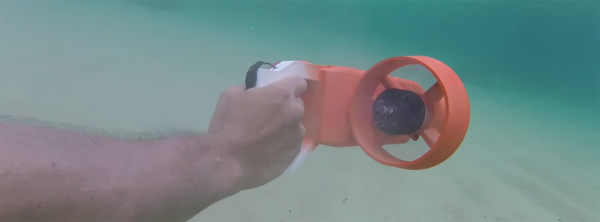
A dive scooter, or a submersible ducted fan used by divers, is not a new invention. They’ve been around for years, used by everyone from the villain of the week on Miami Vice to professional divers. Now that high-capacity Lipos, 3D printers, and powerful brushless motors are cheap, it was only a matter of time before someone built a DIY dive scooter. [Peter Sripol] is the man, and he also built a dive scooter, underwater pistol thing.

[Peter]’s dive scooter is almost entirely 3D printed. That includes the ducted fans/thrusters. The electronics are what you would expect from a grab bag from Hobby King and include two 2530 sized 400Kv motors from Avroto. These are massive motors made for massive quadcopters but they do seem to work just as well pulling a human underwater.


While this dive scooter was a marginal success, there were a few problems [Peter] had to work through. These were the lowest pitch propellers [Peter] has ever printed. To be fair, most of the props [Peter] has printed were used in air, not a fluid that’s hundreds of times denser. The electronics held up very well, considering the bath in salt water.

You can check out [Peter]’s video build and demo below.

Continue reading “The Almost Working, DIY Underwater Scooter Pistol Thing”

Printrbot Teases Infinite Build Volume Printer

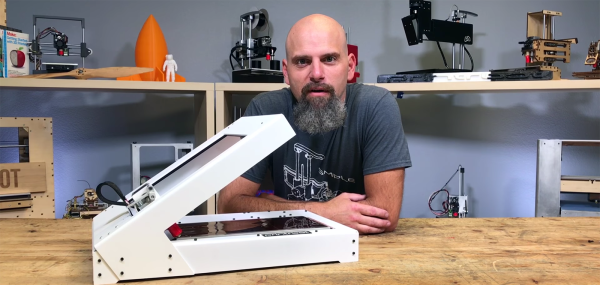
[Brook Drumm] of Printrbot is teasing a new 3D printer. This is no ordinary 3D printer; this is an infinite build volume 3D printer, the Next Big Thing™ in desktop fabrication.

The world was introduced to the infinite build volume 3D printer last March at the Midwest RepRap Festival with a built by [Bill Steele] from Polar 3D. The design of [Bill]’s printer began as simply a middle finger to MakerBot’s Automated Build Platform patent. This was patent engineering — [Bill] noticed the MakerBot patent didn’t cover build plates that weren’t offset to the plane of the print head, and it just so happened a printer with a tilted bed could also build infinitely long plastic parts.

While [Bill Steele]’s unnamed printer introduced the idea of an infinite build volume printer to the community, a few pieces of prior art popped up in the weeks and months after MRRF. Several years ago, [Andreas Bastian] developed the Lum Printer, an unbounded conveyor belt printer. A month after MRRF, Blackbelt 3D introduced their mega-scale tilted bed printer and later started a Kickstarter that has already reached $100,000 in pledges.

Right now, details are sparse on the Printrbelt, but there are a few educated guesses we can make. The belt of the Printrbelt appears to be Kapton film attached to some sort of substrate. The hotend and extruder are standard Printrbot accouterments, and the conveyor is powered by a geared stepper motor. All in all, pretty much what you would expect.

We do know that [Brook] and [Bill Steele] are working together on this printer, apparently with [Brook] in charge of the hardware and [Bill] taking either his slicing algorithm or firmware modifications (we’re not exactly sure where the ’tilt’ in the Gcode comes from) and getting this printer running.

While the Printrbelt isn’t ready for production quite yet, this is a fantastic advance in the state of consumer, desktop 3D printing. You can check out [Brook]’s teaser videos below.

Continue reading “Printrbot Teases Infinite Build Volume Printer”