Maker Faire Multicolor And Multi Material 3D Printing

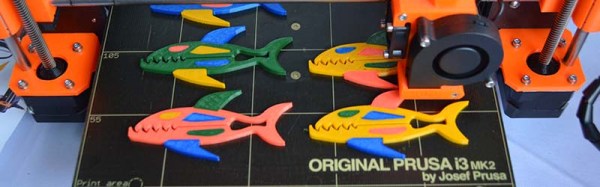
The next frontier of desktop 3D printing is multi-material and multi-color prints. Right now, you can buy a dual toolhead for a Lulzbot, and dual toolheads from other companies exist, although they are a bit rare. In the next few years, we’re going to see a lot of printers able to print dissolvable supports and full-color 3D printers.

Printing in more than one color is almost here, but that doesn’t mean we’re on the cusp of a complete revolution. Multi-material printing is lagging a little bit behind; you’ll be able to print two colors of PLA next year, but printing an object in PLA and ABS is going to be a bit tricky. Printing something in PLA and nylon will be very hard. Color mixing, likewise, will be tricky. We can do it, the tools are getting there, but think of this year as a preview of what we’ll be doing in five years.

Continue reading “Maker Faire Multicolor And Multi Material 3D Printing”

Scanning Parts Into KiCad

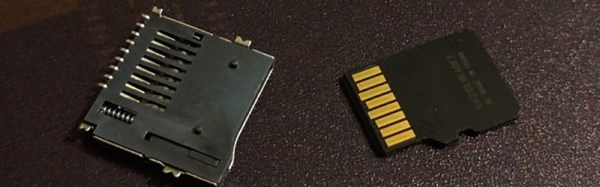
You do not know how to make a PCB unless you can make your own parts. [Jan] knows this, but like everyone else he checked out the usual online sources for a footprint for an SD card socket before making his own. It turns out, this SD card socket bought from an online marketplace was completely undocumented. Not only was an Eagle or KiCad footprint unavailable, but CAD files showing the dimensions of the part were non-existent. A solution had to be devised.

Instead of taking calipers and finely measuring all the pads on this SD card socket – a process that would surely fail – [Jan] decided to use a flatbed scanner to trace out the part. The part was placed on the glass and scanned at 300 dpi with a convenient reference object (a public transport card) in the same picture. This picture was imported into a CAD package, scaled to the correct ratio, and exported as a DXF. Since KiCad readily accepts importing DXFs, the CAD file was easily accessed, traced over, and a new part created.

From start to finish, making the footprint for this no-name, off-brand SD card socket took fifteen minutes. That’s nothing compared to the time it would take to manually measure each of the pads, draw a footprint, and print out the footprint at 1:1 scale to see if it matched up several times. It’s awesome work, and a great reminder that the best tools are usually right in front of you.

Hackaday Prize Entry: FPGAs For The Raspberry Pi Zero

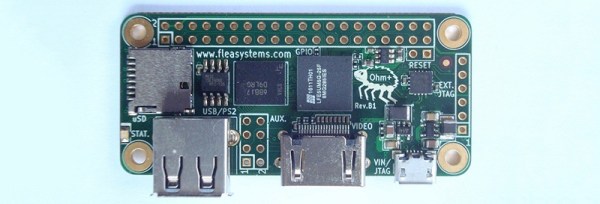
The Raspberry Pi is the Arduino of 2016, and that means shields, hats, add-ons, and other fun toys that can be plugged right into the GPIO pins of a Pi. For this year’s Hackaday Prize, [Valentin] is combining the Pi with the next age of homebrew computation. He’s developed the Flea Ohm, an FPGA backpack or hat for the Pi Zero.

The Flea Ohm is based on Lattice’s ECP5 FPGA featuring 24k LUTs and 112kB BRAM. That’s enough for some relatively interesting applications, but the real fun comes from the added 32MB or 128MB of SDRAM, a micro SD card slot, USB + PS/2 host port and an LVDS output.

The combination of Raspberry Pis and FPGAs are extremely interesting and seem to be one of the best FPGA learning platforms anyone can imagine. Another Hackaday Prize entry, the ZinqBerry does a similar trick, but instead of a Pi hat, the ZinqBerry drops a Xilinx Zynq with an FPGA and ARM Cortex A9 core onto a board with Ethernet, HDMI, and USB.

If it’s a Flea or a Zinq, the age of FPGA’d Raspberry Pis is quickly approaching, and hopefully we’ll see them as finalists in the Hackaday Prize. You can check out a video of the Flea Ohm below.

Continue reading “Hackaday Prize Entry: FPGAs For The Raspberry Pi Zero”

Hackaday Links: October 2, 2016

Hey Elon, three weeks ago I was in Burning Man in the Nevada desert and after I dug myself a nice K-hole I notice that Mars is a lot like the Nevada desert which got me thinking that if we can live here we can live on Mars but then I realized that Mars really isn’t a lot like the Nevada desert because there are toilets here but if we could build toilets on Mars it would be a lot like the Nevada desert? This week Elon Musk unveiled the Interplanetary Transport System at the International Astronautical Congress in Guadalajara. Instead of filling the room with industry experts the highlights of the Q&A session consisted of a woman who wanted to give Elon a kiss onstage and some guy who was super, super high. Discussion of the technical feasibility of a big, heavy window on the Heart of Gold has not appeared anywhere. Zero thought has been given to the consequences of building a civilization consisting entirely of the wealthiest 1% of Earth’s population. I fully support the Interplanetary Transport System; I’m going because this planet sucks.

[FoamieNinja] over on /r/radiocontrol is experimenting with single bladed propellers. Single bladed propellers are the most efficient way of pushing air behind an engine but haven’t really seen widespread use because they’re really weird, and I don’t know if you can do a variable pitch prop like this. You can find these types of props rarely on big-sized aircraft such as vintage J-3 Cubs sporting a 40HP engine. I haven’t seen them on anything bigger.

Next weekend is the Open Hardware Summit in Portland, Oregon. Hackaday is going to be there, and there’s a BringAHack at OSH Park on Thursday. Last year at the summit, the Open Source Hardware Certification was announced. This year, OSHWA is ready to launch their certification program. The takeaway from last year is that Open Hardware Certification will be free, self-certifying, with penalties based on fines for non-compliance.

The ESP32 is here, but most of them are still in a shipping container somewhere in the Pacific. Here’s a breakout board for the Espressif ESP-WROOM-02.

The J-Core is a clean room, open source CPU and SOC. Currently, it’s only implemented in VHDL until someone has a ton of money to burn on an ASIC. Now, the J-Core is supported by Linux. That makes an ASIC just a bit more likely. Thanks [Stefano] for the tip.

MakerBot is not at the New York Maker Faire this year. This is the greatest proof of the imminent failure of MakerBot, but it does deserve some context. In 2009, MakerBot demoed their first printer, the Cupcake, at the New York Maker Faire in Queens, NY. This was, by any reasonable historical reckoning, the introduction of a simple, easy to use, consumer 3D printer to the masses. The current trend of cheap desktop printers began seven years ago this weekend. MakerBot was so successful that it can be argued that Make:, the magazine and the faire, has tried to take credit for the consumer 3D printer ecosystem, simply because they hosted the launch of the Cupcake. Over the years, everyone has tried to ride MakerBot’s coattails. Since then, a few things happened. Last month, MakerBot introduced a new line of (China-manufactured) 3D printers, and they don’t have a booth. The reasons for this could be that Maker Faire is horrifically expensive for any vendor, and MakerBot is going to be at CES next year anyway, but this is it. The MakerBot obituary was not premature. We won.

The Tiny 3D Printers Of Maker Faire

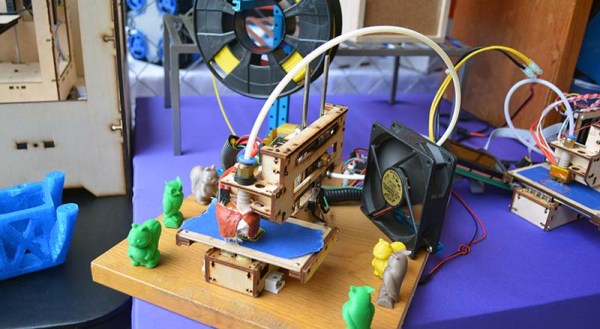
Building a big 3D printer has its own challenges. The strength of materials does not scale linearly, of course, and long axes have a tendency to wobble. That said, building a bigbot isn’t hard – stepper motors and aluminum extrusion are made for industry, and you can always get a larger beam or a more powerful motor. [James] is going in the opposite direction. He’s building tiny, half-scale printers. They’re small, they’re adorable, and they have design challenges all their own.

At this year’s New York Maker Faire, [James] is showing off his continuing project of building baby 3D printers. He has a half-scale wooden Printrbot, a half-ish scale Mendel Max, a tiny Makerbot Replicator, and a baby delta and baby Ultimaker in the works.

Click past the break for a gallery, and more info on [James’s] tiny creations.

Continue reading “The Tiny 3D Printers Of Maker Faire”

Hackaday Prize Entry: The GECK

The Garden of Eden Creation Kit, or GECK, is the MacGuffan of Fallout 3 and the name of the modding tool for the same game. In the game, the GECK is a terraforming tool designed to turn the wasteland of Washington DC into its more natural form — an inhospitable swamp teeming with mosquitos.

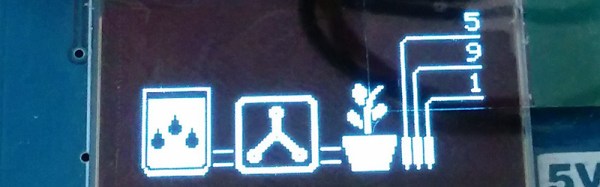
A device to automatically terraform any environment is improbable now as it was in Wrath of Khan, but a “Garden of Eden Kit” is still a really great name. For their Hackaday Prize entry, [atheros] is building a simplified version of this terraforming device. Instead of turning the Tidal Basin into potable water or turning a nebula into a verdant planet, [atheros]’s Garden of Eden Watering Kit turns empty potted plants into a lush harvest of herbs.

The device, like most home gardening solutions presented in this year’s Hackaday Prize, isn’t geared towards irrigating acres of crops. This is just a simple, small device meant to water a few herbs growing in a pot on a balcony. The hardware consists of a Teensy LC and a small OLED for command and control. A soil moisture sensor goes into each pot, and a few 12V peristaltic pumps water the plants from a bucket reservoir.

For the home gardener, it’s the perfect setup to grow some herbs, some chilis, or a cherry tomato plant that produces a year’s worth of tomatoes every week.  It’s a great adaptation of off the shelf tech, and a great entry for the Hackaday Prize.

Arduino Vs. Arduino: Arduino Won

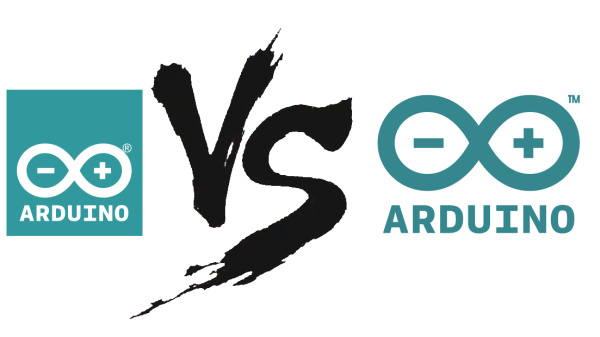
For the last two years, Arduino LLC (the arduino.cc, Massimo one) and Arduino SRL (the arduino.org, Musto one) have been locked in battle over the ownership of the Arduino trademark. That fight is finally over. Announced at the New York Maker Faire today, “Arduino” will now go to Arduino Holding, the single point of distribution for new products, and a non-profit Arduino Foundation, responsible for the community and Arduino IDE.

Since early 2015, Arduino — not the Arduino community, but the organization known as Arduino — has been split in half. Arduino LLC sued Arduino SRL for trademark infringement. The case began when Arduino SRL, formerly Smart Projects SRL and manufacturers of the Arduino boards with a tiny map of Italy on the silk screen, began selling under the Arduino name. Arduino LLC, on the other hand, wanted to internationalize the brand and license production to other manufacturers.

While Arduino and Arduino have been tied up in court for the last few years, from the outside this has look like nothing else but petty bickering. Arduino SRL forked the Arduino IDE and bumped up the version number. Later, an update from SRL was pushed out to Amazon buyers telling them Arduino.org was the real Arduino. Resellers were in a tizzy, and for a time Maker Faires had two gigantic Arduino booths. No one knew what was going on.

All of this is now behind us. The open source hardware community’s greatest source of drama is now over.

I spoke with Massimo after the announcement, and although the groundwork is laid out, the specifics aren’t ready to be disclosed yet. There’s still a lot to work out, like what to do with the Arduino.org Github repo, which TLD will be used (we’re rooting for .org), support for the multitude of slightly different products released from both camps over the years, and finer points that aren’t publicly visible. In a few months, probably before the end of the year, we’ll get all the answers to this. Now, though, the Arduino wars are over. Arduino is dead, long live Arduino.