Hackaday Prize Entry: Laptop Batteries For A Power Bank

USB power banks – huge batteries that will recharge your phone or tablet – are ubiquitous these days. You can buy them at a gas station or from your favorite online retailer in any capacity you would ever want. Most of these power banks have a tremendous shortcoming; they need to charge over USB. With a 10,000 mAh battery, that’s going to take a while.

We already have batteries with huge capacities, are able to charge quickly, and judging from a few eBay auctions, can be picked up for a song. [Kumar] is working on a device that leverages these batteries – and the electronics inside of them – to build a smarter power bank.

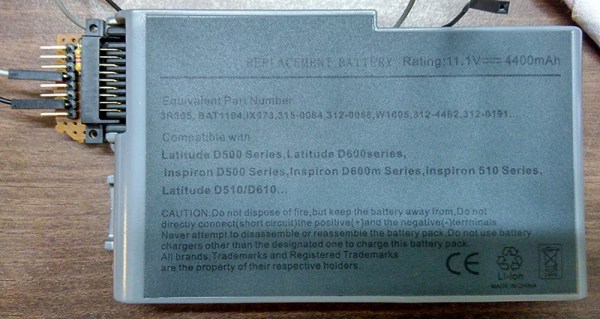
Right now, [Kumar] is working with Dell Latitude D5xx/D6xx replacement batteries that he can pick up easily. These batteries have an SMBus interface, and with a low power ARM microcontroller and a TI BQ24725a, he has everything he needs to efficiently and safely charge these batteries.

[Kumar] says he’s looking for some community suggestions and feature requests for his project. If you have any, be sure to drop them over on his project page.


The 2015 Hackaday Prize is sponsored by:

Hackaday Prize Entry: Circular Knitting Machines

Deep in the recesses of a few enterprising hackerspaces, you’ll find old electronic knitting machines modified for use with modern computers. They’re cool, and you can knit colorful designs, but all of these machines are ultimately based on old equipment, and you’ll have a hard time building one for yourself.

For their entry to the Hackaday Prize, [Mar] and [Varvara] is building a knitting machine from scratch. Not only is it a 3D printed knitting machine anyone can build given enough time and plastic, but this machine is a circular knitting machine, something no commercial offering has yet managed.

We saw [Mar] and [Varvara]’s Circular Knitic last January, but this project has quite the pedigree. They originally started on their quest for a modern knitting machine by giving a new brain to old Brother machines. This was an incredible advancement compared to earlier Brother knitting machine hacks; before, everyone was emulating a floppy drive on a computer to push data to the machine. The original Knitic build did away with the old electronics completely, replacing it with a homebrew Arduino shield.

While the Circular Knitic isn’t completely 3D printed, you can make one in just about any reasonably equipped shop. It’s a great example of a project that’s complex and can be replicated by just about anyone, and a perfect example of a project for The Hackaday Prize.

Check out the video of the Circular Knitic below.

The 2015 Hackaday Prize is sponsored by:

Continue reading “Hackaday Prize Entry: Circular Knitting Machines”

THP Community Voting: Results & A New Round

Last Friday we wrapped up a round of community voting for The Hackaday Prize. The theme? Most Likely To Save The Planet. Now it’s time for some results:

2015THPVotingRound2 (2)

The projects voted Most Likely To Save The Planet by the Hackaday.io community are, in order:

Congratulations to everyone who has a project that was voted up to the top. Even though these rounds of community voting don’t decided which projects make it into the Hackaday Prize semifinals, you’ve earned the respect of your peers and a nifty Hackaday Prize t-shirt.

Since NIRGM – Non-Invasive NIR Glucose Meter won last week, we’re moving down the list to #11 and awarding SciPlo a Hackaday Prize t-shirt as well.

A New Round Of Voting!

This week, we’re asking the Hackaday.io community to vote for the most Amazingly Engineered project entered into the Hackaday Prize. To entice everyone to vote, I’m going to pick a random Hackaday.io user next Friday around 22:00 UTC. If that person has voted, they get a $1000 gift card for the Hackaday Store. If that person has not voted, I’ll be giving a few prizes away to people who have voted. Last week, we gave away a SmartMatrix, an Analog Stepper Gauge, and a Simon Says kit. We’ll probably change that up this week; I don’t know what it will be, but someone who votes will get something. Imagine; giving away stuff just for clicking a button. How magnanimous can we get?

As with every community voting update, it is requested that you vote. If you need a nudge to understand how this works, here’s a video tutorial on how to vote.

Etching PCBs With A 3D Printer

There are dozens of circuit board printers out there that lay down traces of conductive ink and ask you to glue down components to a fragile circuit board. This is a far cry from the old way of making PCBs, but these printers are going gangbusters, cashing in on the recent popularity of hardware startups and rapid prototyping.

People who think deeply about a problem are few and far between, but lucky for us [Arvid] is one of them. He’s come up with a way of creating PCBs with any 3D printer and steel rod. The results are better than anything you could make with a circuit board printer, and the technique is very, very cheap.

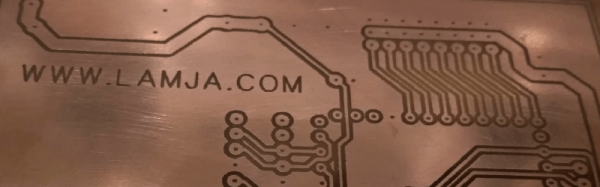
[Arvid] is using the traditional method of etching away copper, just some ferric chloride and a bit of time. How he’s masking the copper that shouldn’t be etched away is a unique process we haven’t seen before. He’s simply covering a piece of copper clad board with permanent marker, and scribing the parts he wants to be etched with a sharp steel rod attached to a 3D printer.

The G code for the printer was generated by FlatCAM, a piece of software made specifically for cutting PCBs with a mill. [Arvid]’s technique works so well that spindles and mills aren’t needed; only a sufficiently sharp instrument to scrape away permanent marker.

Thanks [Hassi] for sending this one in.

Hackaday Prize Entry: An SD Card Arduino

About a year ago, Intel announced they’d be launching a new platform stuffed into an SD card. Imagine – an entire computer packaged into an SD card, with nine whole pins for power and I/O. Cooler heads prevailed, the Intel Edison was launched, but the idea stuck; why can’t you fit an Arduino in an SD card?

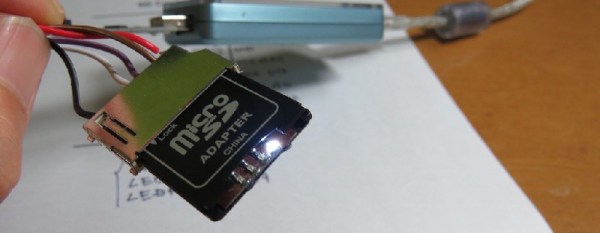
[kodera2t] found out there’s no real reason why you can’t put a small microcontroller inside an SD card. For his Hackaday Prize entry, he created the SDuino, and it’s exactly what it says on the tin: an ATMega328p stuffed into a microSD adapter.

Unlike the other microcontroller stuffed in an SD card platform — the Electric Imp, [kodera] is, for the most part, respecting the standard pinout for SD cards. The MISO and MOSI signals are reversed, of course, one of the grounds on the SD pinout is tied to an analog input pin on the microcontroller, and the chip select on the SD pinout is ignored completely. Other than that, it’s the closest you’re going to get to an SD card with a microcontroller.


The 2015 Hackaday Prize is sponsored by:

Hackaday Links Column Banner

Hackaday Links: June 28, 2015

The iBookGuy is using CPU heatsinks to cool microwave dinners. It’s an old Pentium II heatsink and a modern fan, cobbled together into a device that can quickly and effectively cool down a microwave dinner. I have several heatsinks from some old Xeon servers in my kitchen, but I don’t use them to cool food; I use them to defrost food. It’s very effective, and now I need to get some data on how effective it is.

[juangarcia] is working on a 3D printable PipBoy – the one in the upcoming Fallout 4. The extra special edition of Fallout 4 include a PipBoy that works with your cellphone, but if you want one before November, 3D printing is the way to go.

[Collin] over at Adafruit is teaching Oscilloscope Basics. Note the use of the square wave output to teach how to use the controls. Also note the old-school DS1052E; the Rigol 1054Z is now the de facto ‘My First Oscilloscope’

[Donovan] has one of those V212 toy quadcopters. The remote has a switch that controls a bunch of lights on the quad. This switch can be repurposed to control a small camera. All it takes is some wire, an optocoupler, and a bit of solder. Very cool. Video here.

I go to a lot of events where hackers, devs, and engineers spend hours banging away on their laptops. The most popular brand? Apple. The second most popular brand for savvy consumers of electronics? Lenovo, specifically ThinkPad X- and T-series laptops (W-series are too big, and do you really need a workstation graphics card for writing some node app?). They’re great computers, classic works of design, and now there might be a ThinkPad Classic. With a blue Enter key, 7-row keyboard, a multi-color logo, ThinkLights, a bunch of status LEDs, and that weird rubberized paint, it’s a modern realization of what makes a ThinkPad great. Go comment on that Lenovo blog post; the designer is actually listening. Now if we could just get a retina display in a MacBook Air (the one with ports), or get manufacturers to stop shipping displays with worse than 1080 resolution…

Need a fan guard? Know OpenSCAD? Good. Now you have all the fan guards you could ever want. Thanks [fridgefire] for sending this one in.

3D Printing Binaural Microphones

Binaural audio is probably the coolest thing you can listen to with a pair of headphones. Instead of just a single microphone, binaural recordings use two microphones, set inside an analog for a human head, to replicate exactly what you would hear if you were there.

The only way to record binaural audio is with fake plastic ears attached to a dummy head. Most of the famous microphone manufacturers have something like this, but with a 3D printer, anything is possible. [Carlos] created his own binaural microphone using a 3D printer and went through the trouble of creating a few audio demos. The results are weird, like [Carlos] is whispering into your ear.

The ears used in this microphone setup are taken from a Thingiverse project by [Jonathan March]. This model did not properly model the ear canal,and didn’t have any way to mask the sound from ear to ear; this is why the professional models also include a head. [Carlos] fixed these shortcomings and created a few 3D models that accurately model the human ear and head.

There’s also a simple stereo microphone amplifier for this project that is designed to fit right between the ears. This amplifier was designed in KiCAD, and the PCB is single sided. It’s not quite simple enough to assemble on a piece of stripboard, but [Carlos] did manage to manufacture it on some copper clad board in his mill.

The results? It sounds awesome. [Carlos] put together a demo of his microphone, link below, and it only works if you’re wearing headphones.

Continue reading “3D Printing Binaural Microphones”