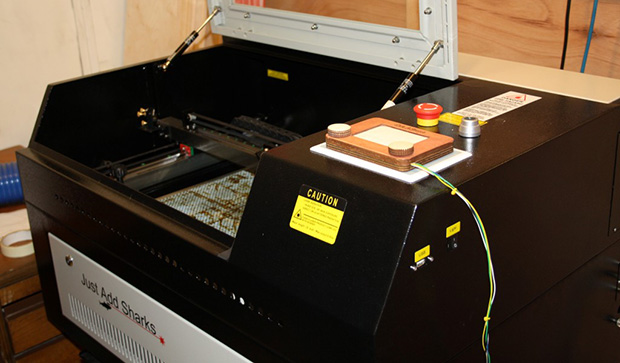
Laser Cutter Becomes An Etch A Sketch

etch

The mirror in a laser cutter moves along an X Y axis. An Etch A Sketch moves its stylus along an X Y axis. Honestly, this laser cutter with Etch A Sketch controls is so obvious, we’re shocked we haven’t seen it before.

The Etch A Sketch interface is extremely simple – just two rotary encoders attached to laser cut knobs set inside a small, laser cut frame. The lines from the encoders are connected to an Arduino Pro Mini that interfaces with the controller unit on the laser cutter, moving the steppers and turning on the laser only when the head is moving. There’s an additional safety that only turns on the laser when the lid is closed and the water pump is running.

The circuit is extremely simple, and with just a few connections, it’s possible to retrofit the Etch A Sketch controller to the laser cutter in just a few minutes.  Just the thing for a weekend hackerspace project.

 

Continue reading “Laser Cutter Becomes An Etch A Sketch”

Hackaday 68k: So You Want A Kit?

68000

It’s yet another update to the Hackaday 68k, the wire-wrapped backplane computer that will eventually be serving up our retro site.

This is also a demo of Hackaday Projects, our new, fancy online documentation tool for all your adventures in making and tinkering. Did you know we’re having a contest on Hackaday Projects? Make something sci-fi, and you’re in the running for some really good prizes. There’s soldering stations, o-scopes, and a lot of other prizes being thrown at the winners. It’s awesome. First one to build a working Mr. Fusion wins.

In this update, I’m going to go over the beginnings of the video board, why Hammond enclosures are awesome and terrible at the same time, and some thoughts on turning this into a kit or product of some type. Click that, ‘Read more…’ link.


Continue reading “Hackaday 68k: So You Want A Kit?”

WS2812b Ambilight Clone For The Raspi

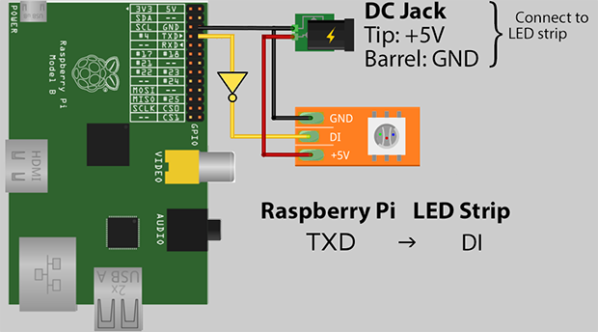
For how often the Raspberry Pi is used as a media server, and how easy it is to connect a bunch of LEDs to the GPIO pins on the Pi, we’re surprised we haven’t seen something like Hyperion before. It uses the extremely common WS2812b individually controllable RGB LEDs to surround the wall behind your TV with the colors on the edges of the screen.

One of the big features of Hyperion is the huge number of LEDs it’s able to control; a 50 LED strip only eats up about 1.5% of the Pi’s CPU. It does this with a “Mini UART” implemented on the Pi running at 2MHz.

There’s only one additional component needed to run a gigantic strip of RGB LEDs with a Pi – an inverter of some sort made with an HCT-series logic chip. After that, you’ll only need to connect the power and enjoy a blinding display behind your TV or monitor.

Thanks [emuboy] for sending this one in.


The Mostly 3D Printed Violin

violin

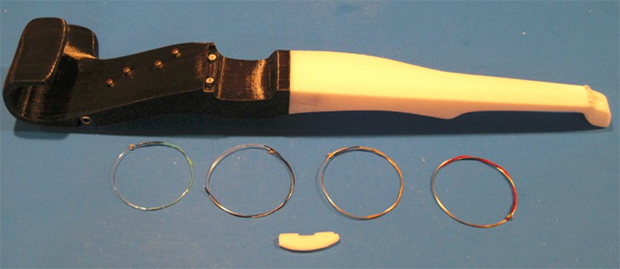
While Thingiverse is filled with Ocarinas, there’s little in the way of printable instruments for more serious musicians. [David Perry] hopes to change this with the F-F-Fiddle, the mostly 3D printed full-size electric violin.

The F-F-Fiddle is an entry for the LulzBot March 3D Printing Challenge to make a functional, 3D printed musical instrument. Already there are a few very, very interesting submissions like this trombone, but [David]’s project is by far the most mechanically complex; unlike the other wind and percussion instruments found in the contest, there are a log of stresses found in a violin, and printing a smooth, curved fingerboard is quite the challenge.

While there are a few non-printed parts, namely the strings, a drill rod used as a truss rod, some awesome looking tuners, and of course the piezo pickups – the majority of this violin, including the bridge, is 3D printed. It’s an amazing piece of work, and after listening to the video (below), sounds pretty good too.

You can grab all the files on Thingiverse and read up on the build at Openfab PDX.


Continue reading “The Mostly 3D Printed Violin”

Open Source Humanoid Robot Is Awesom-o

awesome-o

Coming from a lab in France is The Poppy Project, an open source humanoid robot that’s at least as cool as ASIMO.

Poppy was designed as an affordable bipedal robot for use in education and art. It’s a small robot at just over 80 cm in height, but it can walk, move its arms, rotate its torso, and interact with bags-of-meat humans with two cameras and an LCD face.

Although Poppy is open source, that doesn’t mean it’s exactly cheap; the current design includes twenty-one Robotis Dynamixels MX-28 robotic actuators, actually servos with magnetic encoders, temperature sensor, and an ARM microcontroller. These actuators sell for about $200, meaning Poppy contains $4000 in motors alone. The estimated cost of the entire robot is €7500-8000, or about $10,000 to $11,000 USD.

Still, there’s an incredible software platform that comes along with Poppy, and being open source any enterprising engineer can take up the project and attempt to bring the costs down. We’d love to take one out for a walk. Just get rid of the hands. That’s too far down the uncanny valley for us. Video below.


Continue reading “Open Source Humanoid Robot Is Awesom-o”

Rebuilding A 50,000 Volt Power Supply

Spark

The theory behind building power supplies is relatively easy, but putting it into practice and building a multi-kilovolt supply is hard. A big transformer in air will simply spark to itself, turning what could be something very cool into something you just don’t want to be around. [glasslinger] over on YouTube is an expert at this sort of thing, as shown in his 50,000 Volt power supply build. That’s a 55 minute long video, and trust us: it’s worth every minute of your time.

[glasslinger] began his build by taking an old 15,000 Volt neon sign transformer and repurposing the coils and cores for his gigantic 50,000 volt transformer. There was a small problem with this little bit of recycling: the neon sign transformer was potted with tar that needed to be removed.

To de-pot the transformer, [glasslinger] made a small oven from a helium tank, melting all the goo out with an old school gasoline torch. From there, hours and hours of cleaning ensued.

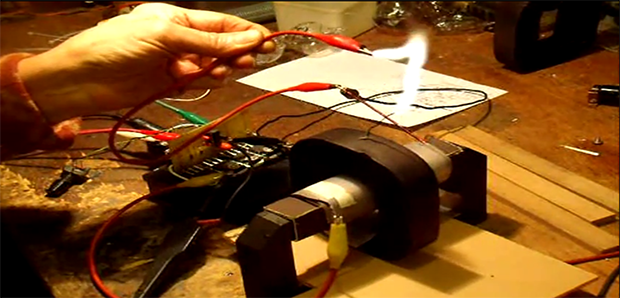
The transformer cores were cleaned up and cut down, and a new primary wound. A small-scale test (shown above) using the old secondaries resulted in a proof of concept with some very large sparks. The next step was putting the entire transformer in a box and filling it with transformer oil.

The money shot for this build comes when [glasslinger] assembles his transformer, rectifier, and all the other electronics into a single, surprisingly compact unit and turns standard wall power into a 50,000 Volt spark. You can literally smell the ozone from the video.


Continue reading “Rebuilding A 50,000 Volt Power Supply”