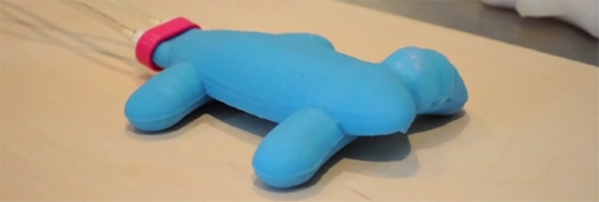
Soft Robotics, Silicone Rubber, And Amazing Castings

Most of the robotics projects we see around here are heavy, metallic machines that move with exacting precision with steppers, servos, motors, and electronics. [Matthew] is another breed of roboticist, and created a quadruped robot with no hard moving parts.

[Matthew] calls his creation the Glaucus, after the blue sea slug Glaucus atlanticus. Inside this silicone rubber blob are a series of voids, allowing compressed air to expand the legs, gently inching Glaucus across a table under manual or automatic control.

Even though no one seems to do it, making a few molds for casting on a 3D printer is actually pretty easy. [Matthew] is taking this technique to an extreme, though: First, a mold for the interior pressure bladders are printed, then a positive of this print made in silicone rubber. These silicone molds – four of them, for the left, right, top and bottom – are then filled with wax, and the wax parts reassembled inside the final ‘body’ mold. It’s an amazing amount of work to make just one of these soft robots, but once the molds and masters are made, [Matthew] can pop out a soft robot every few hours or so.

There’s a lot more info on Glaucus over on the official site for the build, and a somewhat simpler ‘compressed air and silicone rubber’ tentacle [Matthew] built showing off the mechanics. Video below.


Continue reading “Soft Robotics, Silicone Rubber, And Amazing Castings”

This Machine Sucks Balls

The best career choice anyone could ever make – aside from the richest astronaut to ever win the Super Bowl – is the designer of the kinetic art installations found in science centers that roll billiard balls along tracks, around loops, and through conveyors in a perpetual display of physics and mechanics. [Niklas Roy] isn’t quite at that level yet, but he has come up with a new twist on an old idea: a machine that literally sucks balls from a ball pit into transparent tubes, sending them whizzing around the installation space.

The installation consists of eighty meters of plastic tubing suspended in the staircase of Potocki Palace in Kraków. Electronically, the installation is extremely simple; a PIR sensor turns on a vacuum cleaner whenever someone is in the ball pit. This sucks balls up through a hose, around the space, and into a bin suspended over the pit. Pull a lever, and the balls stored in the bin are dispensed onto the person vacuuming up thousands of balls below.

Image source, with video below.

Continue reading “This Machine Sucks Balls”

Hackaday At MakeDC

makedc

Last Wednesday, our Hackaday travels took us to the Washington, DC area for a visit to NOVA Labs near Dulles and a yet-to-be opened Metro stop. Also on our itinerary was a visit to MakeDC, an informal get together for people around the nation’s capitol to show off their latest projects and builds.

The highlight of the evening was a pair of talks from [Julian] and [Taylor] on a project they did for work: a social cooler, or a locked box holding cool drinks that will only open when enough people send a text to a certain number. We’ve got [Julian]’s talk on video, but despite our fancy new camera gear for this sorta thing, [Taylor]’s demo of what an Electric Imp can do was lost to the digital wastes.

Aside from [Julian]’s talk on APIs and [Taylor]’s talk on the Electric Imp, there were a few impromptu presentations from the attendees. One of the most thorough was the duo from Shiny & Jackal Cosplay, crafters of EVA foam and LEDs. Truth be told, Hackaday doesn’t see many of these ‘softer’, cosplay and prop making builds in the tip line, and that’s a shame; the amount of skill that goes into these costumes is at least as equal as a woodsmith that can build fine furniture using only hand tools.

Perhaps a little premature, but TechShop is opening a new location in Arlington, VA at the end of the month. The GM [Addam Hall] was there scoping out the hacks and letting the attendees know there’s going to be a huge, awesome shop that’s down town in Crystal City. Close enough to public transportation, anyway, because anyone who drives in DC is certifiable.

The last item of note isn’t a build yet, but it’s shaping up to be pretty cool. It’s BRWRY – pronounced, ‘brewery’ – and will be a semi-automated beer making machine. Robots and beer, what can’t you love?

We’d like to thank [Zach], [Julian], [Taylor], and all the other guys from iStrategyLabs for putting together a nice evening of hanging out, drinking beer, eating pizza, and talking about what you’ve built. We had a great time, and we’re looking forward to the next one, as well as any other similar get together in other cities.

Bitbanging USB On Low Power ARMs

M0

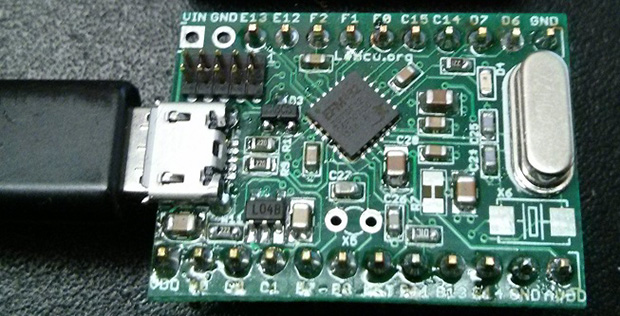
With the Adafruit Trinket, the Digispark, and some very clever work with the smallest microcontroller Atmel offers, it looks like the ‘in’ thing to do for embedded software developers is to bitbang the USB protocol on hardware that shouldn’t support it. There are a lot of very small ARM chips out there without USB support, so it was only a matter of time before someone was able to bitbang USB on the ARM Cortex M0+.

The board above is based on an Energy Micro EFM32ZG, a very small 24-pin QFN device with up to 32 kB of Flash and 17 GPIOs. As with all the bitbanged USB hacks, the differential data lines are attached directly to the microcontroller. A 24 MHz crystal is needed, but the team behind the project is working on using the internal RC oscillator instead.

The code is portable with minimal changes between other manufacturer’s Cortex M0+ chips, and with a little work, this could become a very, very cheap USB-programmable ARM dev board, something the community could certainly use.

Build Your Own Radio Clock Transmitter

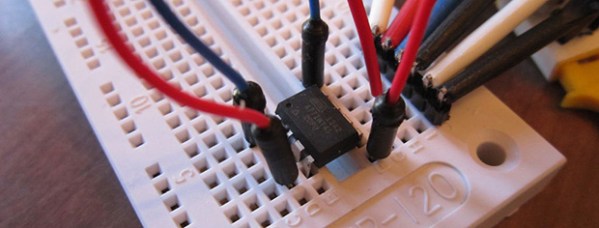
Deep in the Colorado foothills, there are two radio transmitters that control the time on millions of clocks all across North America. It’s WWVB, the NIST time signal radio station that sends the time from several atomic clocks over the airwaves to radio controlled clocks across the continent. You might think replicating a 70 kW, multi-million dollar radio transmitter to set your own clock might be out of reach, but with a single ATtiny45, just about everything is possible.

Even though WWVB has enough power to set clocks in LA, New York, and the far reaches of Canada, even a pitifully underpowered transmitter – such as a microcontroller with a long wire attached to a pin PWMing at 60kHz – will be more than enough to overpower the official signal and set a custom time on a WWVB-controlled clock. This signal must be modulated, of course, and the most common radio controlled clocks use an extremely simple amplitude modulation that can be easily replicated by changing the duty cycle of the carrier. After that, it’s a simple matter of encoding the time signal.

The end result of this build is an extremely small one-chip device that can change the time of any remote-controlled clock. We can guess this would be useful if your radio controlled clock isn’t receiving a signal for some reason, but the fact that April 1st is just a few days away gives us a much, much better idea.

Hackerspace Tour: Xerocraft In Tucson, Arizona

xero

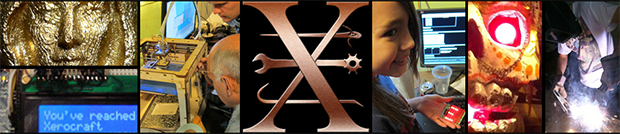
While we try to get out to as many hackerspaces as possible, we can’t be everywhere. Not wanting to wait for a Hackaday compatriot to roll through their dusty town, the folks over at Xerocraft in Tucson, Arizona sent in their own video tour of their space.

We’ve seen the Xerocraft space before when [Caleb] rolled through town on his south-west tour a few years ago. Since then, a lot has changed; they have a new, larger, and cleaner space a few miles north of the old one. There’s also a huge increase in the number of tools. While the old space had all the usual metalworking tools, the new space has a much improved wood shop and more 3D printers than anyone can shake a stick at.

From the video, it looks like a great space, and from their blog it looks like they’ve got some really cool projects under their belt. If you’re a member of a hackerspace, we’re always looking for some tour videos. Be sure to send them in so you can share your space with the rest of the Hackaday readership.

Continue reading “Hackerspace Tour: Xerocraft In Tucson, Arizona”

Hackaday Visits NOVA Labs And Small Batch Assembly

header

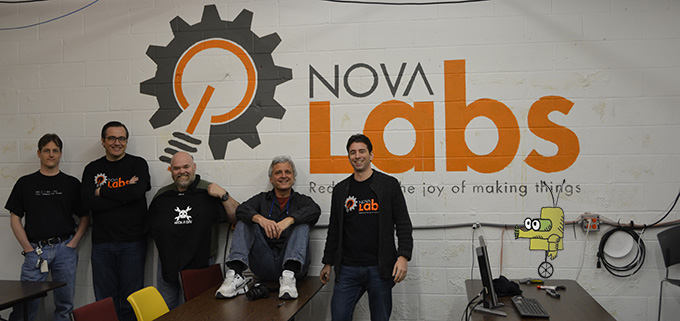
A few days ago Hackaday visited NOVA Labs, one of the premier hackerspaces around Washington, DC. In our video tour, co-founder [Justin Leto] shows off the space, going through all the awesome tools, workspaces, and projects his space has put together over the years.

One of the most impressive parts of NOVA Labs is the incredible amount of woodworking equipment. Everything from a Blacktoe CNC router, table and bandsaws, jointers, planers, real woodworking benches, and enough clamps to hold anything together are from a NOVA member that is co-locating his equipment for the rest of the hackerspace to share.

Apart from the woodworking tools, NOVA also has a few laser cutters and enough 3D printers for all the octopodes and Yoda heads you could ever imagine. A few of the members put together 3D build classes, and the machines being constructed are very, very cool. They’re using a Raspi with OctoPrint in their latest builds, attaching a camera to the frame and using a tablet for the interface. It’s just about the smoothest and cleanest 3D printer interface possible without using a computer.

There’s a lot of cool stuff happening at NOVA; the DC Area Drone User Group is the area’s largest group of unmanned aerial vehicles not housed in a five-sided building, and have done some aerial mapping for the metro station that will soon displace the hackerspace. NOVA also hosted a mini maker faire last weekend with over four thousand attendees. Impressive, to say the least.

Also at NOVA Labs is a small business the guys are incubating headed up by [Bob Coggeshall], also known as one of the guys who wrote sudo. It’s Small Batch Assembly, a very cool service that takes panelized PCBs and reels of components and assembles them. While we were there, [Bob] was assembling a few dozen boards stuffed with WS2812 LEDs for the R2D2 Builders Club.

[Bob] is using a very cool and very expensive Manncorp pick and place machine for placing all the components, squeegeeing the solder paste through Kapton film he laser cut on the NOVA Labs machines. It’s only a small-scale operation, but when it comes to placing thousands of SMD components for a few dozen boards, there probably isn’t a better way.

You can check out the video of NOVA, Small Batch Assembly, and a whole bunch of pics below.

Continue reading “Hackaday Visits NOVA Labs And Small Batch Assembly”