MRRF: ARM-Based CNC Controllers


8-bit microcontrollers are the standard for RepRap electronics, but eventually something better must come along. There has been a great deal of progress with ARM-based solutions, and of course a few of these made a showing at the Midwest RepRap Festival.

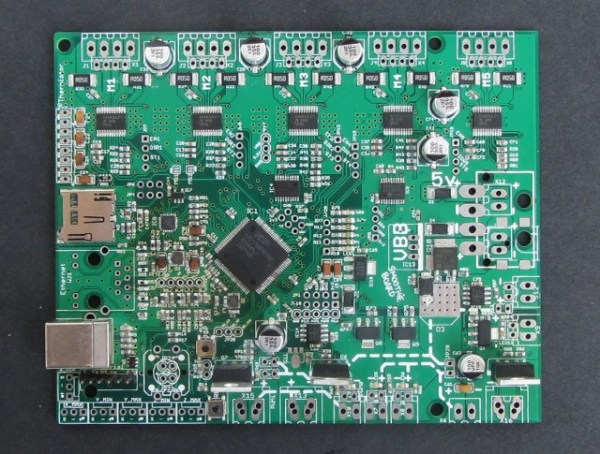
First up is [Mark Cooper], creator of Smoothieboard, the ultimate RepRap and CNC controller. It’s an ARM Cortex-M3 microcontroller with Ethernet, SD card, and up to five stepper drivers. It had a Kickstarter late last year and has just finished shipping all the rewards to the backers. In our video interview, [Mark] goes over the functions of Smoothieboard and tells us about some upcoming projects: the upcoming Smoothiepanel will feature a graphic LCD, SD card, rotary encoder and buttons, all controlled over USB by the Smoothieboard.

Next up is [Charles] with a whole bunch of CNC capes for the Beaglebone. By far the most impressive board was a huge I/O expander, motor driver, and everything controller for a Beaglebone featuring – get this – three parallel port interfaces. This was a one-off board costing thousands of dollars, but [Charles] did show off a few smaller and more practical boards for Beaglebone CNC control. Here’s a link to [Charles]’ capes.

Videos below.
Continue reading “MRRF: ARM-Based CNC Controllers”

MRRF: 3D Printed Resin Molds


Visiting the Midwest RepRap Festival, you will, of course, find a ton of 3D printed baubles and trinkets. A slightly more interesting find at this year’s MRRF was a lot of resin cast parts from [Mark VanDiepenbos]. He’s the guy behind the RotoMAAK, a spinny, ‘this was in the movie Contact‘-like device designed for spin casting with resins. At the festival, he’s showing off his latest project, 3D printed resin molds.

With the right mold, anyone with 2-part resins can replicate dozens of identical parts in an hour. The only problem is you need a mold to cast the parts. You could print a plastic part and make a silicone mold to cast your part. The much more clever solution would be to print the mold directly and fill it with resin.

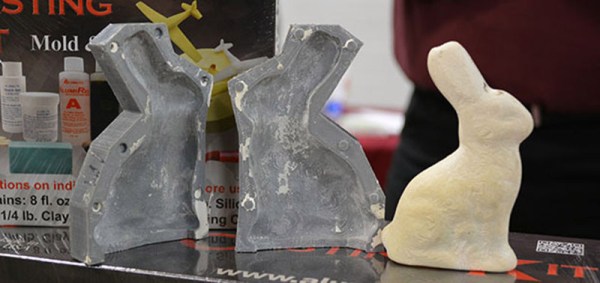
[Mark] printed the two-part rabbit mold seen above out of ABS, filled it with urethane resin, and chucked it into his RotoMAAK spin casting machine. Six minutes later the part popped right out, and the mold was ready to make another rabbit.

Video below.

Continue reading “MRRF: 3D Printed Resin Molds”

Cordwood Puzzle Kit Without Instructions

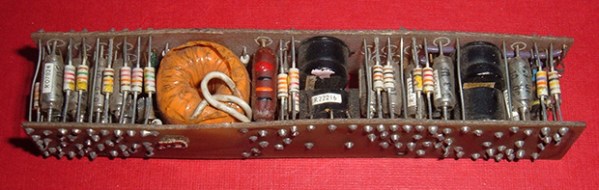
What you see above is a cordwood circuit, an interesting circuit construction technique from before the days of integrated circuits. The circuit consists of two circuit boards arranged parallel to each other with components holding them apart. This was, for its day, the densest circuit construction technique, used in everything from late 50s aerospace tech to huge computers that filled rooms.

The folks over at Boldport have a love for interesting PCBs and are apparently aficionados of antiquated tech, leading them to create their own cordwood circuit. Here’s the best part: it’s a kit, without assembly instructions.

The cordwood puzzle assembles into a bunch of LEDs that will light up when power is applied. Not much, but there’s a few FETs in there that allow you to control them all individually with a microcontroller. The real fun is trying to assemble the kit: both sides of the cordwood circuit are identical, meaning there’s going to be holes that aren’t meant to be filled, components that will need to be soldered, and most likely a bit of swearing.

Still, this is an exceptionally small circuit for something using this construction technique. If you know of a denser and more modern cordwood circuit out there, leave a note in the comments. If you want to know what the kit looks like when it’s built, [Phil Wright] has your back.

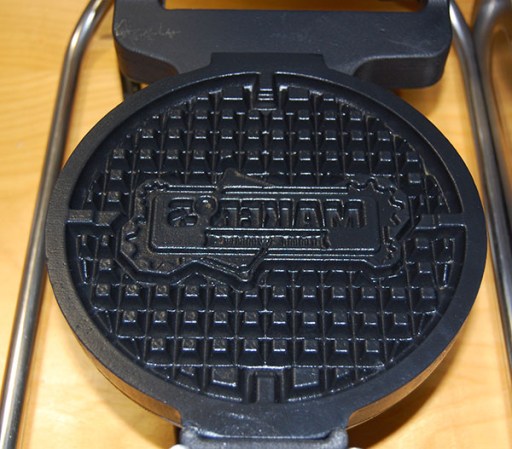
Midwest RepRap Festival: 3D Printed Waffles

Hackaday is settling in with the action at the Midwest RepRap Festival in Goshen, Indiana. Already it’s turning out to be a great weekend; an hour after the doors opened at 6:00 pm on Friday, with a freight train blocking traffic for half the town, there were more than 100 people through the doors. I have since stopped counting.

As far as who’s here, Lulzbot, the guy behind the Smoothieboard, Ultimaker, [Josh] from MakerJuice, [Jo Prusa], [Nicholas Seward], creator of the RepRap Wally, Gus, and Simpson, and the folks from MakerHive and Maker’s Tool Works.

Everybody is having tons of fun and I’m currently giving away Hackaday T-shirts in return for a contribution to the beer fund. The real show starts Saturday morning with a waffle breakfast, talks from famous reprappers, and hours and hours of fun.

Pics of some cool stuff below, here are two live streams, videos of awesome stuff up tomorrow.

Continue reading “Midwest RepRap Festival: 3D Printed Waffles”

DAGU: The Standalone CNC Controller

CNC

In terms of user interfaces, 3D printers are far, far beyond the usual CNC machine. It’s difficult to find a new, commercial 3D printer without some sort of display, set of buttons, and an SD card slot for loading G Code and running a printer. For CNC routers, though, you’re usually dealing with a parallel port interface connected to an old computer.

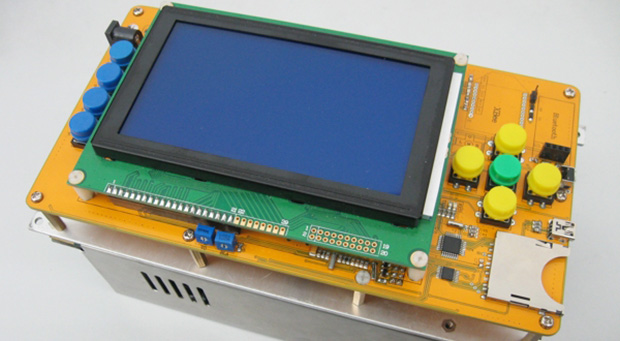
DAGU hopes to change that by providing a huge 240×128 LCD display, a bunch of buttons, and an SD card slot for loading G Code directly from an SD card. This is a fully functional controller, able to deliver 3.5 A to each stepper motor winding.

Right now DAGU is in the prototype stage, but already there are some really interesting features: the interface allows for a basic preview of the job before it begins, and should be somewhat affordable. At least as cheap as using an old computer for CNC control, anyway.

Video demo of the use and operation of DAGU below.

Continue reading “DAGU: The Standalone CNC Controller”

Old Inkjet Turned Into An SVG Plotter

plotter

What do you do when you have an old printer, a portable CD player, and a handful of other electronics sitting around? Turn it into a plotter, of course.

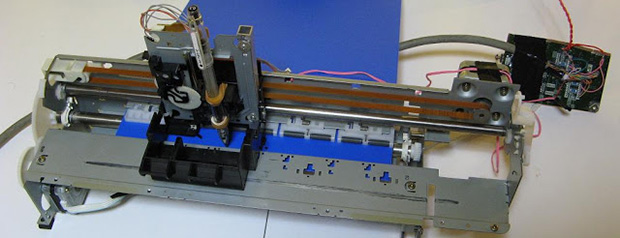
The frame of the plotter was taken from a ye olde Epson printer, reusing the two stepper motors to move the paper along its length and width. The pen is attached to the laser head of a junked portable CD player. With this, it’s just three stepper motors that allow the Arduino control system to move the pen across the paper and put a few markings down.

The motors on the printer are, in the spirit of reuse, still connected to the printer’s driver board, with a few leads going directly from the Arduino to the parallel port interface. The motor in the CD player is another ordeal, with a single H-bridge controlling the lifting of the pen.

On the software side of things, a Processing sketch reads an SVG file and generates a list of coordinates along a path. The precision of the coordinates is set as a variable, but from the video of the plotter below, this plotter has at least as much resolution as the tip of the pen.

Continue reading “Old Inkjet Turned Into An SVG Plotter”

Hackaday 68k: Gluing Architecture Buffer Maps

68000It’s time for more blatant advertising for Hackaday Projects, the best project hosting site on the Internet. Did we tell you it’s collaborative? That you and your friends can work on projects together? Want more encouragement to join? How about a contest with prizes that include oscilloscopes, FPGA dev boards, soldering and rework stations, Beaglebones and Raspberries and Spark Cores? Oh my!

Oh. We’re also developing a retrocomputer to show off the features of Hackaday Projects. This is the latest update, showing off the architecture of the entire system, the memory map, and the logic glue and buffers. The plan for this project is to have it host another awesome Hackaday site, our retro version, a small off-shoot of the main Hackaday site that’s specifically designed to be loaded by computers built before 1993. There haven’t been many retro successes in the Hackaday tip line recently, so if you manage to get a vintage computer to pull the retro site up, snap a pic and send it in.

For those of you wanting to catch up on the Hackaday 68k project, here’s the Hackaday Projects page, and here’s all the front page updates. Click that ‘Read more…’ link for the update.

Continue reading “Hackaday 68k: Gluing Architecture Buffer Maps”