Hackaday Links: January 16, 2012

Finally the 13-year-old on Battlefield 3 will get their comeuppance
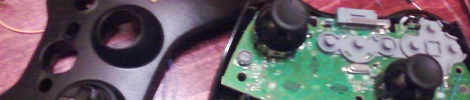
[Shawn] sent in his fully adjustable auto-fire mod for an XBox360 controller. It’s pretty simple – just an ATtiny85 soldered to a button with a pot to adjust the rate and switch to turn it on and off. It could have been done with a 555, but this is good enough.

Now one for the PS3 bronies

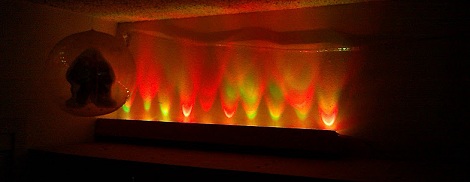
[Capt-Nemo] loves and tolerates everyone so he modded his 60 Gig PS3 with a bunch of LEDs to display Rainbow Dash’s cutie mark. Yes, it’s from My Little Pony. Don’t judge us. Watch the demo video instead.

How do you organize resistors?

A while ago we saw a neat way to store resistors in a piece of foam with a grid according to the first and third color bands. [Greg] did it another way that just puts a label on a piece of foam. Can you think of a better way?

It’s not a synthesizer, but is it fake?

A lot of people have been sending in this video of [Stephen] turning his kitchen into a synthesizer. We’re thinking he turned a bunch of bowls and cans into an MPC / MIDI controller at best, or it was all done in post. We’ll let our readers duke it out in the comments.

Blinky things spinning very fast

A gracious Hack a Day reader sent in a mechanical television demo he found during late night intertube browsing. We know it’s from a 1992 episode of Computer Club that aired in Germany. It’s four rotating bars of 232 LEDs that will display a standard TV signal. We think it might be time for an RGB LED version of this. Any takers?
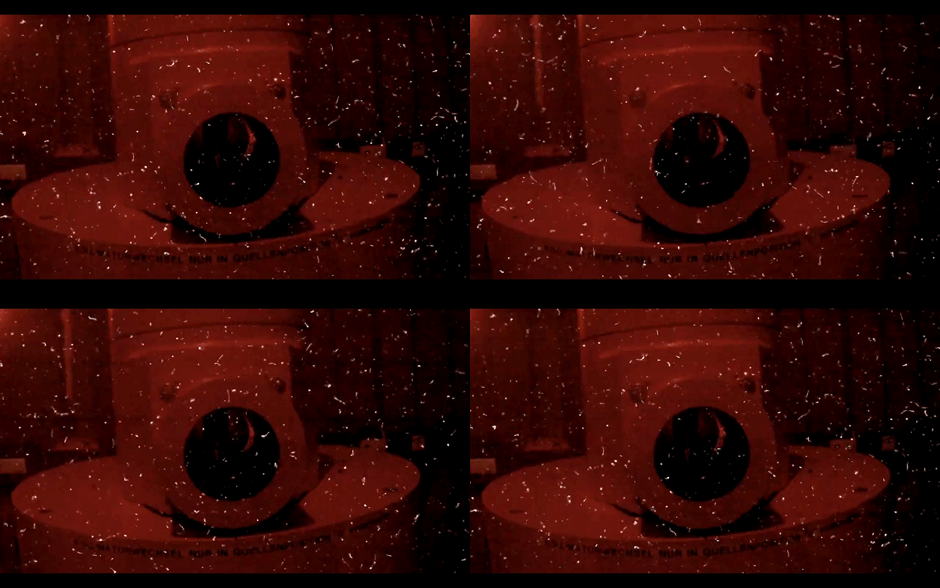

Turn Your Camera Phone Into A Geiger Counter

Next time you’re waiting in the security line in an airport, why don’t you pull out your smartphone and count all the radiation being emitted by those body scanners and x-rays? There’s an app for that, courtesy of Mr. [Rolf-Dieter Klein].

The app works by blocking all the light coming into a phone’s camera sensor with a piece of tape or plastic. Because high energy radiation will cause artifacts on the CMOS camera sensor inside the phone, radiation will be captured as tiny specks of white light. The title picture for this post was taken from a camera phone at the Helmholtz Research Center in Munich being bathed in 10 Sieverts per hour of Gamma radiation from the decay of Cesium-137.

We have to note that blips of ‘bad data’ from a CMOS camera sensor aren’t unusual. These can come from electrical weirdness in the sensor itself or even the heat from the battery. [Rolf]’s app takes a reading of the noise floor and subtracts it from the counter. Radioactive decay resulting in Beta particles such as the Potassium-40 in bananas or the Uranium in granite counter tops don’t really register, although [Rolf] did have some success with Potassium chloride and a long measurement time. Still though, it’s a really cool way to turn a phone into a tricorder.

Continue reading “Turn Your Camera Phone Into A Geiger Counter”

Nice Shoes, Wanna Recognize Some Input?

Even though giant multouch display tables have been around for a few years now we have yet to see them being used in the wild. While the barrier to entry for a Microsoft Surface is very high, one of the biggest problems in implementing a touch table is one of interaction; how exactly should the display interpret multiple commands from multiple users? [Stephan], [Christian], and [Patrick] came up with an interesting solution to sorting out who is touching where by having a computer look at shoes.

The system uses a Kinect mounted on the edge of a table to extract users from the depth images. From there, interaction on the display can be pinned to a specific user based on hand and arm orientation. As an added bonus the computer can also recognize users from their shoes. If a user is wearing a pair of shoes the computer recognizes, they’ll just walk up to the table and the software will recognize them.

Continue reading “Nice Shoes, Wanna Recognize Some Input?”

DIY Dimmable Clapper For All Your Lazy Lighting Needs

For the lazy man who can’t be bothered to buy a proper wattage lamp here’s the Clever Clapper, a Clapper that finally has the ability to dim the lights.

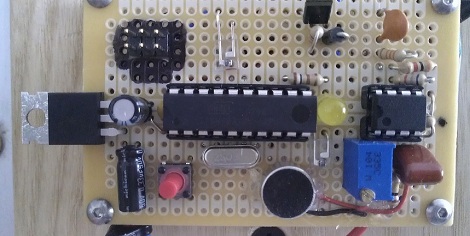
Like the clapper we saw last month, [Pete]’s version uses an ATtiny2313 and an electret mic. What sets [Pete]’s version apart from the vintage 80s model is the ability to dim the lights. Like any clapper, two hand claps within a second toggles the relay. Clapping three times within one second puts the lamp into fading mode. In this mode, the lights dim up and down with PWM until a fourth clap is detected.

[Pete] saw that the program memory in his ATtiny2313 wasn’t 100% full, so he added a few more capabilities. If you shine a laser onto his circuit, a relay trips and turns on a decorative moon lamp. There’s also a ‘lecture mode’ that feeds the microphone directly into the microcontroller to vary the PWM signal. The result is a light that brightens with more intense sound. Check that feature out after the break after the demo video of [Pete]’s Clever Clapper.

Continue reading “DIY Dimmable Clapper For All Your Lazy Lighting Needs”

Freeze Drying Astronaut Ice Cream

In our younger and more vulnerable years nothing was greater than visiting a museum, going to the gift shop, and badgering our parents to buy a pack of astronaut ice cream. Freeze dried ice cream leaves a taste of nostalgic chalky sweetness in our mouths, so we’re very excited to see that [Ben Krasnow] is now making his own astronaut ice cream.

The basic principle of freeze drying is simple. All you have to do is reduce the pressure and temperature of the food below the triple point of water and pump the sublimated water vapor out. For [Ben], this meant he needed to cool his Neapolitan Klondike bar to -30° C in a bath of chilled ethanol and pump out the air with a vacuum pump.

Interestingly, [Ben] found it necessary to heat his ice cream while under vacuum to extract more water vapor. This makes sense; at the pressures he was dealing with, [Ben] would never come across water in a liquid state. The entire process took about 18 hours. [Ben] admits this may have been a little longer than necessary, but it’s a small price to pay for reliving childhood memories.

[Jamie Zawinski] Controls His Drapes From The Command Line

As one of the founders of Netscape and the Mozilla Project, [Jamie Zawinski] is no stranger to frustration elicited from syntax errors, terrible implementations, and things that don’t work even though they should. This familiarity of frustration is what makes [jwz]’s command line controlled curtains so great; it’s rare to see someone so technically proficient freaking out over the lack of DHCP on an Arduino Ethernet.

[Jamie]’s project begins as so many do – modifying an existing piece of hardware to connect to the Internet. This is easier said than done, as [Jamie] fried a USB hub, FTDI cable and an Arduino Ethernet all at the same time. Finally turned onto the seeed relay shield, [jwz] got busy writing scripts to power his curtain.

Of course, this level of automation is nothing without a good bit of integration. After [Jamie] realized his projector (a Panasonic PT-D5500U) and receiver (Denon AVR-2805) could talk to his computer, he got busy mashing them together with a Griffin PowerMate. Mashing the button on the PowerMate turns on the projector and closes the drapes. There’s also a cron job running so that [Jamie] is reminded of the glowing orange ball in the sky.

Building A LED Strip The Minimal Way

For his first big build with an MSP430, [Javon] decided to an RGB LED fader. Having worked with Arduinos in the past, he figured that his MSP430 would have a few PWM channels. After being proved wrong by the data sheet, [Javon] needed to figure out a way to switch a bunch of RGB LEDs with only one PWM channel on his microcontroller.

Because there was only one PWM pin on [Javon]’s micro, he needed a way to multiplex his output. He ended up using a 74HC4052 mux/demux chip to drive 20 LEDs. The LEDs were mounted onto hard board and the main part of the circuit built on a bit of perfboard. While there’s no total cost for his build, we’re guessing [Javon] didn’t spend much on his project; certainty much less than this explosion of LEDs.

[Javon] put all the build pictures up as a Google+ album and a few video demos up. Check those out after the break (009 Sound System warning, you might want to hit mute).

Continue reading “Building A LED Strip The Minimal Way”