An E-paper Information Panel

With all the Kindles and Nooks we’re bound to find at yard sales and thrift shops in the coming years, this might be useful. [Chris] made a door-mounted e-paper display to keep himself up to date on recent events.

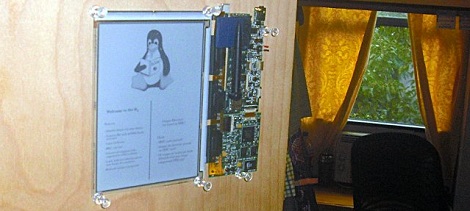
The hardware comes from an e-paper development kit [Chris] and his friend [Deian] were given a few years back. The dev kit sat in a dusty drawer until [Chris] decided to do something with it. With his door looking like a suitable palette, [Chris] decided to make an information panel that displays the date, his calendar, the weather, and a few RSS feeds.

There was already a Gumstix single board computer attached to the e-paper display, so [Chris] wrote a few scripts on his server and upload information to the paper display. The server renders the display as a PNG image at 800×600 resolution, converts it to PGM and compresses it for the Gumstix. There is a script running on the Gumstix to download the image from the server every five minutes and put it up on the display.

With the awesome readability and low power consumption of e-paper, we’re surprised we haven’t seen a project like this before. Guess we’ll have to wait until Kindles start showing up at flea markets.
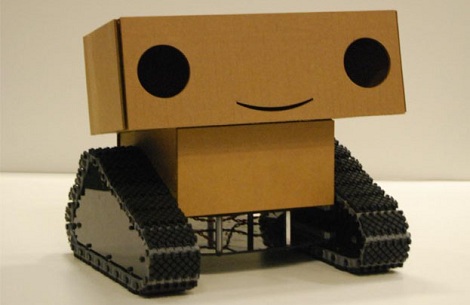

Boxie Is An Adorable Toddler Videographer

Meet Boxie. He’s a robot videographer with levels of interaction we haven’t seen outside an episode of Dora the Explorer. The project was conceived by [Alex] as his MIT thesis project to see if robots can use humans to make themselves more useful. All we know is Boxie is freaking adorable, as evidenced by this video.

The idea behind Boxie was inspired by Afghan Explorer to capture video in an attempt to tell a story. In the videos (after the break), Boxie wanders around the halls of MIT searching for people to help him (“can you carry me up the stairs?”) and tell stories (“what do you do here?”). It’s an experiment in autonomous documentary directorial skill that was edited down into a video that made sense.

[Alex] designed Boxie to be the cutest thing we’ve ever seen so he could elicit a response from the subjects of the documentary. We’re going to say the voice helped, but [Alex] also found the cardboard robot factor also played into the success. Boxie was originally planned to have a plastic skin, but [Alex]’s friends thought it looked really creepy. They suggested that [Alex] go back to the prototype cardboard body. All we know is there’s a robot cuter than a Keepon, finally.

Continue reading “Boxie Is An Adorable Toddler Videographer”

3D Printed Zoetrope

Normally, 29 men walking around in an endless circle would be the stuff  of an [M.C. Escher] engraving. [Tobias] turned this into a reality with a little help from some LEDs and a 3D printer.

Like his earlier project, [Tobias] built himself a nice little strobing zoetrope that maintains the illusion of movement by flashing LEDs at precise intervals. Instead of a flat 2D image, [Tobias] went for a walking 3D figure that marches to the beat of a timer circuit. The figures themselves were printed via Shapeways.

The electronics were improved for this iteration. Formerly, [Tobias] used a 555 and a whole bunch of auxiliary components. The circuit was improved for this version to uses Schmitt triggers and an optical encoder. The easy-to-build-on-perfboard schematics and layouts are available, so feel free to build one for yourself.

[Tobias]’ zoetrope isn’t much different from the gigantic Charon sculpture seen at last year’s Burning Man. Sure, it’s not 40 feet tall but it’s still a nice piece of work.

Continue reading “3D Printed Zoetrope”

Universal Commodore 64 Cartridge Speeds Up Demo Production

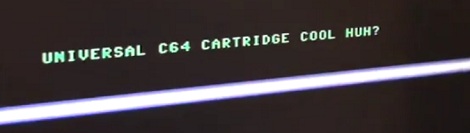
As a life long lover of his venerable Commodore 64, [Frank] was looking for a way to speed up the development time when writing C64 demos. His solution is a universal C64 cartridge that will connect to a PC over a USB port.

The board is powered by a CLPD and a microcontroller loaded with code from [Frank]’s previous C64 USB controller adapter. A 16 Mbit flash chip is able to store 31 classic games like Pitfall, Dig Dug, and Lode Runner.

On his Google+ announcement, [Frank] says this is a very early prototype. He plans on reducing the board size to fit inside a standard C64 cartridge, and the firmware for the micro and CLPD aren’t finished yet. That being said, [Frank] does have a board that does what he wants it to do: extremely rapid C64 development.

Check out [Frank]’s demo after the break of him compiling and re-uploading a simple demo to his cherished computer in just a few seconds. That’s a lot faster than it would take with a 1541 Ultimate or other SD card reader.

Continue reading “Universal Commodore 64 Cartridge Speeds Up Demo Production”

Hackaday Links: January 10, 2012

They can put a man on the moon, but they can’t put a man in LEO

Yeah, we’re enraged by that headline. Anyway, NASA put up a whole bunch of projects and made them open source. From the looks of it, there’s plenty of cool stuff: genetic algorithm libs, toolkits for astrodynamics simulations (on the Goddard site), and this cool thing.

Nyan all the disks!

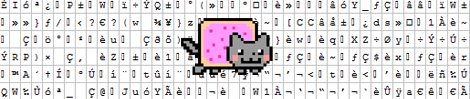
[brainsmoke], a hacker over at revspace, made an assembler version of nyan cat that can be placed on the bootloader of any disk. Just a reminder that you shouldn’t mount everything out there. We learned that lesson the week we discovered a penicillin allergy.

It’ll replace the Buffy poster.

[Anthony Clay] has been working on a set of EE posters that he’s putting up as a Kickstarter. They’re Ohm’s Law, resistor calculator, capacitance, and inductance posters that would look great above any workbench. He’s looking for ideas for other posters, so drop him a line and vote for the 7400 logic poster. All of them.

Ooooohhhh MIDI sampler

A while ago, we saw this neat MIDI Arduino shield. The Kickstarter reached its funding goal (there’s still time left!), but now [Keith] writes in to tell us that the AvecSynth library is platform independent. You could use this to record and play back MIDI messages. MIDI tape delay, anyone?

Open mind, not mouth.

With the success of the Stanford AI class last year, it looks like MIT is really getting their head into the game. Think of it this way: it’s MIT opencourseware that can lead to credentials. Now the only question is, ‘how do you prank a virtual campus?’

Crank Out The Jams With [Dino]’s Fuzz Face

Weekly Hack a Day feature [Dino] is back again, this time with his very own guitar pedal. It’s modeled on a three-transistor Fuzz Face clone and sounds very good in our humble opinion.

Fuzz pedals were some of the first guitar pedals on the market, and for good reason. Their easy construction and simple theory of operation (just amplify sound until the transistor saturates) made them an economical and available pedal for the legends of rock in the 60s. [Dino]’s build follows this tradition of simplicity with a common 2N3904 transistor and a pair of BC547 Silicon transistors. We’re guessing [Dino] couldn’t find any cred-worthy and mojo-giving Germanium transistors, but the result sounds just as good as we could imagine.

To test out his pedal, [Dino] hooked up a [Jack White] style single string lap steel and turned everything up to 12*. The result is rock. Check out the build vid after the break.

Continue reading “Crank Out The Jams With [Dino]’s Fuzz Face”

Help [Chris] Boot His Cray-1 Supercomputer

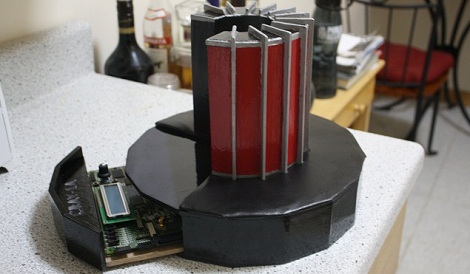
[Chris Fenton] needs your help. After constructing a 1/10th scale, cycle accurate Cray-1 supercomputer and finding a disk with Cray software on it, he’s ready to start loading the OS. There’s a small problem, though: no one knows how to boot the thing.

[Chris] posted a disk image for a Cray-1/X-MP with the help of the people at archive.org. Now he needs your help – if you think you can reverse engineer the file system, [Chris] will pay handsomely with a miniature model of a Cray printed on his MakerBot. In any case, it seems like a fun challenge.

From our quick glance at the disk image with a HEX editor, it looks like [Chris] has something special on his hands. We see a few references to “Cray memory and registers,” as well as “IOP-0 Kernel, Version 4.2.2” in the header along with a few dates referencing July of 1989.  This is consistent with the history of the source disk pack. If you think you’ve got what it takes to reverse engineer the file system of a Cray-1, this is your chance.