Bruce Schneier’s Opinion On Everything


Honestly, we were originally sent this Q&A with famed cryptographer [Bruce Schneier] as a restaurant recommendation (112 Eatery, Minneapolis). Posted last fall on NYTimes’ Freakonomics blog it covers [Bruce]’s opinion on nearly everything. Here are a few items in particular that really stuck out to us:

The most immediate threat to the average person is crime – in particular, fraud. And as I said before, even if you don’t store that data on your computer, someone else has it on theirs. But the long-term threat of loss of privacy is much greater, because it has the potential to change society for the worse.

What you’re really asking me is about the security. No one steals credit card numbers one-by-one, by eavesdropping on the Internet connection. They’re all stolen in blocks of a million by hacking the back-end database. It doesn’t matter if you bought something over the Internet, by phone, by mail, or in person – you’re equally vulnerable.

We already knew he doesn’t secure his WiFi (neither do we) and you’ll find many other interesting discussions in the article. If you want Bruce Schneier facts though, you’ll have to look elsewhere.


Cold Boot Encryption Attack Video

We haven’t made a regular habit of watching BoingBoing TV, but lately they’ve been covering topics we’ve been interested in… not the dolphin pr0n. In yesterday’s episode they talked to Jacob Appelbaum and members of the EFF about the cold boot encryption attack. The attack involves dumping the contents of memory to a storage device by power cycling the system. Cooling the memory chip with compressed air helps preserve the integrity of the data. The attacker can then search the data to find encryption keys protecting the contents of the hard drive. A fool proof solution to mitigate this attack hasn’t been developed yet. You can read more about cold boot attacks at the Center for Information Technology Policy. The BoingBoing TV episode, bizarre editing and all, can be downloaded directly here.

Charter Screwing With DNS


Charter Communications seems to be pulling some sort of crap with their DNS servers. While working on a new project our friend Billy Hoffman, discovered that Charter was reporting absolutely every domain as resolving. They do offer a solution by providing an opt-out cookie, which isn’t useful at all if you’re not using a web browser… and I’m guessing most of Charter’s subscribers aren’t looking for a bastardized version of the net. We’ve seen recently that messing with DNS like this can actually open up new security holes.

XBMC For Your Mac


XBMC (formerly Xbox Media Center) has always been a popular choice for retiring an original Xbox. Maybe people install it for lack of something better to do or maybe it’s the pride in having better media support than the 360. The XBMC team has found another device that has a pretty weak television experience, the Mac. Lifehacker took the latest XBMC for OSX beta build for a run now that it supports remote controls. It seems like a much more functional than Apple’s built in Front Row. There are a few things that don’t quite work yet, which you can find in the FAQ. We’re definitely going to try this on our old Mac mini… once we upgrade it to Leopard, which is an unfortunate caveat that might prevent people from running XBMC on legacy hardware. There is no Apple TV support planned because of limited horsepower and the hacking hurdles that might be required. If you’re interested in repurposing your old Xbox with XBMC, check out Lifehacker’s install guide.

The Future Of The Internet And How To Stop It


Yes, even we were getting tired of that Indiana Jones marathon on TV. So, we ventured online to find something entirely too geeky for a Sunday afternoon. The Future of the Internet and How to Stop It is a presentation Harvard Law School professor Jonathan Zittrain gave at Princeton near the end of March.

He begins by covering early 20th century “sterile” technology like tabulation machines that were rented by the census bureau. The machines didn’t encourage any sort of innovation. Next he talks about “generative” technology like the internet and modern OSes where anyone can build whatever they want. The final step is the more recent move to what he calls “tethered” technology. These are the systems with upgradeable firmware where devices can ship with unfinished features and remove features after the consumer has already purchased the device. He uses the iPhone as an example of this walled garden that could hurt innovation. Watch the video for his thoughts on this new world and how he thinks it could be fixed.

Maker Faire 2008: Schwag


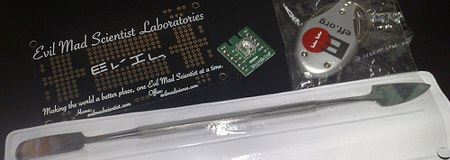
As our final Maker Faire post, we thought we’d talk about some of the curious items that were handed us during the event.

While checking out Evil Mad Scientist Laboratories‘ latest generation CandyFab were given their AVR business card breakout board.

[Garrett] gave us a handful of ShiftBrites to play with in a future project.

We donated to the EFF, as we’re wont to do, and received a super bright blue flashlight for spotting the yellow tracking dots on color laser printouts. If you’re not familiar with this topic, you should check out bunnie’s blue light scanner.

Our final stop was at ifixit to pick up a free set of spatulas (spudgers?) for popping open iPods. All around a decent haul.

Maker Faire 2008: Puzzlemation


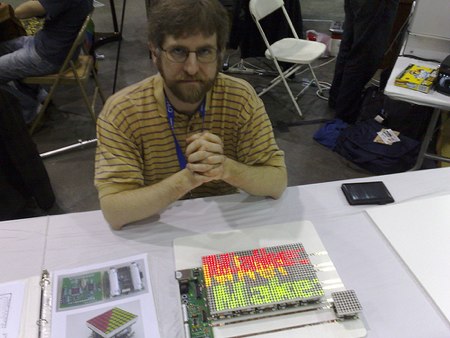
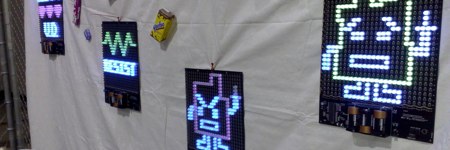
[John Peterson] showed us his Puzzlemation, animated tile puzzle at Maker Faire. It was originally designed for the Microchip 16-bit Embedded Control Design Contest. The puzzle is made from multiple modules each with an 8×8 LED grid. The tiles are battery powered and each one has PIC24FJ64GA004 microcontroller. They sit on a tray with flat copper strips as a serial bus. The tray controller broadcasts the animation to the tiles. Each tile waits for its unique identifier and saves that portion of the animation. The tiles don’t actually know what order they’re in so once the animation is in motion you can figure out their proper order; rearranging them so the animation is correct. We’ve got a video of it in action after the break.

Continue reading “Maker Faire 2008: Puzzlemation”