24C3 Hacking DNA

[Drew Endy]’s Programming DNA talk was by far the most interesting talk we saw at Chaos Communication Congress. No, DNA doesn’t have much to do with computers, but he points out that hacking principles can be applied just the same. Right now engineers are reversing genetic code and compiling building blocks for creating completely arbitrary organisms. This talk was designed to bootstrap the hacking community so that we can start using and contributing standard biological parts to an open source collection of genetic functions.

You should definitely watch the video to get a good idea of where biohacking is at today. You can find a higher quality version of the video in the archives.
24C3 Mifare Crypto1 RFID Completely Broken

Another highlight for us at CCC was [Karsten Nohl] and [Henryk Plötz] presenting how they reversed Philips crypto-1 “classic” Mifare RFID chips which are used in car keys, among other things. They analyzed both the silicon and the actual handshaking over RF. Looking at the silicon they found about 10K gates. Analyzing with Matlab turned up 70 unique functions. Then they started looking “crypto-like” parts: long strings of flip-flops used for registers, XORs, things near the edge that were heavily interconnected. Only 10% of the gates ended up being crypto. They now know the crypto algorithm based on this analysis and will be releasing later in the year.

The random number generator ended up being only 16-bit. It generates this number based on how long since the card has been powered up. They controlled the reader (an OpenPCD) which lets them generate the same “random” seed number over and over again. This was actually happening on accident before they discovered the flaw.

One more broken security-through-obscurity system to add to the list. For more fun, watch the video of the presentation.

24C3 Toying With Barcodes

[FX] from Phenoelit gave an entertaining talk about barcode security. He covered both how the systems are implemented and how they’ve been exploited. The first example was a parking garage in Dresden that issues non unique barcodes for the unlimited passes that hotels give out. Anyone code print out an image of that particular code and park for free. German grocery stores have automated machines that refund you for your empty beer bottles. The barcode generated just states the refund amount (5 digits) that you’ll get at the register. Just stick the barcode under something like a six pack and it’ll scan even without the cashier seeing it.

Check out the video to find out more silliness involving DVD rentals, boarding passes, asset management, and SQL injection via the scanner. You can even find higher res versions in the 24C3 media archives.

24C3 Build Your Own UAV


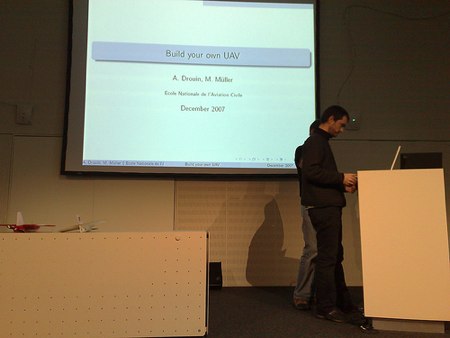
The 24th annual Chaos Communications Congress in Berlin is already off to a great start. The first talk we attended was [Antoine Drouin] and [Martin Müller] presenting Paparazzi – The Free Autopilot. Paparazzi is an open source hardware and software project for building autonomous unmanned aerial vehicles. The main hardware board has an ARM processor and GPS. It uses inertial and infrared sensors to determine orientation and altitude. The four infrared thermopiles measure the air temperature. The ground is warmer than the sky and if you compare the temperature in the direction of each wing tip your can tell what angle the airplane is at. It’s really that simple.

They did a pretty amazing live demo. Using the network connection they controlled a UAV flying in France and another in Germany. Both planes were streaming live video from belly mounted cameras. One relaying through a home DSL connection and the other through a UMTS cellphone. They were able to change way-points on the fly and issue flight pattern commands. There is a ground crew at each location with a security pilot that will switch the controls to manual if things get out of hand.

Wireless Keyboards Easily Cracked

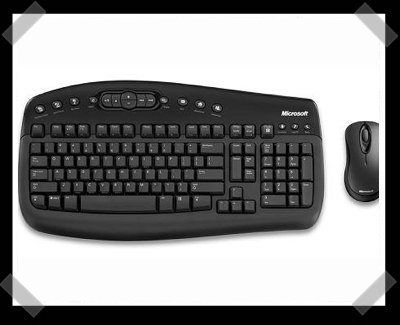
We first covered breaking the commodity 27MHz radios used in wireless keyboards, mice, and presenters when [Luis Miras] gave a talk at Black Hat. Since then, the people at Dreamlab have managed to crack the encryption on Microsoft’s Wireless Optical Desktop 1000 and 2000 products (and possibly more). Analyzing the protocol they found out that meta keys like shift and ALT are transmitted in cleartext. The “encryption” used on each regular keystroke involves XORing the key against a random one byte value determined during the initial sync with the receiver. So, if you sniff the handshake, you can decrypt the keystrokes. You really don’t have to though; there are only 256 possible encryption keys. Using a dictionary file you can check all possible keys and determine the correct one after only receiving 20-50 keystrokes. Their demo video shows them sniffing keystrokes from three different keyboards at the same time. Someone could potentially build a wireless keylogger that picks up every keystrokes from every keyboard in an office. You can read more about the attack in the whitepaper(pdf).

[via Midnight Research Labs]

Continue reading “Wireless Keyboards Easily Cracked”

Hackit: Cocktail Robotics


Here is a special edition Hackit in honor of Roboexotica. Ever since making the decision to attend Roboexotica we’ve been speculating on the type of machines we’d like to see at such an event. Here are a handful of ideas:

Iceware via rapid prototyping: As we type this post, [Bre] is in the background attempting to build a RepRap style rapid prototyping machine that will construct shot glasses on demand. We were thinking it would be neat to cut beverage glasses out of blocks of ice using a milling machine, but why stick with normal milling equipment? It’s ice right; you could be doing something stupid like using a butane torch for your working tool. We then began to wonder “Has anyone built an ice based rapid prototyping machine?” You could just deposit water on a frozen surface to create your glassware. A group at the University of Missouri has been investigating “rapid freeze prototyping“. Since they’re using water, they only have to create the frozen shell of the part and then fill in the empty cavity with water to create a solid.

Continue reading “Hackit: Cocktail Robotics”