Need Many Thin Parts? Try Multi-material Stack Printing

Admittedly it’s a bit of a niche application, but if you need lots of flat 3D printed objects, one way to go about it is to print them in a stack and separate them somehow. An old(er) solution is to use a non-extruding “ironing” step between each layer, which makes them easier to pull apart. But another trick is to use the fact that PLA and PETG don’t stick well to each other to your advantage. And thus is born multi-material stack printing. (Video, embedded below the break.)

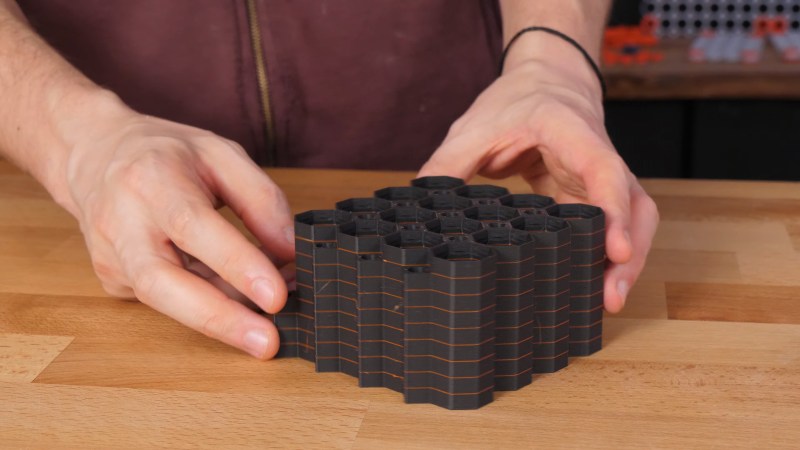
[Jonathan] wants to print out multiples of his fun Multiboard mounting system backplates, and these are the ideal candidate for stack printing: they’re thin, but otherwise take up the entire build plate. As you’d expect, the main trick is to print thin layers of PETG between the PLA plate layers that you do want. He demonstrates that you can then simply pull them apart.

There are some tricks, though. First is to make two pillars in addition to the plates, which apparently convinces the slicer to not flatten all the layers together. (We don’t really understand why, honestly, but we don’t use Bambu slicer for multi-materials.) The other trick that we expect to be more widely applicable, is that [Jonathan] extrudes the PETG interlayers a little thicker than normally. Because the PETG overflows the lower PLA layer, it physically locks on even though it chemically doesn’t. This probably requires some experimentation.

As multi-material printers get cheaper, we’ve seen a lot more innovative uses for them popping up. And we wouldn’t be so stoked about the topic if there weren’t a variety of hacker projects to make it possible. Most recently, the impressive system from [Armored_Turtle] has caught our eye. Who knows what kind of crazy applications we’ll see in the future? Are you doing multi-material yet?

Continue reading “Need Many Thin Parts? Try Multi-material Stack Printing”

Hacker Olympics

The opening ceremony of the Summer Olympics is going on today. It’s an over-the-top presentation meant to draw people into sport. And for the next few weeks, we’ll be seeing people from all across the world competing in their chosen physical activities. There will be triumph and defeat, front-runners who nonetheless lag behind on that day, and underdogs who sneak ahead. In short, a lot of ado about sport, and I don’t necessarily think that’s a bad thing. Sports are fun.

But where is the Hacker Olympics? Or even more broadly the Science Olympics or Engineering Olympics? Why don’t we celebrate the achievements of great thinkers, planners, and builders the same way that we celebrate fast runners or steady shooters? With all the pomp and showmanship and so on?

Here at Hackaday, we try our best! When we see a cool hack, we celebrate it. But we’re one little blog, with about a millionth the budget of the International Olympic Commission. However, we have you all as our biggest multiplier. It would be awesome if we could take over the entire city of Paris in celebration of science and engineering, but until then, if you see something smart, share it with us. And if you see something on Hackaday that you think was awesome, share it with your friends.

CeraMetal Lets You Print Metal, Cheaply And Easily

3D printing metal has been somewhat of a holy grail for the last decade in the hobby 3DP scene. We’ve seen a number of solutions, including using expensive filaments that incorporate metal into the usual plastic. In parallel, we’ve seen ceramic printers, and paste printers in general, coming into their own. What if you combined the two?

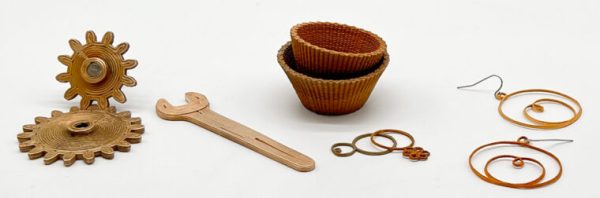
You’d get [Leah Buechly] et al’s CeraMetal process, which is the cheapest and most straightforward metal printing method we’ve seen to date. It all starts off with a custom bronze metal clay, made up of 100 g bronze powder, 0.17 g methyl cellulose, 0.33 g xanthan gum, and 9 g water. The water is fine-tuned to get the right consistency, and then it’s extruded and sintered.

The printer in question is an off-the-shelf ceramic printer that appears to use a pressurized clay feed into an auger, and prints on a linen bed. [Leah] had to write a custom slicer firmware that essentially runs in vase mode but incorporates infill as well, because the stop-start of normal slicers wreaked havoc with clay printing.

The part is then buried in activated carbon for support, and fired in a kiln. The result is a 3D printed bronze part on the cheap; the material cost is essentially just the cost of the metal powder and your effort.

We had never heard of metal clay before, but apparently jewelers have been using it for metals other than just bronze. The Metal Clay Academy, from the references section of the paper, is an amazing resource if you want to recreate this at home.

Paste printers are sounding more and more interesting. Obvious applications include printing chocolate and printing pancakes, but now that we’re talking metal parts with reasonably consistent shrinkage, they’ve got our attention.

Do Your Research

We were talking about a sweet hack this week, wherein [Alex] busts the encryption for his IP web cam firmware so that he can modify it later. He got a number of lucky breaks, including getting root on the device just by soldering on a serial terminal, but was faced with having to reverse-engineer a binary that implemented RSA encryption and decryption.

Especially when they’re done right, and written to avoid side-channel attacks, encryption routines aren’t intuitive, even when you’re looking at the C source. Reversing it from the binary would be a tremendous hurdle.

That’s when [Alex] started plugging in strings he found in the binary into a search engine. And that’s when he found exactly the open source project that the webcam used, which gave him the understanding he needed to crack the rest of the nut.

Never forget! When you’re doing some reverse engineering, whether hardware or software, do a search for every part number and every string you find in memory. If you’re like me, it might feel like cheating a little bit, but it’s just being efficient. It’s what all your hacker heroes say they do, and if you’re lucky, it might just be the break you need too.

Show Us Your Minimalist Games, And Win

Sometimes the tightest constraints inspire the highest creativity. The 2024 Tiny Games Challenge invites you to have the most fun with the most minimal setup. Whether that’s tiny size, tiny parts count, or tiny code, we want you to show us that big fun can come in small packages.

The Tiny Games Challenge starts now and runs through September 10th, with the top three entries receiving a $150 gift certificate courtesy of DigiKey.

Continue reading “Show Us Your Minimalist Games, And Win”

Congratulations To The 2024 Business Card Challenge Winners!

When you ask a Hackaday crowd to design a business card, you should expect to be surprised by what you get. But still, we were surprised by the breadth of entries! Our judges wracked their brains to pick their top ten, and then we compared notes, and three projects rose to the top, but honestly the top ten could have all won. It was a tight field. But only three of the entries get to take home the $150 DigiKey gift certificates, so without further ado…

Continue reading “Congratulations To The 2024 Business Card Challenge Winners!”

Undo Arduino Encryption With An Oscilloscope

Cryptography ain’t easy. Seemingly small details like how many times a computationally intensive loop runs can give the game away. [Lord Feistel] gives us a demo of how this could work with nothing more than poorly designed code, a resistor, and an oscilloscope.

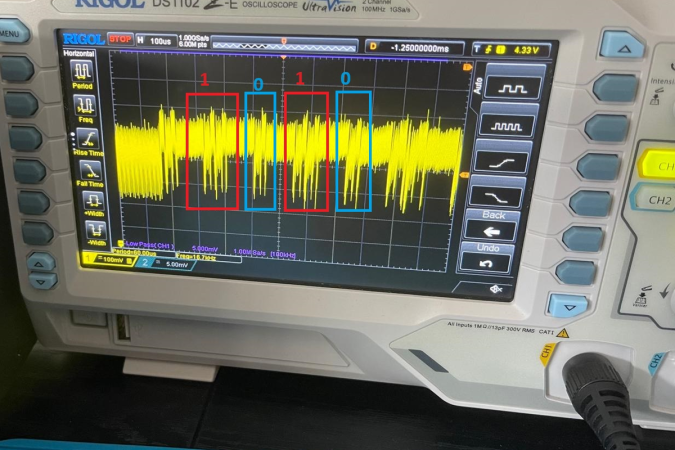
The hardware side is, as mentioned, really simple. Put a resistor inline with the Arduino and monitor the voltage drop across the resistor with the scope. When the chip is working hard, it consumes more current, and code sections that take longer will show up as longer dips.

On the software end, it’s only a little more complicated.  The RSA encryption scheme involves a lot of exponentiation and modulo-taking. Here, [Lord Feistel] is targeting a naive way of computing the exponents quickly, and demonstrates how you can read the exponent straight out the chip’s power demand.

Implementing this attack against a real-world RSA algorithm, in the context of the Arduino doing other stuff, will be harder. And we don’t know if the algorithm implemented in “standard” Arduino libraries is smarter than this one. (If you know, let us know in the comments.) But still, this is a cool example of just how simple and straightforward it can be to eavesdrop on bad code.

If you only need to bypass encryption instead of breaking it, check out [Lord Feistel]’s other tutorial on power glitching that we featured previously. If you haven’t played around with the hardware side of security, it gets deep pretty quickly, but you can at least dip your toes in the shallow end with what you’ve got in your closet.