Hacker Camps Post-Pandemic, Electromagnetic Field 2022

After a four-year hiatus and a cancelled event, it was time earlier this month for British and European hackers to return to their field in Herefordshire. A special field, Eastnor Castle Deer Park, venue for the Electromagnetic Field 2022 hacker camp. I packed up an oversized rucksack and my folding bike, and set off to enjoy a few days in the company of my fellow geeks.

As the first of the large European hacker camps since 2019 there was both an excitement and a slight trepidation in finally hanging out with several thousand people, even if mostly outdoors. The UK has a good COVID vaccine uptake and the camp organisers requested that attendees test themselves before travelling to Eastnor, but after two years of precautions and the pandemic still being with us there’s still some risk to take into account. Happily they were able to strike a decent balance between precautions and event progress, and we were able to proceed with a fairly normal hacker camp.

Plenty Of Talks, But They’re Not Online Yet

Sadly the extensive programme of talks has yet to make it onto YouTube or media.ccc.de at the time of writing, so the section I’d normally devote to them may have to wait for another time. Thus this write-up is more about the social aspect than the action.

Eastnor Castle Deer Park lies in a secluded Herefordshire valley, and the entry is vla a small estate road that treats you to an unfolding vista as you approach, of the marquees and other structures nestled among the trees. The usual queue for a wristband and you’re in, with the minor inconvenience of a trek trough the site to wherever your village lies. This year I was with my hackerspace in the Milton Keynes Makerspace village, next to one of the estate roads at the side of the valley and clustered round a tent with the commendable purpose of distributing free cups of very high quality tea. My tent up, I was ready to tour the site, and renew some friendships after so long apart. Continue reading “Hacker Camps Post-Pandemic, Electromagnetic Field 2022”


An Anodiser That Does Gradients

Anodizing aluminium, the process of electrolytic build up of the metal’s the oxide layer in the presence of dyes to create colored effects, is such a well-established process that we probably all have anodized items within sight. It’s usually an industrial mass-production process that creates a uniform result, but there’s an anodizing machine from a Dutch design studio which promises to place anodized aluminium in a new light. Studio Loop Loop’s Magic Color Machine enacts a small-scale automated anodizing process driven by a microcontroller, and is capable of effects such as gradated colors.

Unfortunately their website is long on marketing and short on technical details, but the basic function of a line of chemical baths with a pulley to lower and lift the item being anodized shouldn’t be too difficult for any Hackaday reader to understand. There’s a short video clip posted on Instagram which also gives some idea. It’s a powerful idea that should lead to some eye-catching work for their studio, but its interest here lies in the techniques it might inspire others to try. We look forward to an open-source version of a gradated anodize. Meanwhile if anodizing takes your fancy, it’s a subject we’ve visited before.

It’s RAID. With Floppy Drives.

There are some tings that should be possible, so just have to be tried. [Action Retro] has a great video showing just such an escapade, the creation of a large RAID 0 array using a pile of USB floppy drives. Yes, taking one of the smallest and most unreliable pieces of data storage media and combining a load of them together such that all the data is lost if just one of them fails.

Surprisingly the process of creation is quicker and simplier than we expected, with a slightly long-in-the-tooth version of Mac OS X making short work of the process. Starting with 30 USB floppies and a pair of large USB hubs, he whittled the pile down to 13 drives that would play nicely and RAID together. The sight of so many drives all lighting up together as the precious megabytes are filled with data is probably not one seen outside the realm of floppy duplication machines, which brings back bad memories for those of us in the consumer software business in years past.

Would you do this? Probably, but should you do it? Of course not, but then again he’s done it so the rest of us don’t have to. Here in 2022 maybe there are better uses for a brace of floppy drives. Continue reading “It’s RAID. With Floppy Drives.”

A GPS Frequency Standard For When The Timing Has To Be Right

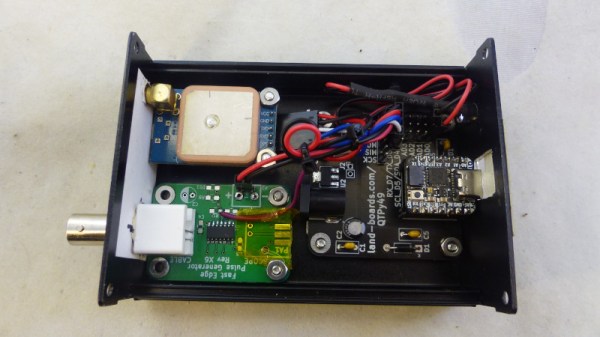
A metrology geek will go to extreme lengths to ensure that their measurements are the best, their instruments the most accurate, and their calibration spot-on. There was a time when for time-and-frequency geeks this would have been a difficult job, but with the advent of GPS satellites overhead carrying super-accurate atomic clocks it’s surprisingly easy to be right on-frequency. [Land-boards] have a GPS 10 MHz clock that’s based around a set of modules.

Since many GPS modules have a 10 MHz output one might expect that this one to simply hook a socket to the module and have done, but instead it uses another of their projects, a fast edge pulse generator with the GPS output as its oscillator, as a buffer and signal conditioner. Add to that an QT Py microcontroller board to set up the GPS, and there you have a standalone 10 MHz source to rival any standard. Full details can be found on the project’s wiki, and the firmware can be found on GitHub.

Careful with your exploration of standard frequencies, for that can lead down a rabbit hole.

Shielding A Cheap RTL-SDR Stick

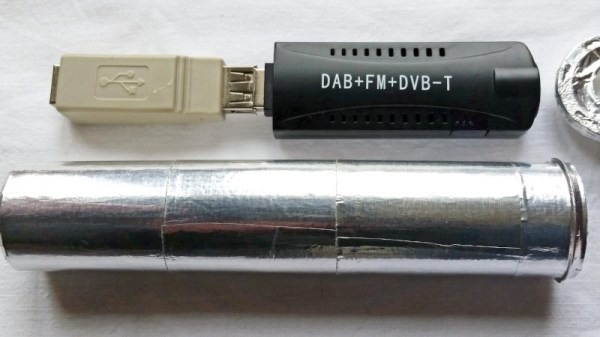
Even though not every Hackaday reader is likely to be a radio enthusiast, it’s a fair guess that many of you will have experimented with an RTL-SDR USB dongle by now. These super-cheap devices are intended for digital TV reception and contain an RTL2832 chip, which with the proper software, can be pushed into service as a general purpose software defined radio receiver. For around $10 USD they’re fantastic value and a lot of fun to play with, even if they’re not the best radio ever. How to improve the lackluster performance? One of the easiest and cheapest ways is simply to shield it from RF noise, which [Alan R] has done with something as mundane as a tubular fizzy orange tablet container.

This is probably one of the simpler hacks you’ll see on this site, as all it involves is making an appropriate hole in the end of the tube and shielding the whole with some aluminium foil sticky tape. But the benefits can be seen immediately in the form of reduced FM broadcast band interference, something that plagues the cheaper dongles.

Perhaps the value in this hack aside from how easy it is on a cheap dongle is that it serves to remind us some of the benefits of paying a little extra for a better quality device. If you’d like to know more about RTL-SDR improvements, it’s a topic we covered in detail back in 2019 when we looked at seven years of RTL-hackery.

An Epic Tale Of Pirate Radio In Its Golden Age

With music consumption having long ago moved to a streaming model in many parts of the world, it sometimes feels as though, just like the rotary telephone dial, kids might not even know what a radio was, let alone own one. But there was a time when broadcasting pop music over the airwaves was a deeply subversive activity for Europeans at least, as the lumbering state monopoly broadcasters were challenged by illegal pirate stations carrying the cutting edge music they had failed to provide. [Ringway Manchester] has the story of one such pirate station which broadcast across the city for a few years in the 1970s, and it’s a fascinating tale indeed.

It takes the form of a series of six videos, the first of which we’ve embedded below the break. The next installment is placed as an embedded link at the end of each video, and it’s worth sitting down for the full set.

Continue reading “An Epic Tale Of Pirate Radio In Its Golden Age”

Retrocomputing, Time To Hang Up The Original Hardware?

For those of us with penchant for older technology, there’s something special about operating with older hardware. Whether it’s a decades-old camera, a vintage keyboard, or a home computer from the 1980s, the modern equivalent just doesn’t quite compare. But working with older parts definitely isn’t for the faint-hearted, as the passage of time has taken its toll on their reliability. Is it time to recognize that the supply of replacement vintage parts is not infinite, and to switch from using original hardware to more modern alternatives? [Retro Recipes] poses this question after a particularly difficult-to-find Amiga fault, and discusses it while evaluating a replacement Amiga made entirely from modern parts.

The new Amiga in question is a recreation of an A1200 with a re-manufactured case and keyboard, and the guts of an A500 Mini retro console taking the place of the Commodore board. He goes through the process of making an Amiga hard drive image on a USB drive using the image from his original drive in his teenage years, and boots it both on the 500 Mini based machine and on the UAE emulator on a Mac laptop. You can follow him in the video below the break.

We can see the logic in treating original hardware as a precious resource that’s not to be run up for fear of breaking it, but by the same token we’re still standing by that first sentence. But should the enjoyment of an older machine be limited only to those who have an original? We think not, so if enjoying an Amiga without an Amiga can be as good as the real thing then we’re all for it.

Of course, for those whose original Amigas have already broken, there are other ways to bring them back.

Continue reading “Retrocomputing, Time To Hang Up The Original Hardware?”