Why Is Your Cellphone Not A More Useful Computer?

Sometimes when you are browsing randomly through the tech feeds, up pops an article that just crystallizes a nascent thought that had been simmering below the surface for a long time, and is enough to make you sit up and say “Yes! I agree completely with that!”. Such a moment came with [Cheapscatesguide]’s post: “My Fantasy: A Cellphone I can Use as a Desktop Computer“, in which the pertinent question is asked that if smartphones are so powerful, why are they not much better at being more than, well, smartphones?

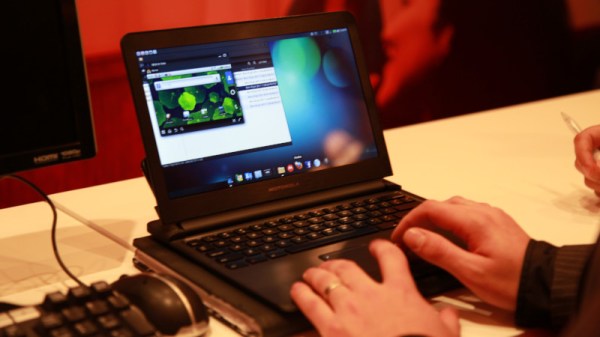
Readers with long memories may recall that the cellphone-as-computer idea is one that has been tried at least once before. The Motorola Atrix appeared in the early years of this decade, and was a high-end smartphone that could be slotted into both desktop replacement and netbook-style base stations and used as a Linux-based personal computer. Unfortunately it was both eye-wateringly expensive and disappointingly slow due to a hobbled operating system, so it failed to set the market alight. There was a brief moment when unsold Atrix netbook docks were available on the surplus market and became popular platforms as a Raspberry Pi desktop interface, but this experiment seems to have put paid to the idea of one device to truly rule them all.

If we had to hazard a guess as to why this has failed to happen, we’d finger both the manufacturer’s desire not to undermine their lucrative sales in other sectors, and both their and the carriers’ desire to lock down the devices as much as possible. A manufacturer such as Apple will for example never  produce an iPhone that can replace a desktop, because it would affect their MacBook sales. Oddly in another form we’re nearly there, this piece is being worked on with a Chromebook, a device that has a useful browser, a functional Android layer, and (because it’s a 64-bit model) an officially supported and useful Debian layer. We don’t expect this to translate into a phone any time soon though.

From another angle, we’ve asked in the past why we aren’t hacking old cellphones.

Moto Atrix lapdock picture: ETC@USC [CC BY-SA 2.0].

Via Hacker News.

Reflection On A Decade Of Hackerspace Expansion

A few days ago I was invited to a party. Party invites are always good, and if I can make it to this one I’ll definitely go. It’s from a continental European hackerspace, and it’s for their tenth birthday party. As I spent a while checking ferries and flights it struck me, a lot of the spaces in my sphere are about a decade old. I went to London Hackspace’s 10th earlier in the year, and a host of other British hackerspaces aren’t far behind. Something tells me I’ll be knocking back the Club Mate and listening to EDM of some form at more than one such party in the coming year.

For most of the decade since I found the then-recently-established mailing list of my local hackerspace I’ve spent a lot of my time involved in more than one space. I’ve been a hackerspace director, a member, and many roles in between and I’ve seen them in both good times and bad ones. Perhaps it’s time to sit back and take stock of that decade and ask a few questions about hackerspaces. How have they fared, what state are they in now, and where are they going?

Continue reading “Reflection On A Decade Of Hackerspace Expansion”

Patch, Or Your Solid State Drives Roll Over And Die

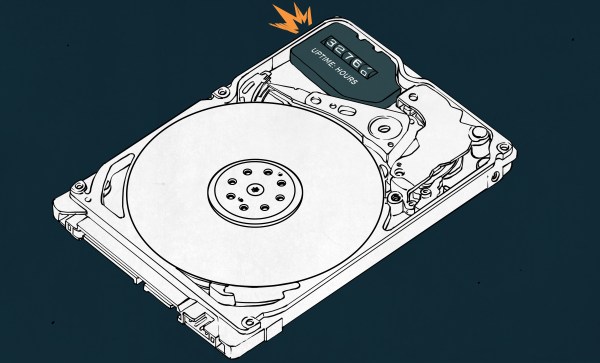
Expiration dates for computer drives? That’s what a line of HP solid-state drives are facing as the variable for their uptime counter is running out. When it does, the drive “expires” and, well, no more data storage for you!

There are a series of stages in the evolution of a software developer as they master their art, and one of those stages comes in understanding that while they may have a handle on the abstracted world presented by their development environment they perhaps haven’t considered the moments in which the real computer that lives behind it intrudes. Think of the first time you saw an SQL injection attack on a website, for example, or the moment you realised that a variable type is linked to the physical constraints of the number of memory locations it has reserved for it. So people who write software surround themselves with an armoury of things they watch out for as they code, and thus endeavour to produce software less likely to break. Firmly in that arena is the size of the variables you use and what will happen when that limit is reached.

Your Drive Is Good For About 3 Years And 9 Months

Sometimes though even developers that should know better get it wrong, and this week has brought an unfortunate example for the enterprise wing of the hardware giant HP. Their manufacturer has notified them that certain models of solid-state disk drives supplied in enterprise storage systems contain an unfortunate bug, in which they stop working after 32,768 hours of uptime. That’s a familiar number to anyone working with base-2 numbers and hints at a 16-bit signed integer in use to log the hours of uptime. When it rolls over the value will then be negative and, rather than the drive believing itself to be in a renewed flush of youth, it will instead stop working.

Egg on the faces of the storage company then, and an urgently-released patch. We suspect that if you own a stack of these drives you will already know about the issue and be nervously pacing the racks of your data centre.

Continue reading “Patch, Or Your Solid State Drives Roll Over And Die”

Hackaday Superconference: An Analog Engineer Dives Into RF

Those of us who work with electronics will usually come to the art through a particular avenue that we master while imbibing what we need from those around it. For example, an interest in audio circuitry may branch into DSP and microcontrollers as projects become more complex. Some realms though retain an aura of impossibility, a reputation as a Dark Art, and chief among them for many people is radio frequency (RF). Radio circuitry is often surprisingly simple, yet that simplicity conceals a wealth of complexity because the medium does not behave in the orderly manner of a relatively static analogue voltage or a set of low-frequency logic levels.

Chris Gammell is a familiar face to many Hackaday readers for his mastery of much electronic trickery, so it comes as something of a surprise to find that RF has been one of the gaps in his knowledge. In his talk at the Hackaday Superconference he took us through his journey into RF work, and the result is a must-watch for anyone with a curiosity about radio circuitry who didn’t know where to start.

Continue reading “Hackaday Superconference: An Analog Engineer Dives Into RF”

Can You Piezo A Peugeot?

Car manufacturers have a problem when it comes to climate change. Among the variety of sources for extra atmospheric CO2 their products are perhaps those most in the public eye, and consequently their marketing departments are resorting to ever more desperate measures to sanctify them with a green aura. Among these are the French marque Peugeot, whose new electric version of their 208 model features in a slick video alongside a futuristic energy-harvesting billboard.

This is no ordinary billboard, nor is it a conventional wind turbine or solar array, instead it harvests ambient noise in one of the busiest parts of Paris, and turns it into electricity to charge the car with an array of piezoelectric energy capture units. This caught our eye here at Hackaday, because it seemed rather too good to be true. Is it a marketing stunt, or could you make a piezo billboard as a practical green energy device? Let’s take a closer look.

Continue reading “Can You Piezo A Peugeot?”

The Barn Find IBM 360 Comes Home

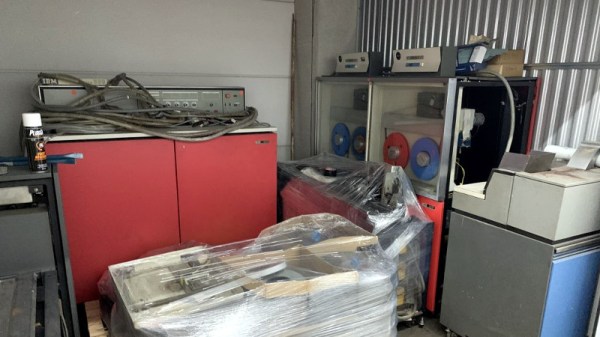
It’s a story that may be familiar to many of us, that of bidding on an item in an online auction and discovering once we go to pick it up that we’ve bought a bit more than we’d bargained for. We told you earlier in the year about the trio of Brits who bought an IBM System/360 mainframe computer from the mid 1960s off of a seller in Germany, only to find in the long-abandoned machine room that they’d bought not just one but two 360s, and a System/370 to boot. Their van was nowhere near big enough for all three machines plus a mountain of cabling, documentation, and period storage media, so they moved it to a hastily-rented storage unit and returned home to work out what on earth to do next.

Now we’ve received an email from the trio with some good news; not only have they managed to bring their hoard of vintage big iron computing back home, but also they’ve found a home for it in the rather unusual surroundings of a former top-secret UK Government signals intelligence station. With the help of a friendly specialist IT relocation company they unleashed it from their temporary storage and into the truck for the UK. It’s a tale of careful packing and plenty of wrapped pallets, as we begin to glimpse the true extent of the collection as you can see in the video below the break, because not only have they secured all the hardware but they also have a huge quantity of punched cards and disk packs. The prospect of a software archaeology peek into how a 1960s mainframe was used by its original customer is a particularly interesting one, as it’s likely those media contain an ossified snapshot of its inner workings.

We’re hoping to follow this project as it evolves, and see (we hope) a room full of abandoned junk transformed into a facsimile of a typical 1960s business computing setup. If you’d like to catch up, read our original coverage of the find.

Continue reading “The Barn Find IBM 360 Comes Home”

This CPU Has Only One Instruction

Most of us will be familiar at some level with the operation of a basic CPU, usually through exposure to microprocessors of the type that find their way into our projects. We can look at its internal block diagram and get how it works, see the registers and ALU, follow the principles of a von Neumann architecture, and understand that it has an instruction set with different instructions for each of its functions. We all know that this only describes one type of CPU though, and thus it’s always interesting to see alternatives. [Ike Jr] then has a project that should provide a lot of interest, it’s a CPU that only has a single instruction. It can only move data from one place to another, which seems to preclude any possibility of computation. How on earth can it work?

The machine has a set of registers as well as memory, and it achieves computation by having specific registers where we might expect to see instructions. For example the AND register is a two-position stack, that when it is full computes the AND of its two pieces of data and places the result in a general purpose register. The write-up goes into significant detail on the CPU’s operation, and while it’s unlikely the world will move en masse to this architecture it’s still a very interesting read. For now this is a machine that exists in software simulation rather than in silicon, and he’s working to release it so enthusiasts for unusual CPUs can have a go.

The idea of having registers that compute reminds us of a transport triggered architecture machine, being not the same as a one instruction CPU with a more conventional computing instruction.

Abstract PCB header image: Harland Quarrington/MOD [OGL v1.0].