The First Bug On Mars

Interplanetary probes were a constant in the tech news bulletins of the 1960s and 1970s. The Space Race was at its height, and alongside their manned flights the two superpowers sent unmanned missions throughout the Solar System. By the 1980s and early 1990s the Space Race had cooled down, the bean counters moved in, and aside from the spectacular images of the planets periodically arriving from the Voyager series of craft there were scant pickings for the deep space enthusiast.

The launch in late 1996 of the Mars Pathfinder mission with its Sojourner rover then was exciting news indeed. Before Spirit, the exceptionally long-lived Opportunity, and the relatively huge Curiosity rover (get a sense of scale from our recent tour of JPL), the little Sojourner operated on the surface of the planet for 85 days, and proved the technology for the rovers that followed.

In these days of constant online information we’d see every nuance of the operation as it happened, but those of us watching with interest in 1997 missed one of the mission’s dramas. Pathfinder’s lander suffered what is being written up today as the first bug on Mars. When the lander collected Martian weather data, its computer would crash.

Like many other spacecraft, the lander’s computer system ran the real-time OS VxWorks. Of the threads running on the craft, the weather thread was a low priority, while the more important task of servicing its information bus was a high priority one. The weather task would hog the resources, causing the operating system equivalent of an unholy row in our Martian outpost. A priority inversion bug, and one that had been spotted before launch but assigned a low priority.

You can’t walk up to a computer on another planet and swap out a few disks, so the Pathfinder team had to investigate the problem on their Earthbound replica of the lander. The fix involved executing some C code on an interpreter prompt on the spacecraft itself, something that would give most engineers an extremely anxious moment.

The write-up is an interesting read, it’s a translation from a Russian original that is linked within it. If the work of the JPL scientists and engineers interests you, this talk from the recent Hackaday superconference might be of interest.

[via Hacker News]

Track Wi-Fi Devices In Your Home

How do you audit your home Wi-Fi network? Perhaps you log into your router and have a look at the connected devices. Sometimes you’ll find an unexpected guest, but a bit of detective work will usually lead you to the younger nephew’s game console or that forgotten ESP8266 on your bench.

Wouldn’t it be useful if your router could tell you where all the devices connected to it are? If you are [Zack Scholl], you can do all this and more, for his FIND-LF system logs Wi-Fi probe requests from all Wi-Fi devices within its range even if they are not connected, and triangulates their position from their relative signal strengths across several sniffing receivers. These receivers are a network of Raspberry Pis with their own FIND-LF server, and any probe requests they pick up are forwarded to [Zack]’s FIND server (another of his projects) which does the work of collating the locations of devices.

It’s an impressive piece of work, though with a Raspberry Pi at each receiver it could get a little pricey. [Zack] has done other work in this field aside from the two projects mentioned here, his other work includes an implementation of the [Harry Potter] Marauder’s Map.

This is by no means the only indoor location system we’ve seen over the years. One that uses ESP8266 modules for example, or this commercial product that is similar to the project shown here.

Power For An Amstrad Spectrum

If you were an American child of the early 1980s then perhaps you were the owner of a Commodore 64, an Apple II, or maybe a TRS-80. On the other side of the Atlantic in the UK the American machines were on the market, but they mostly lost out in the hearts and minds of eager youngsters to a home-grown crop of 8-bit micros. Computer-obsessed British kids really wanted Acorn’s BBC Micro, but their parents were more likely to buy them the much cheaper Sinclair ZX Spectrum.

Sinclair Research was fronted by the serial electronic entrepreneur [Clive Sinclair], whose love of miniaturization and ingenious cost-cutting design sometimes stretched the abilities of his products to the limit. As the 8-bit boom faded later in the decade the company faltered, its computer range being snapped up by his great rival in British consumer electronics, [Alan Sugar]’s Amstrad.

The Amstrad Spectrums replaced the rubber and then shaky plastic keys of the Sinclair-era machines with something considerably more decent, added joystick ports and a choice of a built-in cassette deck or one of those odd 3″ floppy disk drives for which Amstrad seemed to be to only significant customer. For that they needed a more capable power supply offering a selection of rails, and it is this unit that concerns us today. [Drygol] had a friend with an Amstrad-made Sinclair 128K Spectrum +2 with a broken power supply. His solution was to wire in a supply retrieved from a small form factor PC that had all the requisite lines, and for safety he encased it in an improbably huge piece of heat shrink tubing.

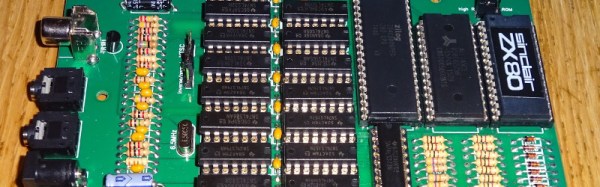
Wiring a PSU to a DIN plug for a retro computer is not an exceptional piece of work in itself even if it’s tidily done and nice to see older hardware brought back to life. What makes this piece worth a look instead is the teardown of what is a slightly unusual footnote to the 8-bit home computer story. We’re shown the familiar Z80 and support chips with the Spectrum edge connector and modulator on a through-hole board with a piece of cutting edge tech for a 1980s home computer, a single SMD chip unusually mounted nestled in a hole cut in the board.

Amstrad eventually stopped making Spectrums in the early 1990s, having also tried the Sinclair name on a spectacularly awful PC-compatible home computer. [Clive Sinclair] continued to release electronic products over the following decades, including a portable computer, the last of his trademark miniature radio receivers, and an electric bicycle accessory. Amstrad continue to make computers to this day, and [Alan Sugar] has achieved fame of a different sort as host of the UK version of The Apprentice. He has not yet become Prime Minister.

We’ve featured another Amstrad Spectrum +2 losing its tape deck for a slimmer machine. On that note, the Spectrum wasn’t Amstrad’s only entry in the 8-bit market, and we’ve also shown you a compact clone of their CPC464. As for [Drygol], he’s featured here several times. His mass-restoration of Commodore 64s for instance, or bringing a broken Atari ST back from the dead.

Get On 10 GHz For 3 Euros

A frequent complaint you will hear about amateur radio is that it is a chequebook pursuit. Of course you can work the incredible DX if you spend $20k on a high-end radio, big antenna, and associated components. The reality is though that because it’s such a multi-faceted world there are many ways into it of which the operator with the shiny rig is taking only one.

On the commonly used HF and VHF bands at the lower end of the radio spectrum you will definitely find chequebook amateurs of the type described in the previous paragraph. But as you ascend into the microwave bands there are no shiny new radios on the market, so even the well-heeled licensee must plow their own furrow and build their own station.

You might think that this would remain a chequebook operation of a different type, as exotic microwave devices are not always cheap. But in fact these bands have a long history of extremely inexpensive construction, in which skilled design and construction as well as clever re-use of components from satellite TV systems and Doppler radar modules play a part. And it is a project following this path that is our subject today, for [Peter Knol, PA1SDB] has repurposed a modern Doppler radar module as a transmitter for the 10GHz or 3cm amateur band (Google Translate version of Dutch original). The best bit about [Peter]’s project is the price: these modules can be had for only three Euros.

Years ago a Doppler module would have used a Gunn diode in a waveguide cavity and small horn, usually with an adjacent mixer diode for receiving. Its modern equivalent uses a transistor oscillator on a PCB, with a dielectric resonator and a set of patch antennas. There is also a simple receiver on board, but since [Peter] is using a converted ten-Euro satellite LNB for that task, it is redundant.

He takes us through the process of adjusting the module’s frequency before showing us how to mount it at the prime focus of a parabolic antenna. FM modulation comes via a very old-fashioned transformer in the power feed. He then looks at fitting an SMA connector and using it for more advanced antenna set-ups, before experimenting with the attenuating properties of different substances. All in all this is a fascinating read if you are interested in simple microwave construction.

The result is not the most accomplished 10 GHz station in the world, but it performs adequately for its extremely low price given that he’s logged a 32 km contact with it.

Though we cover our fair share of amateur radio stories here at Hackaday it’s fair to say we haven’t seen many in the microwave bands. If however you think we’ve been remiss in this area, may we point you to our recent coverage of a microwave radio receiver made from diamond?

Via Southgate ARC.

Cheap Powerbank Logic And Teardown

A fixture on many British high streets are pound shops. You may have an equivalent wherever in the world you are reading this; shops in which everything on sale has the same low price. They may be called dollar stores, one-Euro stores, or similar. In this case a pound, wich translates today to a shade under $1.24.

Amid the slightly random selection of groceries and household products are a small range of electronic goods. FM radios, USB cables and hubs, headphones, and mobile phone accessories. It was one of these that caught [Julian Ilett]’s eye, a USB power bank. (Video embedded below.)

You don’t get much for a quid, and it shows in this product. A USB cable that gets warm at the slightest current, a claimed 800 mA of output at 5V from a claimed 1200 mAh capacity, and all from an 18650 Li-ion cell of indeterminate origin. The active component is an FM9833E SOIC-8 switching regulator and charger (220K PDF data sheet, in Chinese).

A straightforward teardown of a piece of near-junk consumer electronics would not normally be seen as something we’d tempt you with, but [Julian] goes on to have some rather pointless but entertaining fun with these devices. If you daisy-chain them, they can be shown to have the properties of rudimentary digital logic, and in the video we’ve put below the break it is this that he proceeds to demonstrate. We see a bistable latch, a set-reset latch, a very slow astable multivibrator, and finally he pulls out a load more power banks for a ring oscillator.

If only [MacGyver] had found himself trapped in a container of power banks somewhere from which only solving a complex mathematical conundrum could release him, perhaps he could have fashioned an entire computer! The best conclusion is the one given at the end of the video by [Julian] himself, in which he suggests (and we’re paraphrasing here) that if you feel the idea to be unworthy of merit, you can tell him so in the comments.

Continue reading “Cheap Powerbank Logic And Teardown”

So Where’s My Low Voltage DC Wall Socket?

What are the evocative sounds and smells of your childhood? The sensations that you didn’t notice at the time but which take you back immediately? For me one of them is the slight smell of phenolic resin from an older piece of consumer electronics that has warmed up; it immediately has me sitting cross-legged on our living room carpet, circa 1975.

"Get ready for a life that smells of hot plastic, son!" John Atherton [CC BY-SA 2.0], via Wikimedia Commons.
“Get ready for a life that smells of hot plastic, son!” John Atherton [CC BY-SA 2.0], via Wikimedia Commons.
That phenolic smell has gone from our modern electronics, not only because modern enclosures are made from ABS and other more modern plastics, but because the electronics they contain no longer get so hot. Our LCD TV for instance nowadays uses only 50 watts, while its 1970s CRT predecessor would have used several hundred. Before the 1970s you would not find many household appliances that used less than 100 watts, but if you take stock of modern electrical appliances, few use more than that. Outside the white goods in your kitchen and any electric heaters or hair dryers you may own, your appliances today are low-powered. Even your lighting is rapidly being taken over by LEDs, which are at their heart low-voltage devices.

There are many small technological advancements that have contributed to this change over the decades. Switch-mode power supplies, LCD displays, large-scale integration, class D audio and of course the demise of the thermionic tube, to name but a few. The result is often that the appliance itself runs from a low voltage. Where once you would have had a pile of mains plugs competing for your sockets, now you will have an equivalent pile of wall-wart power supplies. Even those appliances with a mains cord will probably still contain a switch-mode power supply inside.

Continue reading “So Where’s My Low Voltage DC Wall Socket?”

UK Government To Hold Drone Licensing Consultation

All over your TV and radio this morning if you live in the UK is the news that the British government is to hold a consultation over the licensing of multirotors, or drones as they are popularly known. It is being reported that users will have to sit a test to acquire a licence before they can operate any machine that weighs above 250 g, and there is the usual fog of sloppy reporting that surrounds any drone story.

This story concerns us on several fronts. First, because many within our community are multirotor enthusiasts and thus we recognise its importance to our readership. And then because it takes as its basis of fact a series of reported near misses with aircraft that look very serious if taken at face value, but whose reported facts simply don’t match the capabilities of real multirotors. We’ve covered this issue in the past with an incident-by-incident analysis, and raised the concern that incident investigators behave irresponsibly in saying “It must have been a drone!” on the basis of no provable evidence. Indeed the only proven British collision was found to have been with a plastic bag.

Of course irresponsible multirotor fliers who threaten public safety should be brought to book. Lock them up, throw away the key, whatever is appropriate. But before that can be done, any debate must be conducted on a level playing field. Our final concern is that this is an issue which is being framed almost entirely on the basis of one side’s interest groups and hysteria on the part of the uninformed about a new technology, rather than a balanced examination of the issues involved. It’s the old “People are having fun. This must be stopped!” idea that infects so much lawmaking, and it’s not very pretty.

Fortunately while it is being reported in some quarters as a done deal as in “Drone fliers must sit a test”, in fact this story is “The Government will ask people what they think about drone fliers sitting a test”. It’s a consultation, which means a Parliamentary committee will sit down and hear evidence before deciding on any legislation. The good news about consultations is that they are open to submissions from the general public, so if you are a British multirotor flier you can submit your own arguments. We will keep you posted with any news about the consultation as we have it.

Header image: 최광모 [CC BY-SA 4.0], via Wikimedia Commons.