SCSI Emulation Of A Rare Peripheral For The Acorn BBC Micro

Mass storage presents a problem for those involved in the preservation of older computer hardware. While today’s storage devices are cheap and huge by the standards of decades ago their modern interfaces are beyond the ability of most older computers. And what period mass storage hardware remains is likely to be both unreliable after several decades of neglect, and rather expensive if it works due to its rarity.

The Domesday Project 86 team face this particular problem to a greater extent than almost any others in the field, because their storage device is a particularly rare Philips Laser Disc drive. Their solution is the BeebSCSI, a small board with a CPLD and an AVR microcontroller providing host adaptor and SCSI-1 emulation respectively for a modern micro-SD card.

An original BBC Domesday set-up. Regregex [CC BY 3.0], via Wikimedia Commons.
1986 saw the 900th anniversary of the Domesday Book, a survey and inventory of his new kingdom commissioned in 1086 by the Norman king of England, William the Conqueror. One of the ways the event was marked in 1986 was the BBC Domesday Project, a collaboration between the BBC, several technology companies including Acorn and Philips, and a huge number of volunteers from the general public and the British school system. Pictures, video, and text were gathered relating to locations all over the country, and the whole was compiled with a not-quite-hypertext interface onto a set of Laser Disc ROMs. The system required the upgraded Master version of the 6502-based BBC Micro, a SCSI interface, and a special Laser Disc player model manufactured by Philips for this project alone. The hardware was expensive, rare, and unreliable, so few of its contributors would have seen it in action and it faded from view to become a cause celebre among digital archivists.

There have been several resurrections of the project over the years, including one from the BBC themselves which you can browse online. What makes this project different from the others is that it strives to present the Domesday experience as it was originally intended to be viewed, on as far as possible the original hardware and with the original BBC Micro interface. Many original parts such as BBC Master systems are relatively easy to source in 2016, but the special Laser Disc player is definitely not. This board replaces that impossible link in the chain, and should allow them to present a glimpse of 1986 in more than just the on-screen information.

If you would like to see an original BBC Domesday Project system, you can find one in action at the National Museum of Computing, at Bletchley Park. Meanwhile we’ve already featured another peripheral from the same stable as this one, the SmallyMouse USB-to-quadrature mouse emulator.


Pumping Up An Antenna From A Stream Of Sea Water

Our Hackaday readership represent a huge breadth of engineering experience and knowledge, and we get a significant number of our story tips from you. For instance, today we are indebted to [sonofthunderboanerges] for delivering us a tip in the comment stream of one of our posts, detailing an antenna created by coupling RF into a jet of sea water created with a pump. It’s a few years old so we’re presenting it as an object of interest rather than as a news story, but it remains a no less fascinating project for that.

The antenna relies on the conductivity of sea water to view a jet of water as simply another conductor to which RF can be coupled. The jet is simply adjusted by altering the flow rate until it is a quarter wavelength long at the desired frequency, at which point it is a good analogue of a metal whip antenna. The RF is coupled at the base by a ferrite cored transformer that clips around the nozzle ejecting the water, and a bandwidth from 2MHz to 400MHz is claimed. If you work with RF you will probably wince at the sight of salt water coming near the RF connector, as we did.

The advantage of the system is that it allows antennas of multiple frequencies to be created at very short notice and using very little space or weight when not in use. The creator of the antenna at the US Navy’s SPAWAR technology organization points to its obvious application on Navy warships. Whether or not the sailors are using these antennas now isn’t clear, but one thing’s for certain, the idea hasn’t gone away. Early last year Popular Mechanics reported on a similar project under way courtesy of Mitsubishi, in Japan.

Continue reading “Pumping Up An Antenna From A Stream Of Sea Water”

Give Your Raspberry Pi A Good Hammering

One of the features of the Raspberry Pi Zero is that it arrives with no GPIO header pins installed. The missing pins reduce the price of the little computer, as well as its shipping volume. A task facing most new Pi Zero owners has therefore been to solder a set of pins into the holes, and indeed many suppliers will sell you the pins alongside your new Zero.

The British Pi accessories supplier Pimoroni think they may have a solution to this problem, with a set of solderless pins that the user is expected to fit by tapping both pins and Pi with a hammer. Each pin is designed to deform under pressure, and grip the through-plated walls of the hole in the PCB. In reality they are push-fit pins designed to be fitted with a press or a special tool, but since the average Zero buyer will have neither they supply a small laser-cut jig and give instructions to tap carefully with a pin hammer or similar. They have a demonstration as part of their regular Bilge Tank podcast, which we’ve included below the break.

Pins like these can be quite reliable when installed with the proper tools. They are often used in military and aerospace systems. In this case though, we expect that a chorus of you will be limbering up to comment that it would be far better to solder the connector, and we can’t help agreeing with you. Of course this product isn’t really marketed at Hackaday readers. Instead, the target market of a board like the Zero are children. For them soldering may well be a step too far. We can’t help wondering though whether hammer installation will deliver a reliable enough contact, and whether we’ll see a horde of youngsters whose Pi HATs don’t work due to dodgy connectors. Aside from the ones who’ve broken their Zeros with hammering that was a bit enthusiastic, that is.

Continue reading “Give Your Raspberry Pi A Good Hammering”

Anatomy Of A Digital Broadcast Radio System

What does a Hackaday writer do when a couple of days after Christmas she’s having a beer or two with a long-term friend from her university days who’s made a career in the technical side of digital broadcasting? Pick his brains about the transmission scheme and write it all down of course, for behind the consumer’s shiny digital radio lies a wealth of interesting technology to try to squeeze the most from the available resources.

In the UK, our digital broadcast radio uses a system called DAB, for Digital Audio Broadcasting. There are a variety of standards used around the world for digital radio, and it’s fair to say that DAB as one of the older ones is not necessarily the best in today’s marketplace. This aside there is still a lot to be learned from its transmission scheme, and from how some of its shortcomings were addressed in later standards. Continue reading “Anatomy Of A Digital Broadcast Radio System”

The Internet Of Dirt, A Texting Plant

We will all at some point have forgotten to water a plant. If we’re lucky then the limp vegetation we return to will magically revive when we rush to water it, if not then we have the shame of an empty plant pot to remind us of our folly.

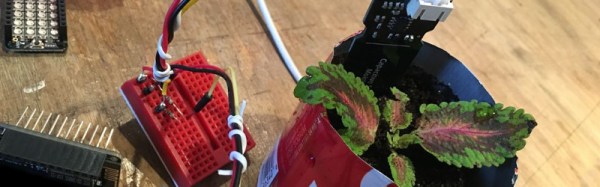
No matter, you might be thinking, we can bring technology to bear on the problem, and automate it with a microcontroller! [Bonnie] has done just that, with a capacitive soil sensor feeding an ESP8266-based Adafruit Feather HUZZAH, which in turn logs soil humidity data with the Adafruit IO online service. An IFTTT applet monitors the data, and triggers a notification when moisture falls to the point at which watering is required.

The Instructables write-up gives a comprehensive step-by-step guide to the whole process, including the code, so it’s a project that almost anyone could try as well as a basic introduction to using an online service with a piece of hardware. We can’t help asking, though, whether it might have been better to have had the system do the watering rather than merely administer a prod to its fleshy horticulturist creator. Perhaps that’s left to anyone else building one to add as an enhancement.

Quite a few plant watering automation projects have found their way onto these pages over the years, from this one using car parts to a system with an impressively simple valve made by compressing a flexible pipe. The ultimate watering device though has to be this fully autonomous greenhouse robot.

“Alexa, Order Everyone In San Diego A Doll House”

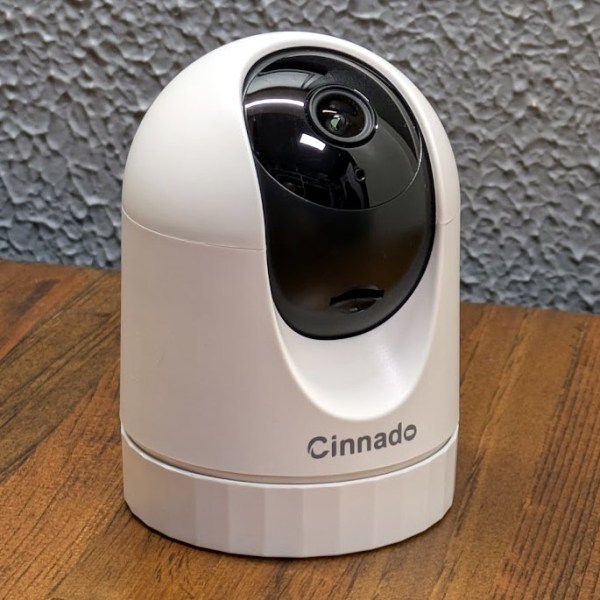
Every day it seems there is a new Alexa story in the news, as for the moment the Amazon voice assistant is in the ascendant over its rivals from Google, Apple, and Microsoft. Today’s slice of Alexa weirdness comes courtesy of a newsreader in San Diego, who inadvertently triggered Alexa-enabled devices within hearing distance of a television to buy doll houses when he reported on a Dallas child’s accidental purchase.

It’s unclear whether any doll houses were dispatched or whether the Echos and Dots merely started the process and asked their owners for confirmation, but we hope it serves to draw attention to the risks associated with an always-on and always-listening device. We’ve looked at how the technology has seemingly circumvented the normal privacy concerns of our own community, so it’s hardly surprising that this kind of incident catches the greater public completely unprepared. It’s one thing for the denizens of a hackspace to troll the owner of a Dot by adding embarrassing products to their wish list, but against a less-informed user who hasn’t worked out how to lock down the device’s purchasing abilities, it’s not too far-fetched to imagine a criminal attack.

Voice assistants are clearly going to become a ubiquitous feature of our lives, and it is inevitable that there will be more such unfortunate incidents which will serve to educate the public about their privacy before the technology reaches maturity. This particular story is definitely Not A Hack, though as our “Alexa” tag shows the devices have huge potential to bring a new dimension to our work. It’s up to all of us in our community to ensure that the voice assistant owners in our lives are adequately educated about them, and maybe resist the urge to say “Alexa, add all the Hackaday merchandise to my wish list!”.

Whole House HiFi Tamed Without Fuss

One of the problems that has accompanied the advent of ever more complex home entertainment systems is the complexity of the burgeoning stack of remote controls that manifest themselves alongside your system. It doesn’t matter if you have a fancy does-the-lot universal remote, you are still left with a slew of functions to perform before you can sit down to enjoy the music.

[Robert Cowan] had this problem with his whole-house audio system. Playing music required a fiddle with the remote, and the moment was gone. What was needed was an automatic system that simply issued the relevant commands to the stereo without all the fuss.

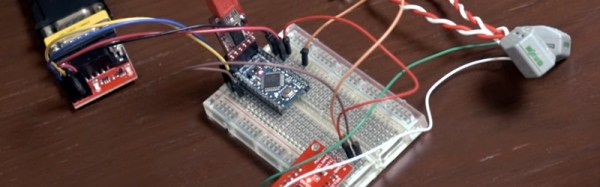
His solution was to have everything happen when an audio output was detected from his Sonos Connect streaming media player. He tried rectifying its line output to detect music but hit problems, so instead used a SparkFun audio detector module. This in turn speaks to an Arduino, which then talks via a level shifter to the stereo’s RS232 port. [Robert] included all the relevant parts, schematic, and software is links in the video description. It’s a project that should almost be a feature built into a decent stereo, yet the manufacturers prefer the awful interfaces of their remote controls.

Continue reading “Whole House HiFi Tamed Without Fuss”