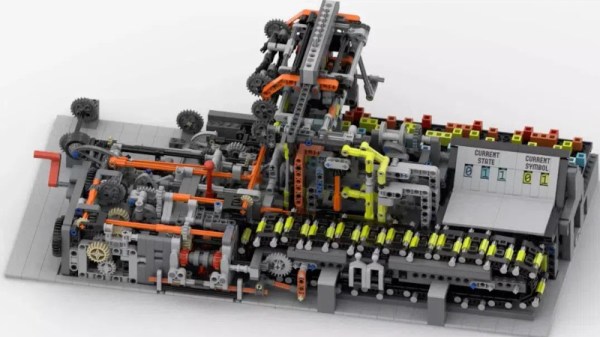
The British mathematician and pioneer of computing Alan Turing published a paper in 1936 which described a Universal Machine, a theoretical model of a computer processor that would later become known as a Turing Machine. Practical computers don’t quite follow the design of a Turing Machine, but if we are prepared to sacrifice its need for an infinitely long paper tape it’s quite possible to build one. This is what [The Bananaman] has done using LEGO as a medium, and if you’d like one for yourself you can even vote for it on the LEGO ideas website.
There’s a video for the project which we’ve placed below, and it goes into quite some detail on the various mechanisms required. Indeed for someone used to physical machinery it’s a better explanation through seeing the various parts than many paper explanations. Not for the first time we’re bowled over by what is possible through the use of the LEGO precision mouldings, this is a machine which would have been difficult and expensive to build in the 1930s by individually machining all its parts.
With just shy of six thousand supporters and a hefty 763 days left at time of writing, there’s plenty of time for it to garner support. But if you want one don’t delay, boost the project by voting for it early.



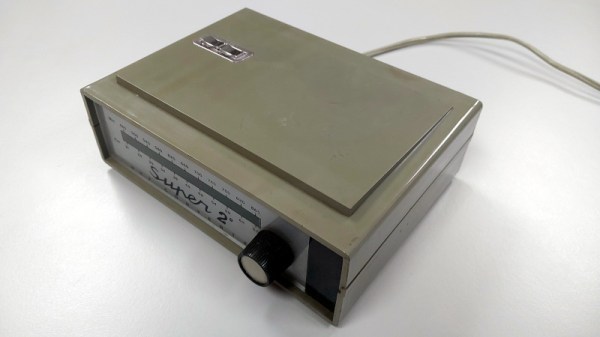
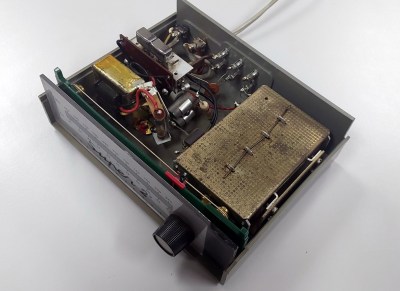 In a Dutch second-had store while on my hacker camp travels this summer, I noticed a small grey box. It was mine for the princely sum of five euros, because while I’d never seen one before I was able to guess exactly what it was. The “Super 2” weighing down my backpack was a UHF converter, a set-top box from before set-top boxes, and dating from the moment around five or six decades ago when that country expanded its TV broadcast network to include the UHF bands. If your TV was VHF it couldn’t receive the new channels, and this box was the answer to connecting your UHF antenna to that old TV.