The Roller Ship Was Not An Effective Way To Cross The High Seas

Boats come in all shapes and sizes. We have container ships, oil tankers, old-timey wooden sailing ships, catamarans, trimarans, and all sorts besides. Most are designed with features that give them a certain advantage or utility that justifies their construction for a given application.

The roller ship, on the other hand, has not justified its own repeat construction. Just one example was ever built, which proved unseaworthy and impractical. Let’s explore this nautical oddity and learn about why it didn’t make waves as its inventor may have hoped.

Continue reading “The Roller Ship Was Not An Effective Way To Cross The High Seas”

How Does Time Work On The Moon?

We’re looking to go back to the Moon. Not just with robots this time, but with astronauts, too! They’ll be doing all kinds of interesting things when they get there. Maybe they’ll even work towards establishing a more permanent presence for humanity on the lunar surface, in which case they’ll have to get up in the morning, eat breakfast, and get to work.

This raises the question—how does time work on the Moon? As simple as they can be down here, Earthly days and years have little meaning up there, after all. So what’s going on up there?

Continue reading “How Does Time Work On The Moon?”

This Air Particulate Sensor Can Also Check Your Pulse Rate

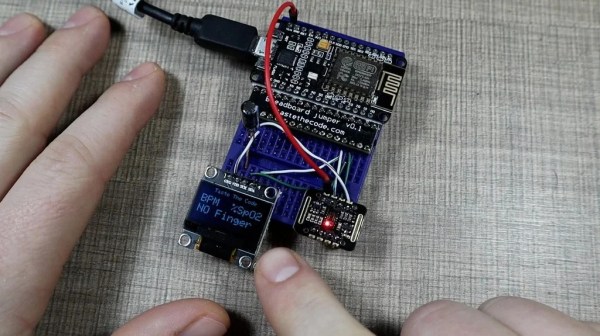
The MAX30105 is an optical sensor capable of a great many things. It can sense particulate matter in the air, or pick up the blinking of an eye. Or, you can use it as a rudimentary way to measure your heart rate and blood oxygen levels. It’s by no means a medical grade tool, but this build from [Taste The Code] is still quite impressive.

The MAX30105 contains red, green, and infrared LEDs, and a very sensitive light detector. The way it works is by turning on its different LEDs, and then carefully measuring what gets reflected back. In this way it can measure particles in the air,  such as smoke, which is actually what it was designed for originally. Or, if you press your finger up against it, it can measure the light coming back from your blood and determine its oxygenation level. By detecting the variation in the light over time, it’s possible to pick up your pulse, too.

Getting this data out of the sensor is remarkably easy. One need only hook it up to a suitable microcontroller like the ESP8266 and use the MAX3010X library to talk to it. [Taste The Code] did exactly that, and also hooked up a screen for displaying the captured data. Alternatively, if you want the raw data from the sensor, you can get that too.

It should be noted that this build was done for educational purposes only. You shouldn’t rely on a simple DIY device for gathering useful medical data; there are reasons the real gear is so expensive, after all. We’ve looked at this sensor before, too, not long after it first hit the market. Continue reading “This Air Particulate Sensor Can Also Check Your Pulse Rate”

AxxSolder 3.0 Now Takes USB Power Delivery

If you’re big into the soldering iron scene, you’ve probably heard of the AxxSolder project. Now, it’s been updated with a whole host of nifty new features. It’s AxxSolder 3.0!

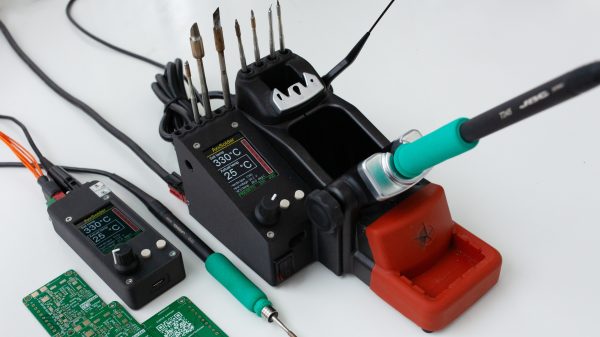
If you’re not intimately familiar with AxxSolder, it’s an open-source iron design based around the popular JBC soldering iron tips. Relying on the STM32G431CBT6 to run the show, it comes in two versions—a lightweight portable design, and a desktop version based around the JBC ADS soldering iron stand. So far, so familiar.

The new 3.0 version adds new functionality, however. Where the previous model ran off any old DC power source from 9 to 26 volts, the new version can run off a USB Power Delivery supply. Thus, you can grab any old USB-PD device, like a laptop charger, and run your iron off that.

The new version also uses a larger color TFT screen with some buttons added on as an improved user interface. Thermal performance is improved, and it’s additionally capable of measuring the current draw by the tip, so you can monitor the performance of the iron in great detail.

We’ve featured the AxxSolder project previously, too, along with some other great soldering iron projects. If you reckon you’ve just designed the hottest new soldering tool yourself, let us know about it!

Dodge, The Weird Tripod Robot

[hannu_hell] created Dodge as a “novel design of tripod.” It’s a small robotic device quite unlike anything else we’ve seen of late. It’s intended to be a self-mobile camera platform that can move itself around to capture footage as needed.

Dodge is essentially a two-legged robot with a large flat “foot” in the center. When stationary, it rests on this flat foot. When it needs to move, it can raise this center foot and rest on its two outside legs. If Dodge needs to move, it can crab back and forth in a line with these two legs. If it wants to turn, it can return to resting on its center foot, and pivot about its central axis. It can thus rotate itself and use its two outer legs to move further as needed.

Dodge does all this while carrying an ESP32 Cam module. The idea is that it’s a small mobile tripod platform with a live camera feed. It reminds us of various small monitoring robots from cartoons and anime.

Ultimately, it’s an interesting take on robot locomotion. Rather than walking with two legs or four legs and dynamic stability, it takes full advantage of static stability instead.

We’ve seen some wild roboticized camera rigs over the years. Video after the break.

Continue reading “Dodge, The Weird Tripod Robot”

Building A Tiny Organic Swimming Pool With Natural Filtering

When we think of swimming pools, we typically think of large fiberglass, plastic, or concrete constructions full of pristine, clear water. They’re usually maintained in this state with the regular addition of chlorine or other chemical. These kill biological stuff and help filter out dirt and other detritus. However,  [David] likes to do things differently, as he demonstrates with a tiny plunge pool built inside his greenhouse.

The basic construction starts with digging a hole and building up a wall with concrete and bricks. There’s nothing particularly controversial there. It’s roughly 2 meters by 3 meters by 0.8 meters deep. To help the pool maintain heat, there’s a layer of foam insulation in the bottom, while the water is held inside a black liner.

Rather than traditional chemical methods, however, [David] relies on organic methods to maintain the pool. He explains how he uses an aquarium pump to create a “bubble filtered” pool that draws water through a gravel bed to maintain it and keep it clear. It’s a very natural setup, with multiple plants in the water to make it as organic as can be. It’s the kind of thing you’d expect to see at a luxury island resort, but [David’s] got one right in his very own greenhouse.  [David] explains the organic filtering concept in greater detail on his website.

We’ve featured some pool hacks before, too, though more traditional ones than this. Video after the break.

Continue reading “Building A Tiny Organic Swimming Pool With Natural Filtering”

It’s Never Been Easier To Build A WiFi-Controlled RC Car

Today, wireless-enabled microcontrollers are everywhere and can be had for just a few bucks. You can use them to build all kinds of connected projects more cheaply than ever before. [ROBO HUB] demonstrates this well with an incredibly simple WiFi-controlled RC car build.

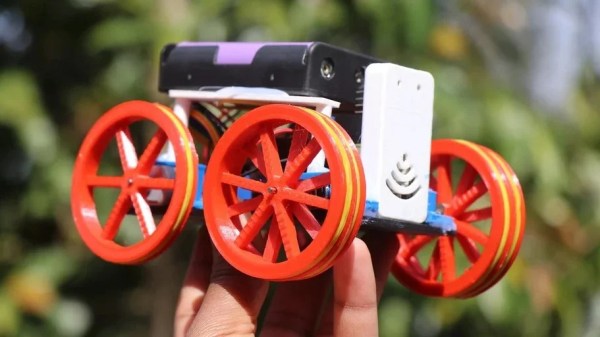
The build is based around an NodeMCU ESP8266 microcontroller, paired with an L293D motor driver. This lets the microcontroller drive brushed DC motors for differential drive. Power is courtesy of three 18650 lithium-ion batteries. These parts are assembled into a 3D-printed car of sorts with four wheels. The drivetrain is rather odd, with gear motors installed on the two front wheels, and simple brushed DC motors installed on the two rear wheels. The motors on each side are paired together so the vehicle has tank-style steering.

Meanwhile, the ESP8266 is programmed so it can be controlled via a smartphone app. The touchscreen controls are not as elegant as toy RC cars of years past, but it’s pretty good for a cheap DIY build.

It’s a fairly simple project and one that any high-school student could follow along to learn something. Projects like these can be a great way to learn about everything from mechanics to electronics and even basic programming. It may not be complicated, but that makes it a great learning tool. We see a ton of projects like this on the regular, and every time they’re built, somebody is picking up some new skills.

We’ve been talking about WiFi-controlled RC cars for a long time. Way back when it was nowhere near this easy. Video after the break. Continue reading “It’s Never Been Easier To Build A WiFi-Controlled RC Car”