Robot Balances Ball On A Plate

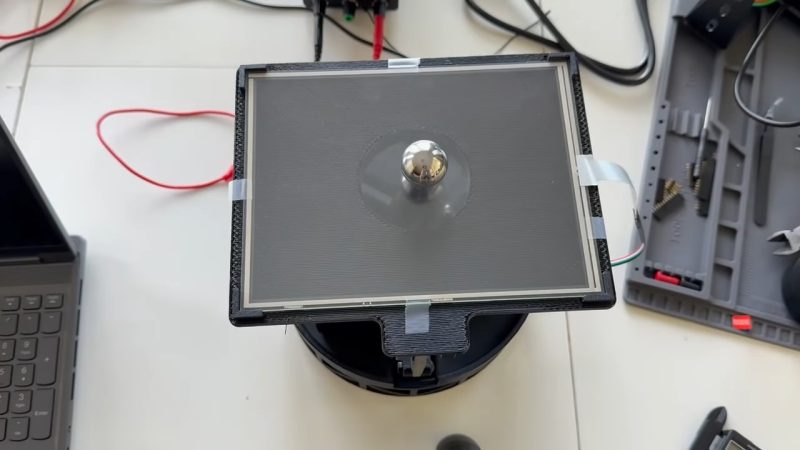
Imagine trying to balance a heavy metal ball bearing on a cafeteria tray. It’s not the easiest thing in the world! In fact, it’s perhaps a task better automated, as [skulkami3000] demonstrates with this robotic build.

The heart of the build is a flat platform fitted with a resistive touchscreen panel on top. The panel is hooked up to a Teensy 4.0 microcontroller. When a heavy ball bearing is placed on the touch panel, the Teensy is thus able to accurately read its position. It then controls a pair of NEMA 17 stepper motors via TCM2208 drivers in order to tilt the panel in two axes in order to keep the ball in the centre of the panel. Thanks to its quick reactions and accurate sensing, it does a fine job of keeping the ball centred, even when the system is perturbed.

Projects like these are a great way to learn the basics of PID control. Understanding these concepts will serve you well in all sorts of engineering contexts, from controlling industrial processes to building capable quadcopter aircraft. Continue reading “Robot Balances Ball On A Plate”

This Device Is A Real Page Turner

You can read e-books on just about anything—your tablet, your smartphone, or even your PC. However, the interface can be lacking somewhat compared to a traditional book—on a computer, you have to use the keyboard or mouse to flip the pages. Alternatively, you could do what [NovemberKou] did, and build a dedicated page-turning device.

The device was specifically designed for use with the Kindle for Mac or Kindle for PC reader apps, allowing the user to peruse their chosen literature without using the keyboard to change pages. It consists of a thumb wheel, rotary encoder, and an Arduino Pro Micro mounted in a 3D printed shell. The Pro Micro is set up to emulate a USB keyboard, sending “Page Up” or “Page Down” key presses as you turn the thum bwheel in either direction.

Is it a frivolous device with a very specific purpose? Yes, and that’s why we love it. There’s something charming about building a bespoke interface device just to increase your reading pleasure, and we wholeheartedly support it.

Continue reading “This Device Is A Real Page Turner”

IPhone Air Still Apparently Repairable Despite Its Compact Construction

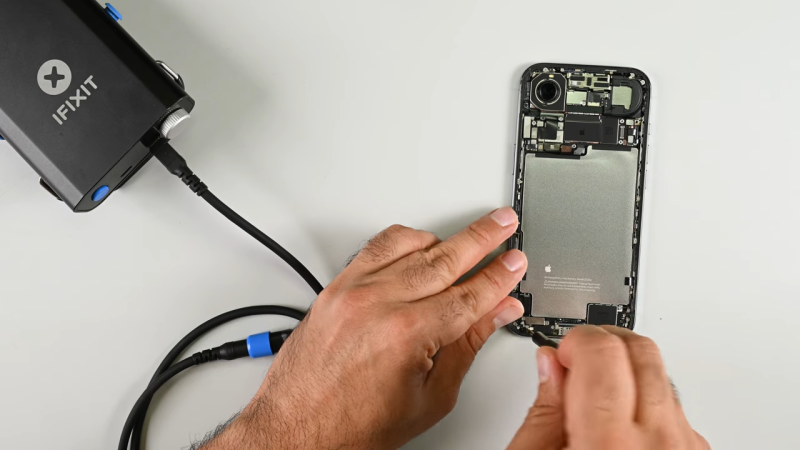
Miniaturization is a trend that comes and goes in the cellular phone space. For a while, our phones were all getting smaller, then they started getting bigger again as screens expanded to show us ever more content and advertising. The iPhone air is going back the other way, with a design that aims to sell based on its slimness. [iFixit] reckons that despite its diminutive dimensions, it should still be quite repairable.

“Thinner usually means flimsier, harder to fix, and more glued-down parts, but the iPhone Air proves otherwise,” states Elizabeth Chamberlain for the repair outlet. Much of this comes down to clever design, that makes repair possible at the same time as ensuring compactness. A big part of this is the way that Apple made the bottom half of the phone pretty much just battery. Most of the actual electronic components are on a logic board up by the camera. Segmenting the phone in this way makes it easier to access commonly-replaced parts like the battery without having to pull a lot of other parts out of the way first.

[iFixit] refers to this as flattening the “disassembly tree”—minimizing the number of components you have to touch to replace what you’re there to fix. In this regard, the thinness of the iPhone Air is actually a boon. The phone is so thin, it wasn’t possible to stack multiple components on top of each other, so everything is easier to get to. The design is also reasonably modular, which should make routine repairs like USB C port swaps relatively straightforward.

Whatever smartphone you’re working on, it often helps to have a disassembly guide to ensure you don’t wreck it when you’re trying to fix something. [iFixit] remains a stellar resource in that regard. Continue reading “IPhone Air Still Apparently Repairable Despite Its Compact Construction”

Death Of The Cheque: Australia Moves On

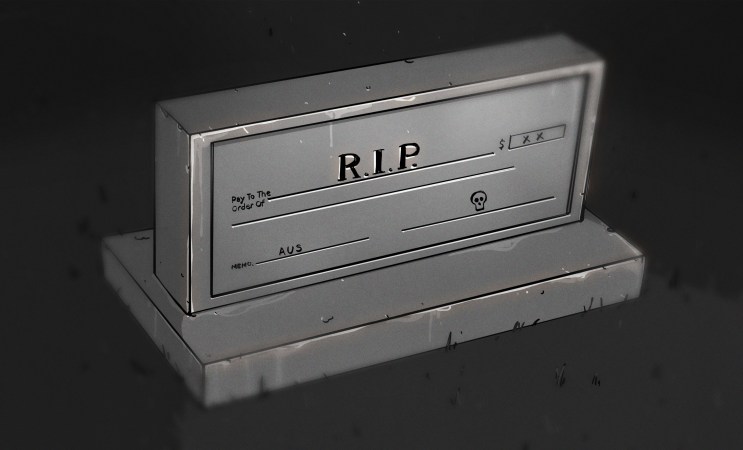
Check (or cheques) have long been a standard way for moving money from one bank account to another. They’re essentially little more than a codified document that puts the necessary information in a standard format to ease processing by all parties involved in a given transaction.

The check was once a routine, if tedious, way for the average person to pay for things like bills, rent, or even groceries. As their relevance continues to wane in the face of newer technology, though, the Australian government is making a plan to phase them out for good.

Continue reading “Death Of The Cheque: Australia Moves On”

Food Irradiation Is Not As Bad As It Sounds

Radiation is a bad thing that we don’t want to be exposed to, or so the conventional wisdom goes. We’re most familiar with it in the context of industrial risks and the stories of nuclear disasters that threaten entire cities and contaminate local food chains. It’s certainly not something you’d want anywhere near your dinner, right?

You might then be surprised to find that a great deal of research has been conducted into the process of food irradiation. It’s actually intended to ensure food is safer for human consumption, and has become widely used around the world.

Continue reading “Food Irradiation Is Not As Bad As It Sounds”

How Laser Headlights Died In The US

Automotive headlights started out burning acetylene, before regular electric lightbulbs made them obsolete. In due time, halogen bulbs took over, before the industry began to explore even newer technologies like HID lamps for greater brightness. Laser headlights stood as the next leap forward, promising greater visibility and better light distribution.

Only, the fairytale didn’t last. Just over a decade after laser headlights hit the market, they’re already being abandoned by the manufacturers that brought them to fruition. Laser headlights would end up fighting with one hand behind their back, and ultimately became irrelevant before they ever became the norm.

Continue reading “How Laser Headlights Died In The US”

2025 One Hertz Challenge: STM32 Blinks In Under 50 Bytes

Many of us have run a Blink program on a microcontroller before. It’s effectively the “Hello, World!” of the embedded space. However, few of us have ever thought about optimizing our Blink code to be as miniscule as possible. But that’s precisely what [Rudra Lad] did for this entry into the 2025 One Hertz Challenge!

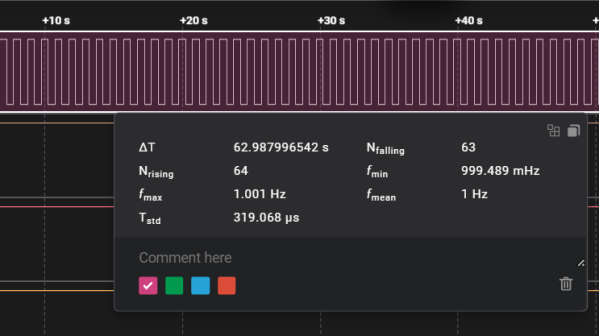
This example of Blink, delay_blinky_13, is built specifically for the STM32F4 Discovery microcontroller development board. [Rudra] notes the code is “highly optimized” and compiles down to a binary size of under 50 bytes. The code doesn’t even use RAM, and it aims to get the blink as close to 1 Hz as possible. Many optimizations were used to crunch it down as small as possible. For example, the standard startup code isn’t used, with the entire program instead written in the Reset_Handler to save space. Bit-band is also used to write to peripheral registers to blink the LED, since this uses less instructions than the typical methods. Meanwhile, with many tweaks to the delay counting routine, [Rudra] was eventually able to get the blink frequency to 1.00019 Hz, as measured on a logic analyzer. That’s pretty darn close!

While it’s rare that you have only 50 bytes of binary space to blink an LED, work like this is a great way to flex your coding muscles. Code is on Github for the curious, and if you’ve worked up your own impressive tiny binaries, don’t hesitate to let us know!