Looking At A Real Fake Raspberry Pi RP2040 Board

Since the RP2040 microcontroller is available as a stand-alone component, it’s easy enough for third parties to churn out their own variations — or outright clones of — the Raspberry Pi Pico. Thus we end up with for example AliExpress sellers offering their own versions that can be significantly cheaper than the genuine article. The ones that [electronupdate] obtained for a test and decapping session cost just $2.25 a pop.
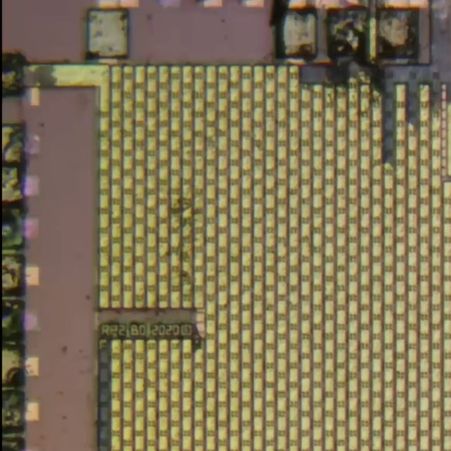
RP2 B0 stepping imprinted on the die shot.

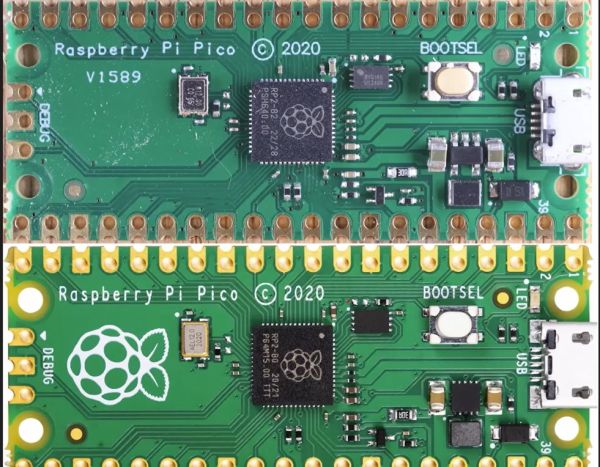
As can be seen in the top image, the board from AliExpress misses the Raspberry Pi logo on the silkscreen for obvious reasons, but otherwise appears to feature an identical component layout. The QSPI Flash IC is marked on the die as BY250156FS, identifying it as a Boya part.

Niggles about flash ROM quality aside, what’s perhaps most interesting about this teardown is what eagle-eyed commentators spotted on the die shot of the RP2040. Although on the MCU the laser markings identify the RP2040 as a B2 stepping, the die clearly identifies it as an ‘RP2 B0’ part, meaning B0 stepping. This can be problematic when you try to use the USB functionality due to hardware USB bugs in the B0 and B1 steppings.

As they say, caveat emptor.

Continue reading “Looking At A Real Fake Raspberry Pi RP2040 Board”
Making Code A Hundred Times Slower With False Sharing

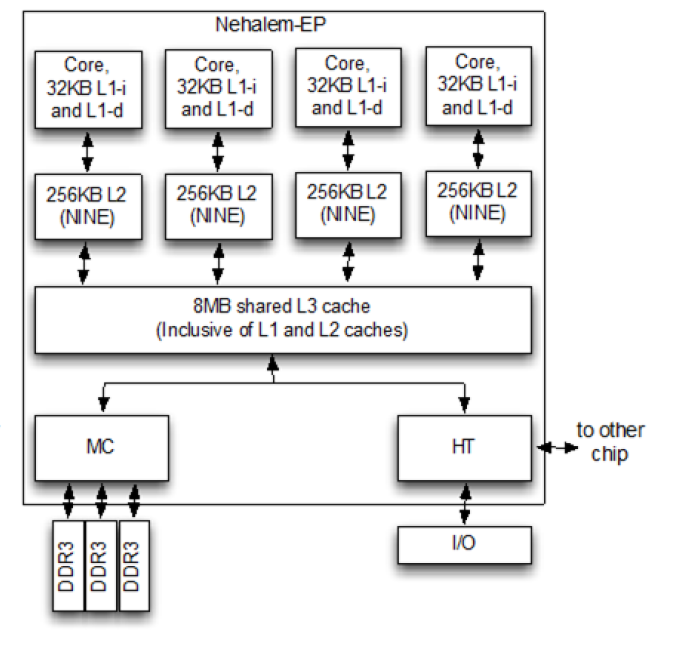
The cache hierarchy of the 2008 Intel Nehalem x86 architecture. (Source: Intel)

Writing good, performant code depends strongly on an understanding of the underlying hardware. This is especially the case in scenarios like those involving embarrassingly parallel processing, which at first glance ought to be a cakewalk. With multiple threads doing their own thing without having to nag the other threads about anything it seems highly doubtful that even a novice could screw this up. Yet as [Keifer] details in a recent video on so-called false sharing, this is actually very easy, for a variety of reasons.

With a multi-core and/or multi-processor system each core has its own local cache that contains a reflection of the current values in system RAM. If any core modifies its cached data, this automatically invalidates the other cache lines, resulting in a cache miss for those cores and forcing a refresh from system RAM. This is the case even if the accessed data isn’t one that another core was going to use, with an obvious impact on performance. As cache lines are a contiguous block of data with a size and source alignment of 64 bytes on x86, it’s easy enough to get some kind of overlap here.

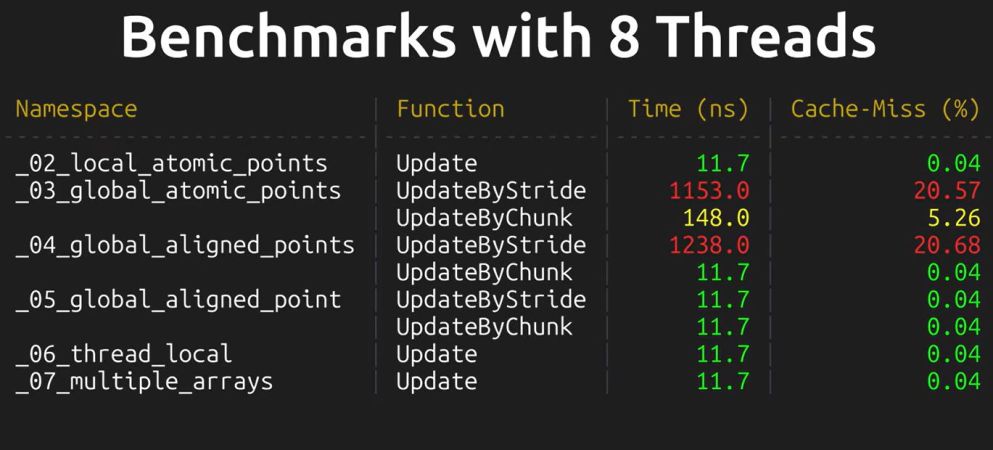
The worst case scenario as detailed and demonstrated using the Google Benchmark sample projects, involves a shared global data structure, with a recorded hundred times reduction in performance. Also noticeable is the impact on scaling performance, with the cache misses becoming more severe with more threads running.

A less obvious cause of performance loss here is due to memory alignment and how data fits in the cache lines. Making sure that your data is aligned in e.g. data structures can prevent more unwanted cache invalidation events. With most applications being multi-threaded these days, it’s a good thing to not only know how to diagnose false sharing issues, but also how to prevent them.

Continue reading “Making Code A Hundred Times Slower With False Sharing”

Pushing China’s EAST Tokamak Past The Greenwald Density Limit

Getting a significant energy return from tokamak-based nuclear fusion reactors depends for a large part on plasma density, but increasing said density is tricky, as beyond a certain point the plasma transitions back from the much more stable high-confinement mode (H-mode) into L-mode. Recently Chinese researchers have reported that they managed to increase the plasma density in the EAST tokamak beyond the previously known upper Greenwald Density Limit (GDL), as this phenomenon is known.

We covered these details with nuclear fusion reactors in great detail last year, noting the importance of plasma edge stability, as this causes tokamak wall erosion as well as loss of energy. The EAST tokamak (HT-7U) is a superconducting tokamak that was upgraded and resumed operations in 2014, featuring a 1.85 meter major radius and 7.5 MW heating power. As a tokamak the issue of plasma and edge stability are major concerns, even in H-mode, requiring constant intervention.

Continue reading “Pushing China’s EAST Tokamak Past The Greenwald Density Limit”

When Electricity Doesn’t Take The Shortest Path

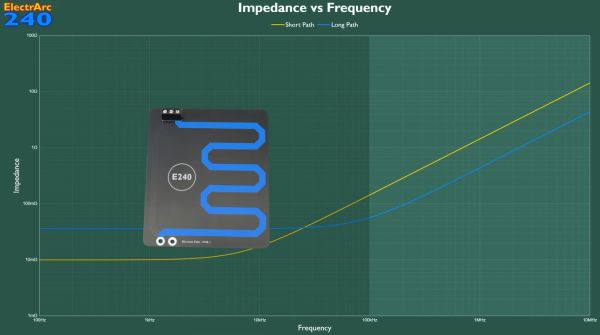
Everyone knows that the path of least resistance is the path that will always be taken, be it by water, electricity or the feet of humans. This is where the PCB presented by [ElectrArc240] on YouTube is rather confusing, as it demonstrates two similarly sized traces, one of which is much shorter than the other, yet the current opts to travel via the much longer trace. If you were to measure this PCB between each path, the shorter path has the lowest resistance at 0.44 Ω while the longer path is 1.44 Ω. Did the laws of physics break down here?

Of course, this is just a trick question, as the effective resistance for an electrical circuit isn’t just about ohmic resistance. Instead the relevant phrasing here is ‘path of least impedance‘, which is excellently demonstrated here using this PCB. Note that its return path sneaks on the back side along the same path as the long path on the front. To this is added a 1 MHz high current source that demonstrates the impact of alternating current, with reactance combining with the resistance.

Although for direct current it’s fair to say that impedance is the equivalent of resistance, once the inductance of a trace has to be taken into account – as in the case of AC and high-frequency signaling – the much higher inductance of the short path means that now the long path is actually the shortest.

When you are doing some impedance matching in your favorite EDA software while implementing an Ethernet RMII link or similar, this is basically part of the process, with higher frequencies requiring ever more stringent mechanisms to keep both sides happy. At some point any stray signals from nearby traces and components become a factor, never mind the properties of the PCB material.

Continue reading “When Electricity Doesn’t Take The Shortest Path”

Hacking The Krups Cook4Me Smart Cooking Pot For Doom

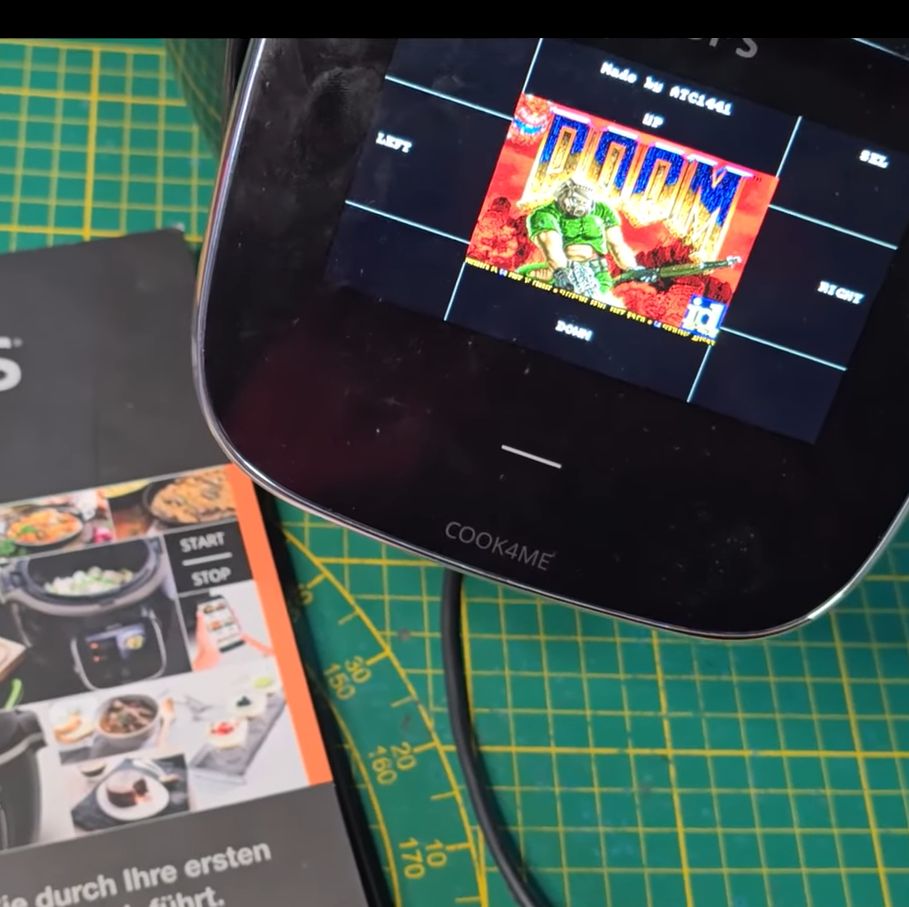
With more and more kitchen utilities gaining touch screens and capable microcontrollers it’d be inconceivable that they do not get put to other uses as well. To this end [Aaron Christophel] is back with another briefly Doom-less device in the form of the Krups Cook4Me pressure cooking pot with its rather sizeable touch screen and proclaimed smarts in addition to WiFi and an associated smartphone app.

Inside is an ESP32 module for the WiFi side, with the brains of the whole operation being a Renesas R7S721031VC SoC with a single 400 MHz Cortex-A9. This is backed by 128 MB of Flash and 128 MB of RAM. The lower touch interface is handled by a separate Microchip PIC MCU to apparently enable for low standby power usage until woken up by touch.

The developers were nice enough to make it easy to dump the firmware on the SoC via SWD, allowing for convenient reverse-engineering and porting of Doom. With the touch screen used as the human input device it was actually quite playable, and considering the fairly beefy SoC, Doom runs like a dream. Sadly, due to the rarity of this device, [Aaron] is not releasing project files for it.

As for why a simple cooking pot needs all of this hardware, the answer is probably along the lines of ‘because we can’.

Continue reading “Hacking The Krups Cook4Me Smart Cooking Pot For Doom

Fixing A KS Jive DAB Radio With A Dash Of Fake ICs

The radio unit after a successful repair. (Credit: Buy it Fix it, YouTube)

The exciting part about repairing consumer electronics is that you are never quite sure what you are going to find. In a recent video by [Mick] of Buy it Fix it on YouTube the subject is a KS Jive radio that throws a few curve balls along the way. After initially seeing the unit not power on with either batteries or external power, opening it up revealed a few loose wires that gave the false hope that it would be an easy fix.

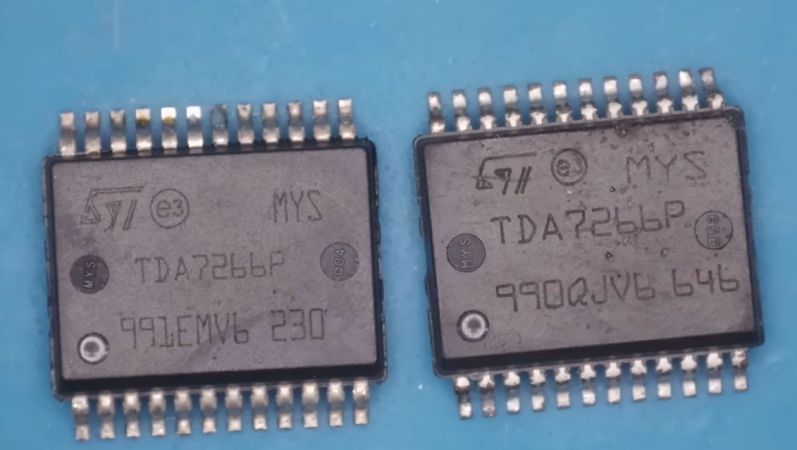
As is typical, the cause of the unit failing appears to have been a power surge that burned out a trace and obliterated the 3.3V LDO and ST TDA7266P amplifier. While the trace was easily fixed, and AMS1117 LDOs are cheap and plentiful, the amplifier chip turned out to be the real challenge on account of being an EOL chip.

The typical response here is to waddle over to purveyors of scrap hardware, like AliExpress sellers. Here [Mick] bought a ‘new’ TDA7266P, but upon receiving his order, he got suspicious after comparing it with the busted original. As can be seen in the top image, the markings, logo and even typeface are wildly different. Thus [Mick] did what any reasonable person does and x-rayed both chips to compare their internals.

Continue reading “Fixing A KS Jive DAB Radio With A Dash Of Fake ICs”

The Distroless Linux Future May Be Coming

Over the decades the number of Linux distributions has effectively exploded, from a handful in the late ’90s to quite literally hundreds today, not counting minor variations. There lately seems to be a counter-movement brewing in response to this fragmentation, with Project Bluefin’s Distroless project being the latest addition here. Also notable are KDE’s efforts, with KDE Linux as its own top-down KDE-based distro, but now with a switch to BuildStream from Arch likely as a distroless move.

It should be clear that there is no obvious course here yet, and that opinions are very much divided. The idea of ‘Linux’ becoming a more singular OS appeals to some, while to others it’s the antithesis of what ‘Linux’ is about. This much becomes clear in [Brodie Robertson]’s exploration of this topic as well.

The way to think about ‘distroless’ is that there is a common base using the Freedesktop SDK on which the customization layer is applied, such as Bluefin, KDE or Gnome’s environments. You could think of this base as the common runtime, using the Freedesktop standards for interoperability for a user-selected layer that’s installed on top. This way the idea of basing a distro on a specific distro is tossed out in favor of something that’s vaguely reminiscent of the Linux Standard Base attempt at standardization.

Continue reading “The Distroless Linux Future May Be Coming”