Intranasal Vaccines: A Potential Off-Ramp For Coronavirus Pandemics

An interesting and also annoying aspect about the human immune system is that it is not a neat, centralized system where you input an antigen pattern in one spot and suddenly every T and B lymphocyte in the body knows how to target an intruder. Generally, immunity stays confined to specific areas, such as the vascular and lymph system, as well as the intestinal and mucosal (nasal) parts of the body.

The result of this is that specific types of vaccines have a different effect, as is demonstrated quite succinctly with the polio vaccines. The main difference between the oral polio vaccine (OPV) and inactivated vaccine (injected polio vaccine, or IPV) is that the former uses a weakened virus that induces strong immunity in the intestines, something that the latter does not. The effect of this is that while both protect the individual, it does not affect the fecal-oral infection route of the polio virus and thus the community spread.

The best outcome for a vaccine is when it both protects the individual, while also preventing further infections as part of so-called sterilizing immunity. This latter property is what makes the OPV vaccine so attractive, as it prevents community spread, while IPV is sufficient later on, as part of routine vaccinations. The decision to use a vaccine like the OPV versus the IPV is one of the ways doctors can tune a population’s protection against a disease.

This is where the current batch of commonly used SARS-CoV-2 vaccines are showing a major issue, as they do not provide significant immunity in the nasal passage’s mucosal tissues, even though this is where the virus initially infects a host, as well as where it replicates and infects others from. Here intranasal vaccines may achieve what OPV did for polio.

Continue reading “Intranasal Vaccines: A Potential Off-Ramp For Coronavirus Pandemics”

Sappers clearing the last mines from the beach front of a former French luxury hotel, now in use as a rest club for troops of 3rd Division, 15 July 1944.

The Long Tail Of War: Finding Unexploded Ordnance Before It Finds Us

Long after the enemy forces have laid down their arms, peace accords have been signed and victories celebrated, there is still a heavy toll to be paid. Most of this comes in the form of unexploded ordnance, including landmines and the severe pollution from heavy metals and other contaminants that can make large areas risky to lethal to enter. Perhaps the most extreme example of this lasting effect is the Zone Rouge (Red Zone) in France, which immediately after the First World War came to a close comprised 1,200 square kilometers.

Within this zone, contamination with heavy metals is so heavy that some areas do not support life, while unexploded shells – some containing lethal gases – and other unexploded ordnance is found throughout the soil. To this day much of the original area remains off-limits, though injuries from old, but still very potent ordnance are common around its borders. Clean-up of the Zone Rouge is expected to take hundreds of years. Sadly, this a pattern that is repeated throughout much of the world. While European nations stumble over ordnance from its two world wars, nations in Africa, Asia and elsewhere struggle with the legacy from much more recent conflicts.

Currently, in Europe’s most recent battlefield, more mines are being laid, booby traps set and unexploded shells and other ordnance scattered where people used to live. Clearing these areas, to make them safe for a return of their inhabitants has already begun in Ukraine, but just like elsewhere in the world, it is an arduous and highly dangerous process with all too often lethal outcomes.

Continue reading “The Long Tail Of War: Finding Unexploded Ordnance Before It Finds Us”

Water drop on rose leaf.

Groundwater: Management Of A Much Neglected Lifeline

It seems obvious that if you dig or drill into the soil, at some point you will hit groundwater. Drill deep enough and you will reach an aquifer containing enormous amounts of fresh water. After this you can just pump water out of these wells and you will have fresh water aplenty. Or so was the thinking among many for the longest time. As enormous the fresh water reserves in the form of groundwater are – with most liquid fresh water being groundwater – we can literally empty them faster than that they’ll refill.

As the Dust Bowl disaster painfully showed in the 1930s and drought along with surface subsidence issues as in e.g. California’s Central Valley shows today is that we cannot simply use the soil and groundwater and expect no consequences. While the 19th century saw many fresh settlers to the West’s arid and semi-arid regions like California believe in the ‘Rain follows the plow‘ mysticism, the 20th century and these first few decades of the 21st century taught us that tilling the soil and drawing groundwater for irrigation does not change an arid climate into a lush one.

Perhaps ironically, even with increasing droughts, most human settlements use stormwater drainage and combined sewage systems to carry rainwater away, rather than letting the groundwater recharge naturally. Fortunately, more and more regions these days are seeing the necessity of managing groundwater.

Continue reading “Groundwater: Management Of A Much Neglected Lifeline”

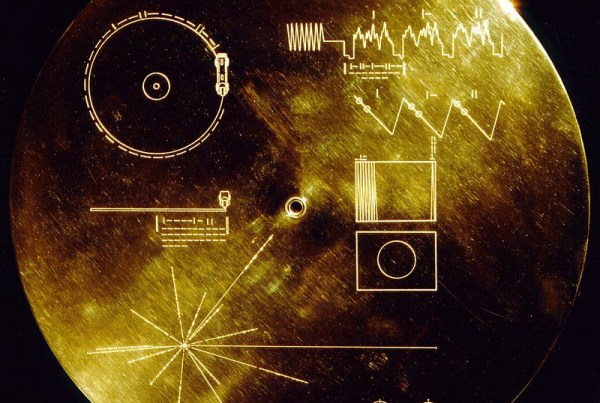
Frank Drake’s Legacy, Or: Are We All Alone In The Universe?

When Frank Drake began his astronomy career in the late 1950s, this was an incredibly exciting time for the field. Humanity was beginning to unlock the secrets of the Universe using ever more powerful radio frequency and optical telescopes, including the tantalizing prospect of space-based telescopes. Amidst the ramping up Space Race between the US and USSR, there was an ever-growing excitement about humankind’s future among the stars.

As concrete plans for landings and colonies on the Moon, Venus and Mars were proposed and put into action, it also brought to the forefront many existing and new questions about humanity’s place in the Universe. During Frank Drake’s 92 years on planet Earth – until his passing on September 2nd of this year – he was one of the driving forces behind the search for extraterrestrial intelligence (SETI), along with other legends like Carl Sagan.

Although to the average person the acronym SETI is most likely to bring to mind popcorn movies about little grey – or green – men, Drake’s Project Ozma, as well as the SETI Institution and the ongoing Breakthrough Listen project are just some of the attempts made by Drake and his colleagues over the decades to answer that one question that may affect the very course of humankind’s future: are we alone in the Universe?

Continue reading “Frank Drake’s Legacy, Or: Are We All Alone In The Universe?”

Don’t Be Salty: How To Make Desalination Work In Tomorrow’s World

Although water is often scarce for human consumption and agriculture, this planet is three-quarters covered by the stuff. The problem is getting the salt out, and this is normally done by the Earth’s water cycle, which produces rain and similar phenomena that replenish the amount of fresh water. Roughly 3% of the water on Earth is fresh water, of which a fraction is potable water.

Over the past decades, the use of desalination has increased year over year, particularly in nations like Saudi Arabia, Israel and the United Arab Emirates, but parched United States states such as California are increasingly looking into desalination technologies. The obvious obstacles that desalination faces – regardless of the exact technology used – involve the energy required to run these systems, and the final cost of the produced potable water relative to importing it from elsewhere.

Other issues that crop up with desalination include the environmental impact, especially from the brine waste and conceivably marine life sucked into the intake pipes. As the need for desalination increases, what are the available options to reduce the power needs and environmental impact?

Continue reading “Don’t Be Salty: How To Make Desalination Work In Tomorrow’s World”

The Akademik Lomonosov floating nuclear power plant, moored at Pevek, Russia. It provides power and heat to the isolated community.

Cogeneration And District Heating For Comfortable Homes And Happy Factories

Most of modern society’s energy usage is spent on heating in some form, whether it is to heat water, raise the temperature in a room, or for use in industrial processes. This makes it an excellent target for improvements in efficiency and resilience, as well as in the effort to decarbonize the world’s energy production. Here district heating and similar solutions are likely to play a major role in the near future.

Over the past decades, a number of nations have either already built out extensive district heating grids, or are in the process of doing so. The main advantage of these heating grids is that they not only allow for more efficient, centralized generating of heat, but also allow for e.g. industrial waste heat to be used productively rather than wasted, even if most of the heat will come from either dedicated or cogeneration thermal plants.

Recently, district heating has received a big push in e.g. China in the form of nuclear cogeneration, while the potential of using thermal storage to buffer heat for later use along with the concept of tying data centers into heating grids are also being explored. Although district heating is hardly new, it may help to ease humanity into a low-carbon future, without losing a bit of comfort.

Continue reading “Cogeneration And District Heating For Comfortable Homes And Happy Factories”

MH-Z19-like NDIR CO2 Sensor HC8 Found And Explored

While on the search for an alternative to directly buying the fairly expensive MH-Z19 CO2 sensor, [spezifisch] came across a ‘BreeRainz’ branded gadget (also found under other brands) that claimed to use an NDIR (Non-Dispersive Infrared) sensor for measuring CO2 levels, while costing only €25. This type of sensor allows for CO2 levels to be measured directly, rather than inferred, making them significantly more precise.

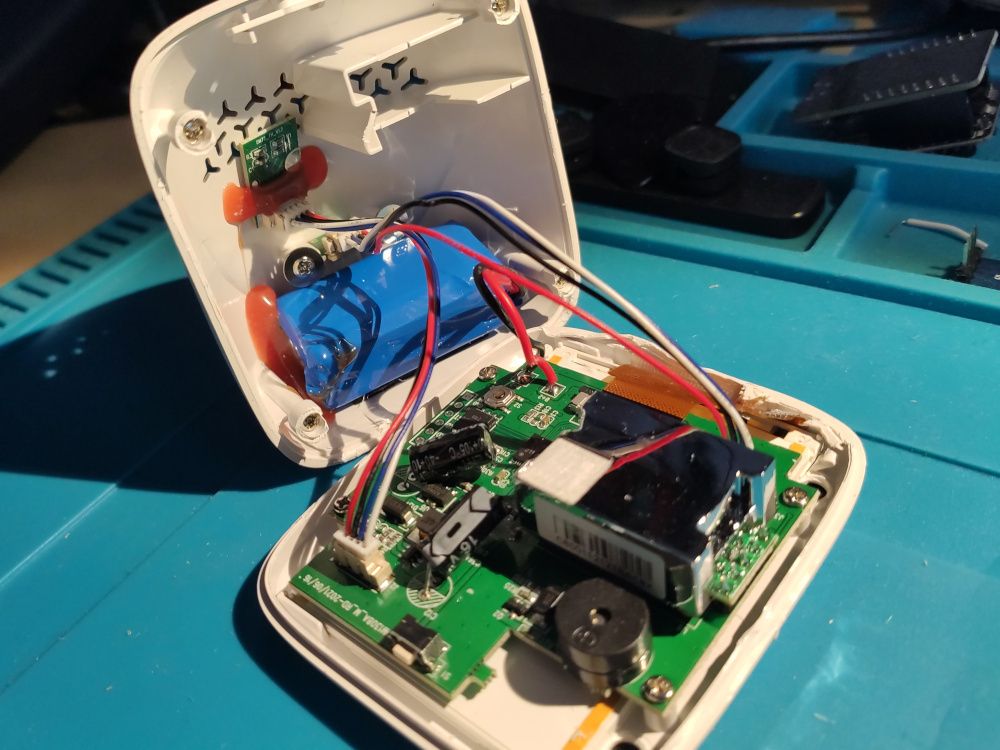
The BreeRainz DM1308A device cracked open.

After cracking the gadget open (literally, due to the hidden screws), the CO2 sensor is clearly visible. While superficially identical to an MH-Z19, the NDIR sensor is actually called ‘HC8’, is produced by 广州海谷电子科技有限公司 (Guangzhou Haigu Electronic Technology Co., Ltd.). While being pin-compatible with the MH-Z19, its UART protocol is not the same. Fortunately there is a datasheet to help with implementing it, which is what [spezifisch] did.

This raises the question of whether harvesting NDIR CO2 sensors like this is worth it to save a few Euros. A quick look on German Amazon shows that the device in question currently costs €35, while a genuine MH-Z19 can be bought for €25 or less. There are also many MH-Z19 models (B, C and D), which cover an even wider price range. All of which points to finding an NDIR sensor-containing device can be interesting when it’s on sale, but if all you care about is the sensor itself, it’s probably best to just buy them directly.