On Getting A Computer’s Attention And Striking Up A Conversation

With the rise in voice-driven virtual assistants over the years, the sight of people talking to various electrical devices in public and in private has become rather commonplace. While such voice-driven interfaces are decidedly useful for a range of situations, they also come with complications. One of these are the trigger phrases or wake words that voice assistants listen to when in standby. Much like in Star Trek, where uttering ‘Computer’ would get the computer’s attention, so do we have our ‘Siri’, ‘Cortana’ and a range of custom trigger phrases that enable the voice interface.

Unlike in Star Trek, however, our virtual assistants do not know when we really desire to interact. Unable to distinguish context, they’ll happily respond to someone on TV mentioning their trigger phrase. This possibly followed by a ludicrous purchase order or other mischief. The realization here is the complexity of voice-based interfaces, while still lacking any sense of self-awareness or intelligence.

Another issue is that the process of voice recognition itself is very resource-intensive, which limits the amount of processing that can be performed on the local device. This usually leads to the voice assistants like Siri, Alexa, Cortana and others processing recorded voices in a data center, with obvious privacy implications.

Continue reading “On Getting A Computer’s Attention And Striking Up A Conversation”
PCB antenna rendered useless by overly enthusiastic copper fill.

The Many Ways You Can Easily Ruin Your PCB Antenna Design

PCB antenna impaired by copper fill and other attenuation sources.

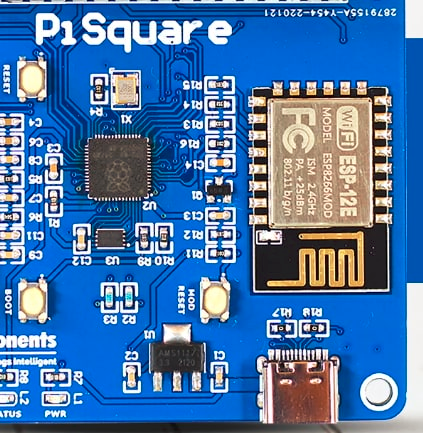
We have all seen Printed Circuit Board (PCB) antennas: those squiggly bits of traces on PCBs connected often to a Bluetooth, WiFi or other wireless communication chip. On modules like for the ESP8266 and ESP32 platforms the PCB antennas are often integrated onto the module’s PCB, yet even with such a ready-made module it’s possible to completely destroy the effectiveness of this antenna. These and other design issues are discussed in this article by [MisterHW].

It covers a range of examples of poor design, from having ground fill underneath an antenna, to having metal near the antenna, to putting dielectric materials near or on top of the antenna. The effect of all of these issues is generally to attenuate the signal, sometimes to the point where the antenna is essentially useless.

Ultimately, the best PCB antenna design is one where there is no nearby copper fill, and there are no traces running near or on layers below the antenna. After all, any metal trace or component is an antenna, and any dielectric materials will dampen the signal. Fortunately, there is e.g. a free KiCad library with ready-to-use PCB antenna designs to help one get started with a custom design, as well as many other resources, covered in the article.

If you want to get really professional about checking the effectiveness of an antenna design, you’ll want to use a Network Vector Analyzer. These will also help you with tuning the capacitors used with the PCB antenna.

(Featured image: PCB antenna rendered useless by overly enthusiastic copper fill.)

DeltaPen: Drawing, Painting And Taking Notes Without The Drawing Tablet

Over the decades, a lot of attempts have been made to try and make pens and pencils “smart”. Whether it’s to enable a pen to also digitally record what we’re writing down on paper, to create fully digital drawings with the haptics of inks and paints, or to jot down some notes on a touch screen, past and present uses are legion.

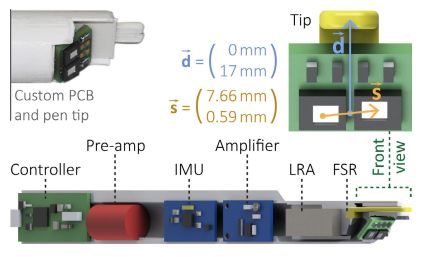
DeltaPen internal components and their function. (Credit: SIP, Guy Luethy et al.)

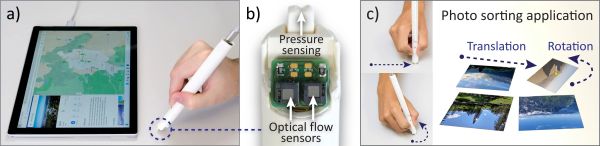
Where SIP Lab’s DeltaPen comes in as an attempt at a smart pen that acts more like the pen of a drawing tablet, just minus the tablet.

This project is related to the decidedly more clumsy Flashpen which we featured previously. Due to the use of new flow sensors, the underlying surface (e.g. a desk) can be tracked without needing to be level with it, which allowed for the addition of a pressure-sensitive tip.

In addition the relative motion of the pen is measured, and there is haptic feedback, which allow for it to be used even for more delicate applications such as drawing. The results of trials with volunteers across a range of tasks is described in their presented paper (PDF).

Continue reading “DeltaPen: Drawing, Painting And Taking Notes Without The Drawing Tablet”

Bare-Metal STM32: Setting Up And Using SPI

The Serial Peripheral Interface (SPI) interface was initially standardized by Motorola in 1979 for short-distance communication in embedded systems. In its most common four-wire configuration, full-duplex data transfer is possible on the two data (MOSI, MISO) lines with data rates well exceeding 10 Mb/s. This makes SPI suitable for high-bandwidth, full-duplex applications like SD storage cards and large resolution, high-refresh displays.

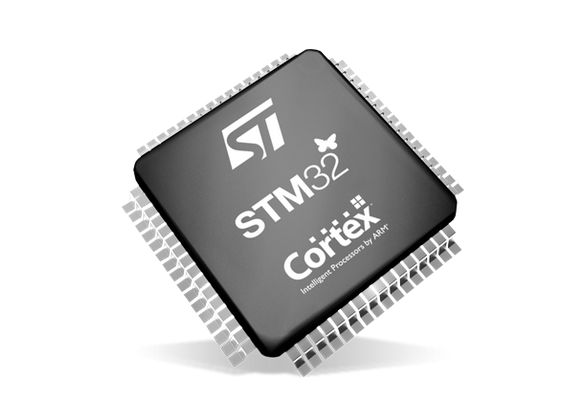
STM32 devices come with a variable number of SPI peripherals, two in the F042 at 18 Mb/s and five in the F411. Across the STM32 families, the SPI peripheral is relatively similar, with fairly minor differences in the register layout. In this article we’ll look at configuring an SPI peripheral in master mode.

Continue reading “Bare-Metal STM32: Setting Up And Using SPI”

Hacking Developers With A Cat Feeder: Who’s A Good Kitty?

Most of us probably know the drudgery of getting through some coding work, with just tedious hours of monkeying around stretching ahead of us. What if this tedium were to be interrupted by an occasional reward when we did something productive, like pushing a commit or other measure of progress? That’s roughly the concept that [John Partee] started off with when his gaze fell upon one of those automated cat feeders. Cat or developer, who doesn’t like to hear the tinkle of a tasty treat falling into their bowl?

The target pet feeder is a PetKit Fresh Element Solo, which allows for objects with a size of 12×12 mm (any orientation) to be fed through the feeding mechanism. Fortunately [John]’s favorite dark chocolate-covered almonds treat fit these requirements, and he set to work to figure out the REST API call needed to trigger a manual feeding event on the cat feeder device, employing the existing PyPetKit Python library that does the heavy lifting of connecting to and communicating with PetKit’s servers, as the feeder is of course an IoT device.

This means that the event flow still depends on PetKit’s “cloud”, which may inspire some enterprising hackers to make a stand-alone version, the development of which may be assisted by [John]’s solution through a regular treat. Before taking such a solution into use, be sure to discuss it with any pets you have, as they may not quite comprehend why there’s no reward for them whenever the *tinkle* sound occurs.

Continue reading “Hacking Developers With A Cat Feeder: Who’s A Good Kitty?”

Leading Edge Erosion: When Precipitation Destroys Wind Turbine Blades

Erosion is all around us, from the meandering course of rivers and other waterways, to the gradual carving out of channels in even the toughest mountains, and the softening of features in statues. Yet generally we expect erosion from precipitation to be gradual and gentle, taking decades to make a noticeable difference. This of course takes into account gentle flows and the soft pitter-patter of rain on stone, not turbine blades passing through the air at many times the terminal velocity of rain drops of up to 9 m/s.

As wind turbines have increased in size and diameter of their blades, this has noticeably increased the speed of especially the blade tips. With more and more wind turbine blade tips now exceeding speeds of 100 m/s, this has also meant a significant increase in the impact of rain drops, hail and other particulates on the lifespan of these turbine blades. As comparison, 100 m/s is 360 km/h (224 mph), which is only slightly slower than the top speed of a Formula 1 car.

The effect of turbine blade leading edge erosion (LEE) not only decreases aerodynamic efficiency, but also invites premature failure. Over the past years, special coatings and leading edge tapes have been developed that act as sacrificial surfaces, but as wind turbines only keep getting larger, so does the effect of LEE. Beyond simply replacing LE tape every year on every turbine, what other options are there?

Continue reading “Leading Edge Erosion: When Precipitation Destroys Wind Turbine Blades”

Intranasal Vaccines: A Potential Off-Ramp For Coronavirus Pandemics

An interesting and also annoying aspect about the human immune system is that it is not a neat, centralized system where you input an antigen pattern in one spot and suddenly every T and B lymphocyte in the body knows how to target an intruder. Generally, immunity stays confined to specific areas, such as the vascular and lymph system, as well as the intestinal and mucosal (nasal) parts of the body.

The result of this is that specific types of vaccines have a different effect, as is demonstrated quite succinctly with the polio vaccines. The main difference between the oral polio vaccine (OPV) and inactivated vaccine (injected polio vaccine, or IPV) is that the former uses a weakened virus that induces strong immunity in the intestines, something that the latter does not. The effect of this is that while both protect the individual, it does not affect the fecal-oral infection route of the polio virus and thus the community spread.

The best outcome for a vaccine is when it both protects the individual, while also preventing further infections as part of so-called sterilizing immunity. This latter property is what makes the OPV vaccine so attractive, as it prevents community spread, while IPV is sufficient later on, as part of routine vaccinations. The decision to use a vaccine like the OPV versus the IPV is one of the ways doctors can tune a population’s protection against a disease.

This is where the current batch of commonly used SARS-CoV-2 vaccines are showing a major issue, as they do not provide significant immunity in the nasal passage’s mucosal tissues, even though this is where the virus initially infects a host, as well as where it replicates and infects others from. Here intranasal vaccines may achieve what OPV did for polio.

Continue reading “Intranasal Vaccines: A Potential Off-Ramp For Coronavirus Pandemics”