Building A Hydraulic Lego Excavator Using Standard Pneumatic Cylinders

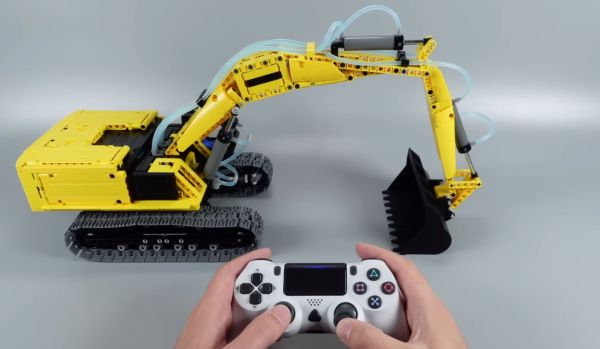
Everyone already knows that Lego Technic is pretty rad when it comes to existing, pre-made kits, but there’s also quite a bit of hacking potential left. One such area is the lack of hydraulics in Lego Technic, an egregious oversight that [Brick Technology] simply had to correct. His effort results in a partially hydraulic, fully remote-controlled excavator. Rather than a traditional gear hydraulic pump as you’d expect in a real-life excavator, a custom peristaltic pump is used to move the fluid to the hydraulic cylinders (rams for our British and Oceanic friends).

The undercarriage is (sadly) purely electrical, with a slip-ring providing power to the electric final drives in the tracks, enabling it to spin around endlessly without limitations. Where the hydraulics come into play is in the excavator’s arm, with two hydraulic lift cylinders on the boom, one cylinder to control the stick, and a final cylinder to control the bucket. Rather than a hydraulic switch, the setup is simplified by using a single peristaltic pump per cylinder circuit.

Remote control and power are provided using the rather chonky BuWizz 3.0 Pro, which offers a wireless control link (here controlled using BrickController 2 on Android). Although original Lego cylinders were used, these are only intended for pneumatics, where it’s hoped that the used mixture of water and windscreen wiper fluid will prevent corrosion.

(Thanks to [Keith Olson] for the tip)

Continue reading “Building A Hydraulic Lego Excavator Using Standard Pneumatic Cylinders” →
Giving Solar Power’s Mortal Enemies A Dusting Without Wasting Water

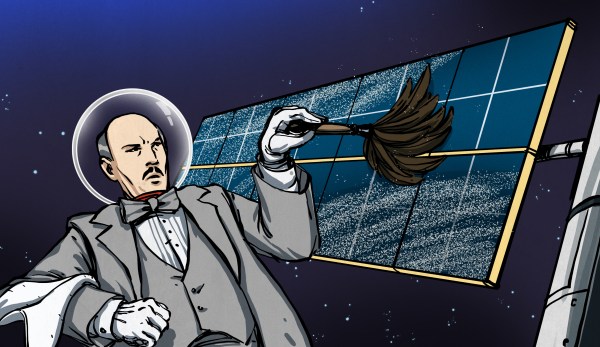
A prerequisite for photovoltaic (PV) and concentrated solar power (CSP) technologies to work efficiently is as direct an exposure to the electromagnetic radiation from the sun as possible. Since dust and similar particulates are excellent at blocking the parts of the EM spectrum that determine their efficiency, keeping the panels and mirrors free from the build-up of dust, lichen, bird droppings and other perks of planetary life is a daily task for solar farm operators. Generally cleaning the panels and mirrors involves having trucks drive around with a large water tank to pressure wash the dirt off, but the use of so much water is problematic in many regions.

Keeping PV panels clean is also a consideration on other planets than Earth. So far multiple Mars rovers and landers have found their demise at the hands of Martian dust after a layer covered their PV panels, and Moon dust (lunar regolith) is little better. Despite repeated suggestions by the peanut gallery to install wipers, blowers or similar dust removal techniques, keeping particulates from sticking to a surface is not as easy an engineering challenge as it may seem, even before considering details such as the scaling issues between a singular robot on Mars versus millions of panels and mirrors on Earth.

There has been research into the use of the electrostatic effect to repel dust, but is there a method that can keep both solar-powered robots on Mars and solar farms on Earth clean and sparkling, rather than soiled and dark?

Continue reading “Giving Solar Power’s Mortal Enemies A Dusting Without Wasting Water” →

Adding Power Over Ethernet Support To A Mac Mini

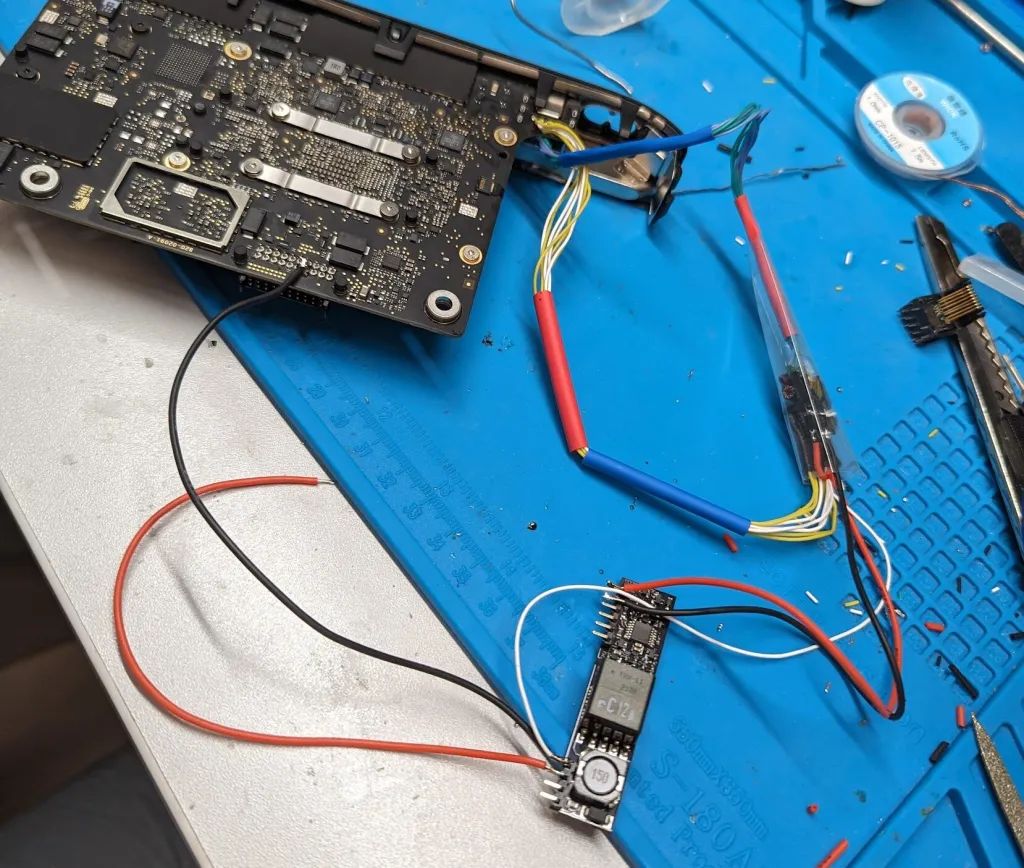
Wiring up a Mac Mini's new PoE module. (Credit: Ivan Kuleshov)
Wiring up a Mac Mini’s new PoE module. (Credit: Ivan Kuleshov)

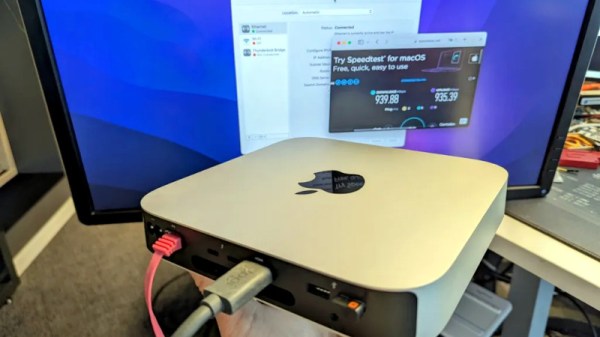
Despite all the fancy features on modern Apple Mac systems like USB-C and Thunderbolt, they have one glaring omission: the absolute lack of any form of Power-over-Ethernet (PoE). This is an issue that [Ivan Kuleshov] sought to rectify with some delicate board-level surgery. Since the original Ethernet jack on the lucky vic^Wrecipient M1 Mac Mini does not have integrated magnetics (magjack), tapping into the appropriate lines would have been rather awkward, with questionable results on the side of the PCB traces that would suddenly be used for PoE purposes they were never designed for.

Rather than choosing this level of experimentation, [Ivan] decided to patch in the Silvertel AG5412 PoE module with plentiful patch wires. This involved removing the Ethernet jack and bypassing the PCB and the magnetics module completely for the new PoE functionality, instead using the magnetics pilfered from a magjack and routing from there back to the mainboard as well as to the PoE module’s inputs. Continue reading “Adding Power Over Ethernet Support To A Mac Mini” →

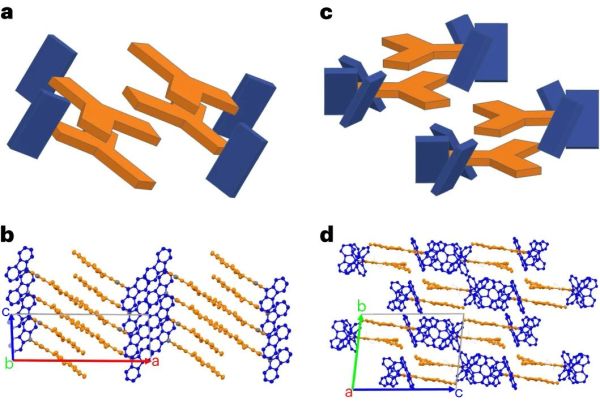
a–d, Crystal structures of the 1CzTrz-F (a,b) and 3CzTrz-F (c,d) compounds, determined by XRD. a,c, Diagrams of the two dimers of both crystallographic unit cells to show the molecular packing. b,d, Spatial arrangement of the acceptor–donor contacts in the 3D crystal structure. The triazine acceptor and the carbazole donor units are coloured orange and blue, respectively. The green features in d indicate co-crystallized chloroform molecules. (Credit: Oskar Sachnik et al., 2023)

Eliminating Charge-Carrier Trapping In Organic Semiconductors

For organic semiconductors like the very common organic light-emitting diode (OLED), the issue of degradation due to contaminants that act as charge traps is a major problem. During the development of OLEDs, this was very pronounced in the difference between the different colors and the bandgap which they operated in. Due to blue OLEDs especially being sensitive to these charge traps, it still is the OLED type that degrades the quickest as contaminants like oxygen affect it the strongest. Recent research published in Nature Materials from researchers at the Max Planck Institute for Polymer Research by Oskar Sachnik and colleagues (press release) may however have found a way to shield the electron-carrying parts of organic semiconductors from such contaminants.

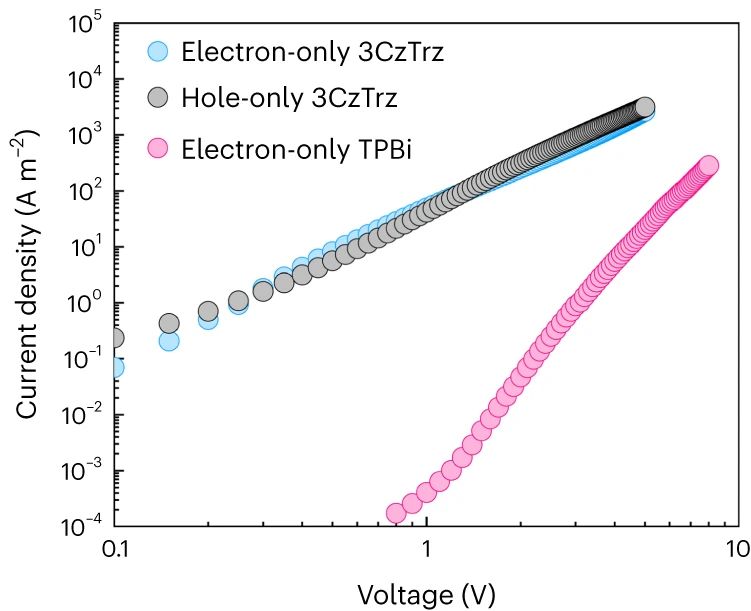
Current density (J)–voltage (V) characteristics of electron- and hole-only devices of 3CzTrz and TPBi. (Credit: Oskar Sachnik et al., 2023)

In current organic semiconductors TPBi is used for electron transport, whereas for this research triazine  (Trz, as electron acceptor) and carbozole (Cz, as donor) were used and compared with the properties of leading-edge TPBi. While a few other formulations in the study did not show remarkable results, one compound (3CzTrz) was found using X-ray diffraction (XRD) to have a structure as shown on the right in the heading image, with the carbozole (in blue) forming essentially channels along which electrons can move, while shielded from contaminants by the triazine.

Using this research it might be possible to create organic semiconductors in the future which are free of charge-traps, and both efficiency and longevity of this type of semiconductor (including OLEDs and perovskites) can be improved immensely.


Using JTAG To Dump The Xbox’s Secret Boot ROM

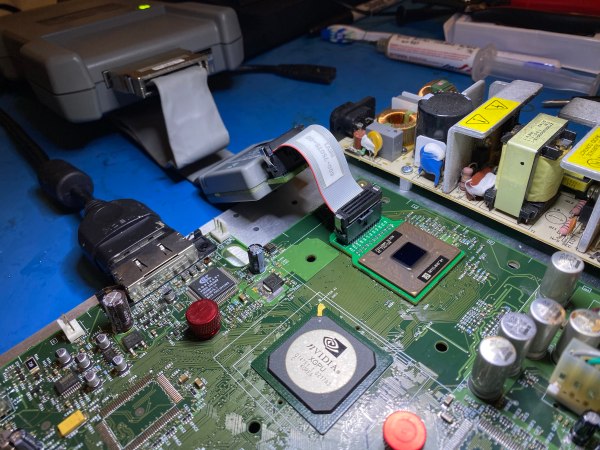
When Microsoft released its first entry into the video game console market with the Xbox, a lot of the discussions at the time revolved around the fact that it used a nearly off-the-shelf Intel CPU and NVIDIA GPU solution. This made it quite different from the very custom consoles from Nintendo and Sony, and invited thoughts on running custom code on the x86 console. Although the security in the console was hacked before long, there were still some open questions, such as whether the secret boot ROM could have been dumped via the CPU’s JTAG interface. This is the question which [Markus Gaasedelen] sought to answer.

The reason why this secret code was originally dumped by intercepting it as it made its merry way from the South to the North Bridge (containing the GPU) of the Xbox was because Microsoft had foolishly left this path unencrypted, and because the JTAG interface on the CPU was left disabled via the TRST# pin which was tied to ground. This meant that without removing the CPU and adding some kind of interposer, the JTAG interface would not be active.

A small issue after the harrowing task of desoldering the CPU and reinstalling it with the custom interposer in place was to keep the system integrity check (enforced by an onboard PIC16 MCU) intact. With the CPU hooked up to the JTAG debugger this check failed, requiring an external injection of the signal on the I2C bus to keep the PIC16 from resetting the system. Yet even after all of this, and getting the secret bootrom code dumped via JTAG, there was one final system reset that was tied to the detection of an abnormal CPU start-up.

The original Xbox ended up being hacked pretty thoroughly, famously giving rise to projects like Xbox Media Center (XBMC), which today is known as Kodi. Microsoft learned their lesson though, as each of their new consoles has been more secure than the last. Barring some colossal screw-up in Redmond, the glory days of Xbox hacking are sadly well behind us.

The World ID Orb And The Question Of What Defines A Person

Among the daily churn of ‘Web 3.0’, blockchains and cryptocurrency messaging, there is generally very little that feels genuinely interesting or unique enough to pay attention to. The same was true for OpenAI CEO Sam Altman’s Ethereum blockchain-based Worldcoin when it was launched in 2021 while promising many of the same things as Bitcoin and others have for years. However, with the recent introduction of the World ID protocol by Tools for Humanity (TfH) – the company founded for Worldcoin by Mr. Altman – suddenly the interest of the general public was piqued.

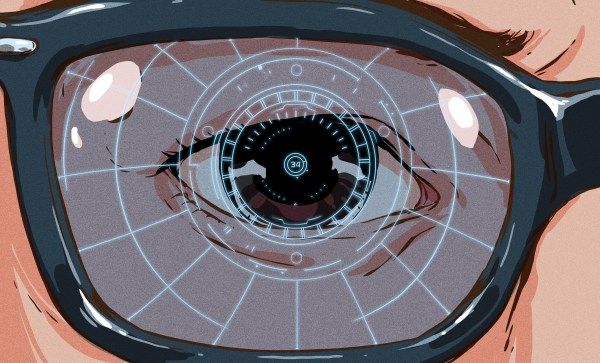
Defined by TfH as a ‘privacy-first decentralized identity protocol’ World ID is supposed to be the end-all, be-all of authentication protocols. Part of it is an ominous-looking orb contraption that performs iris scans to enroll new participants. Not only do participants get ‘free’ Worldcoins if they sign up for a World ID enrollment this way, TfH also promises that this authentication protocol can uniquely identify any person without requiring them to submit any personal data, only requiring a scan of your irises.

Essentially, this would make World ID a unique ID for every person alive today and in the future, providing much more security while preventing identity theft. This naturally raises many questions about the feasibility of using iris recognition, as well as the potential for abuse and the impact of ocular surgery and diseases. Basically, can you reduce proof of personhood to an individual’s eyes, and should you?

Continue reading “The World ID Orb And The Question Of What Defines A Person” →

Humanity’s Return To The Moon And The Prospect Of South Pole Moon Bases

The last time that a human set foot on the Moon, it was December 1972 — when the crew of the Apollo 17 mission spent a few days on the surface before returning to Earth. Since then only unmanned probes have either touched down on the lunar surface or entered orbit to take snapshots and perform measurements.

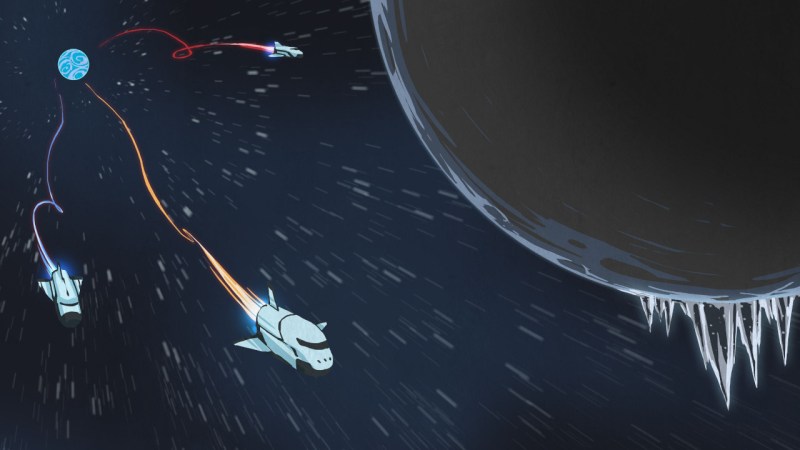
But after years of false starts, there are finally new plans on the table which would see humans return to the Moon. Not just to visit, but with the goal of establishing a permanent presence on the lunar surface. What exactly has changed that the world went from space fever in the 1960s to tepid interest in anything beyond LEO for the past fifty years, to the renewed interest today?

Part of the reason at least appears to be an increasing interest in mineable resources on the Moon, along with the potential of manufacturing in a low gravity environment, and as a jumping-off point for missions to planets beyond Earth, such as Mars and Venus. Even with 1960s technology, the Moon is after all only a few days away from launch to landing, and we know that the lunar surface is rich in silicon dioxide, aluminium oxide as well as other metals and significant amounts of helium-3, enabling in-situ resource utilization.

Current and upcoming Moon missions focus on exploring the lunar south pole in particular, with frozen water presumed to exist in deep craters at both poles. All of which raises the question of we may truly see lunar-based colonies and factories pop up on the Moon this time, or are we merely seeing a repeat of last century?

Continue reading “Humanity’s Return To The Moon And The Prospect Of South Pole Moon Bases” →