
Judge Spotlight: Limor “Ladyada” Fried

judge-spotlight-ladyada

We sent off a list of questions, just like every week, and [Ladyada] offered to do a video response. How awesome is that? Not only did she answer our questions, but she talked at length for several of them. We’re biased, but her explanation about Adafruit’s manufacturing processes and options for home hackers to get boards spun was a real treat.

Perhaps we should step back for a minute though. In case you don’t know [Limor Fried], aka [Ladyada], is a judge for The Hackaday Prize which will award a trip into space and hundreds of other prizes for hackers who build connected devices that use Open Design (Open Hardware and Open Source Software). She’s the founder of Adafruit Industries, an MIT double-grad, and all around an awesome engineer!

Check out the video after the break. We’ve included a list of the questions and the timestamps at which they are answered.

Continue reading “Judge Spotlight: Limor “Ladyada” Fried”

Hackaday’s Wikipedia Page Needs Help

Wikipedia-logo-en-bigHey, did you know we have a Wikipedia page? We didn’t either. Until today you could search for “Hackaday” and nothing would come up. That’s because it’s listed as “Hack a Day” and it hadn’t seen any TLC in at least a couple of years.

Here’s the great thing about Wikipedia, they want factual information so they discourage people with Conflicts of Interest from editing the pages. That means that having the Hackaday Staff edit the page is a sticky issue. I did indeed edit the page in order to add more sections (History, Hackaday Projects, Accolades) to make it easier for the community to work on the article. I disclosed this in the “Talk” section, requested the logo be uploaded, and began a discussion suggesting the page be moved.

Ethically this is about all I think we should do. It’s up to you now. We’d love to see a well-written, immaculately cited Wikipedia article for this great thing we’re all involved in.

Tic Tac Clock

tic-tac-clock

Here’s an excuse to eat a bunch of Tic Tac candies: once the container is empty it makes a nice little enclosure for your next project. This particular offering introduces a point-to-point clock project that’s a ton of fun.

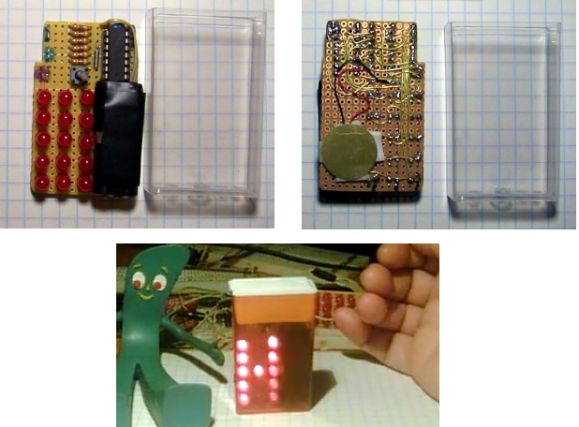
[Danny Chouinard] did a lot with very little. You can get the gist of the circuit just by looking at the photos above. it uses a 3×5 Charlieplexed LED display (this is given away by the fact that there’s only a few resistors on the board. A bit difficult to see, but between the resistors and the ATtiny84 there is a clock crystal, and on the back is a little piezo buzzer. The one thing that isn’t completely obvious is the power source. Two AAAA batteries, salvaged from a 9V battery, are able to keep the unit running at an estimated 2 years of moderate use.

The video after the break is worth a look though. It shows the various characters and information that can be flashed on the LED matrix. At first it’s hard to tell that the single user input button is being pressed by [Danny’s] thumb.

If you don’t want to build a clock, there are still plenty of reasons to eat a whole container of these mints. You could replace them with a PIC programmer or a discreet camera.

Continue reading “Tic Tac Clock”

THP Hacker Bio: Infinityis

thp-contestant-bio-infinityis

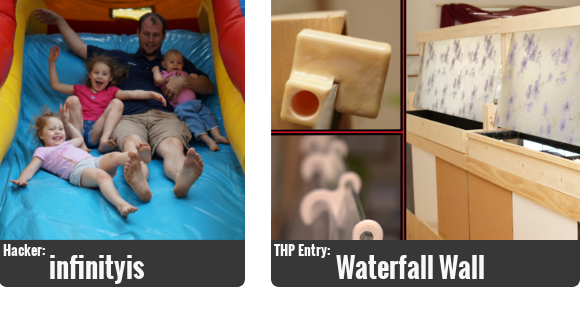
That profile picture is full of pure joy! Meet [infinityis], aka [David Hoelscher] — don’t worry, we’re not revealing his secret identity; he posted his real name on his profile page.

His entry for The Hackaday Prize is a functional show piece to greet guests when they step into his home. His Waterfall Wall will serve as a way to separate the living space from the entryway. The top portion of it is a water feature which will be edge-lit with LEDs whose color will be controlled wirelessly. The bottom part of the wall will provide some storage space.

Join us after the break to find out more about [David], and check out his THP video for a brief introduction to his Waterfall Wall.

Continue reading “THP Hacker Bio: Infinityis”

Banner for community voting

Astronaut Or Not! Your Vote Matters.

You know that little contest we’re running? The one that sends a grand prize winner into SPACE!

We’re happy to announce that community voting for The Hackaday Prize starts today. It’s an interface that we’ve been calling Astronaut or Not! We have hundreds of prizes to give away and this is your chance to decide who some of them go to.

Best Project Concept

This week we’re voting on the best project concept. Don’t vote on projects based on how much work they have done or how many pictures there are, pick the ones that have the potential to be the the best project. We’ll be sending shirts to the top 10 projects voted on over the next few days.

We don’t want this to be purely a popularity contest, so we’re shaking things up a bit. Instead of voting for a particular project we’re pairing the entries in random head-to-head match-ups, with Hackaday readers deciding the ultimate ranking. Check out the contenders, learn a bit about each project, then choose the one you think is more worthy of The Hackaday Prize.

Submit your entry now to be included!

Astronaut or Not isn’t going to decide the top prizes, all entries will still be reviewed by our various judging panels. We are planning to give away different prizes with each round of voting. So make sure you post your entry right away to get in on these giveaways!

THP Hacker Bio: Bradley Worley

thp-contestant-bio-bradley-worley

Somehow we picked two people in a row who are working on lab equipment as part of The Hackaday Prize. This is just a coincidence; we’re picking hackers who we think will be quite interesting to learn about.

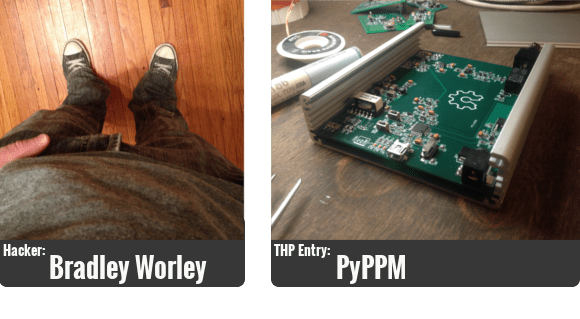
Meet [Bradley Worley]. His contest entry is PyPPM, a Proton Precession Magnetometer which will be used for Nuclear Magnetic Resonance experiments. The “Py” at the beginning reflects the use of the Python API for control.

Let’s see what he’s all about:

Continue reading “THP Hacker Bio: Bradley Worley”

Judge Spotlight: Jack Ganssle

judge-spotlight-ganssle

This week we’re getting to know The Hackaday Prize Judge [Jack Ganssle] a little better. His depth of experience with embedded systems is formidable, and recently I was very interested to learn about his mission to improve the quality of the product in the embedded code universe. We’ll get to that in a little bit, but I wanted to start off with [Jack’s] answer to my final question.


judge-spotlight-q5Is there anything else you’d like our audience to know about you?
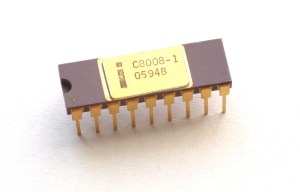
judge-spotlight-a5Intel 8008 Chip on white backgroundMy entry into this field was when the first 8 bit processor (the 8008) came out, and still find it endlessly fascinating. I write a lot about embedded topics, and give talks and seminars, on all of the continents except Antarctica (so far!). We live in heavily-wooded Finksburg, MD, which is just stunning this time of year, and, since my office is in the house, the commute is pretty tolerable. Other passions include sailing; I wrote an on-line book (www.ganssle.com/jack) about racing alone across the Atlantic. Great trip, other than losing the boat.



Continue reading “Judge Spotlight: Jack Ganssle”