Automatic Capacitor Charger Lets You Have Fun With Sparks

[GranTotem] is delighted by the sparks put out when a capacitor is rapidly discharged. But he’s not impressed at the relatively slow process of connecting them to a power supply for a recharge. So he built this auto-charging station for his capacitors that provides a shockingly good time almost continuously. Check out the video to see what we mean.

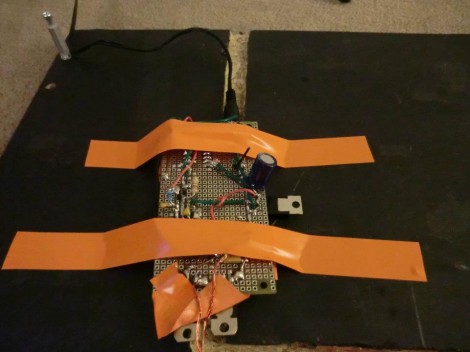
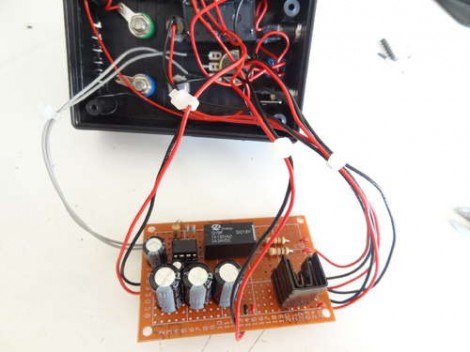
We always like to see the guts of the project, and that’s why we chose this image for the feature. But when everything is properly seated in the project box [GranTotem] has managed to achieve a really clean look. There are two barrel jack connectors on the end, one for 16V and the other for 20V inputs. The lid of the enclosure hosts an on/off switch, adjustment knob, and two banana connector terminals. Once switched on, a relay connects and disconnects the capacitor from the power supply at regular intervals which are adjusted by the knob. Just connect a couple of probes to those banana terminals and let the sparks reign down.

Continue reading “Automatic Capacitor Charger Lets You Have Fun With Sparks”
3D Printed Circuit Boards Using Conductive Ink

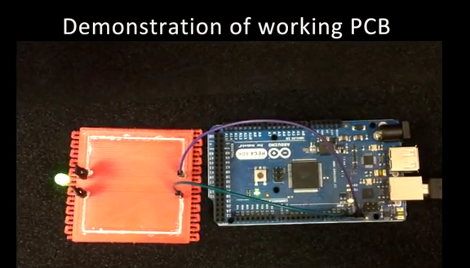
The thought of using a 3D printer to fabricate PCBs is tantalizing and the good news is that it’s a reality. This project shows that it’s possible to use a special printer head to apply traces to an extruded substrate.

This is similar to the point-to-point 3D printer circuits with one big upgrade. Now the traces can be printed directly onto the ABS using conductive ink. The process starts with the design files, which are used to model a substrate that has a trench for each trace. A Makerbot then prints out this model. Once complete, the ABS extruder head is swapped for a special ink head. Each trace is then filled with the conductive fluid, which is kept in place by the trench walls until it can dry. We think this improves on the trace printing techniques we’ve seen before because it doesn’t require your printer heat to use molten metals.

The circuit above uses printed traces for the high and low side of an LED circuit. It’s a bit rough at the edges, but it shows a lot of promise. Don’t miss the demo video embedded after the jump.

Continue reading “3D Printed Circuit Boards Using Conductive Ink”

Volt Teardown Shows More Than Just What’s Under The Hood

The Chevrolet Volt is one of the top contenders in mass-market electric vehicles. Now you can get a look at the components that make up the electrical system with this Chevy Volt teardown article.

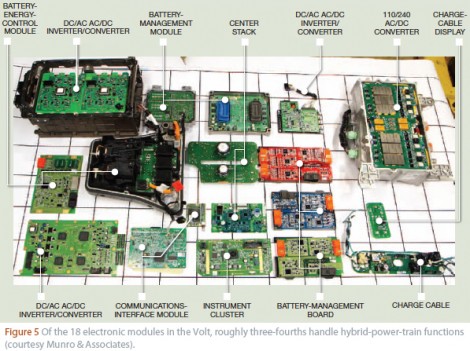
The adventure starts with a look at the 288 cell battery. It forms a T shape and takes up the space that forms the hump down the center of the interior of a vehicle. Theses have a liquid cooling system build into the enclosure to make sure things don’t get too hot during use or charging. The sights are then set on the control and monitoring hardware, and there’s a lot of it. In fact, the image above is an overview of the eighteen modules that pull the new plug-in EV technology together. If you’re brave enough to void the warranty on one of these, this should be a helpful road map to get you started.

Has anyone seen a teardown of the home charging station for one of these?

Heliowatcher Positions Solar Panels For Highest Efficiency

[Jason Wright] and [Jeremy Blum] are showing off the project they developed for their Designing with Microcontrollers course at Cornell University. They call it the Heliowatcher, and if you know your Greek mythology we’d be you figured out this watches the movement of the sun and adjust a solar panel to follow it.

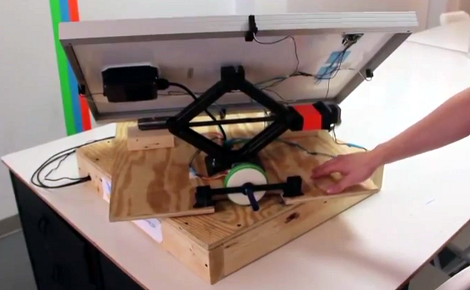
Their design is simple and effective. The base is mounted like a Lazy Susan, able to pivot on the horizontal plane. The bottom edge of the solar panel is mounted with two door hinges, with a motorized screw jack used to raise and lower it. The system uses a GPS to provide geographical position, day, and time feedback. This is used in conjunction with an array of four LEDs to determine the best position of the panel. Those LEDs are acting as light sensors; when the top and the bottom detect similar levels, the panel is at its most efficient orientation. The left and right LED sensors work the same way.

Now if we can just work out a self-cleaning system to keep the panels free of the dirty film that builds up over time we’d be set!

Continue reading “Heliowatcher Positions Solar Panels For Highest Efficiency”

FTA Dish Used To Receive L-band Amateur Radio

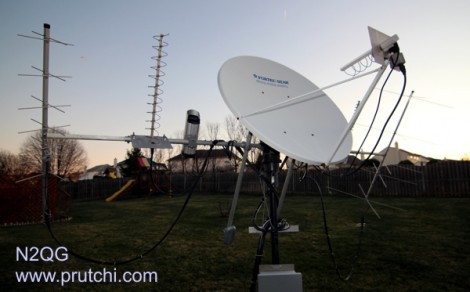
[David Prutchi] has an FTA (free-to-air) satellite dish. This means he can tune and watch freely available satellite television feeds. But this sounds much better than it actually is. There isn’t much that’s broadcasted unecrypted from satellites with the exception of a collection of religious channels. But he still uses the dish by using the FTA satellites to calibrate the alignment, then repositioning it to receive L-Band radio transmissions with his own add-on hardware. In the image above it’s the spiral of wire attached to the dish’s collector.

The satellite transmissions are picked up on the KU-band by an aftermarket horn that [David] purchased for this purpose. To add his own helix receiver he cut a square mounting plate that fits around the horn. This plate serves as a reflector and ground plane, and also hosts the helix connector which picks up the L-band transmissions. He had to be creative with routing the first few inches of the helix but it looks like he manages to get some pretty good performance out of the hardware.

[via Hacked Gadgets]

Salvaged LCD Screen Hacking

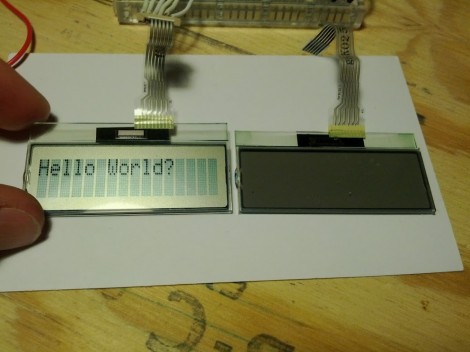
You can find all kinds of LCD screens in broken electronics. But it’s often a chore to figure out how they are controlled if you don’t have a working device that can be used to sniff the communications protocol. [Justin] grabbed this character LCD screen from an old Brother printer and decided to see if he could reuse it in his own projects. Luckily the driver card still worked so he patched into the LCD’s control lines and sniffed the signals when the printer is powered on.

He used the OpenBench Logic Sniffer for this project. It easily captured the data, and also provided analysis tools. The SPI analyzer managed to decode the command signals and message of “Please wait” that pops up at power up. After a bit of folly with the pin out of the display, he is now able to control it thanks to an Arduino library which he wrote. Check out the demo after the break to seem him scrolling through a bunch of different functions for the device.

Continue reading “Salvaged LCD Screen Hacking”

Prototyping An Advanced Inductive Charger

This is an advanced inductive charging system into which [David McIntosh] has put a lot of hard work. It uses the same coil-based concepts that we’ve seen in other DIY systems, but the game changer is a communications function that just isn’t found in home brew versions of the hardware. It lets the receiver (device being charged) give feedback to the transmitter by rolling another signal into the EM field being generated.

Do why would you need feedback? Well, if the two coils are not positioned well, the power produced on the receiving end can vary greatly. For instance, you may have the wrong voltage because the coils are not balanced. Or there may not be enough current to properly start charging. The feedback system is designed to let the sending unit change frequency to try to account for physical orientation, or to shut itself off if the charge is just not possible. This is done in expensive commercial devices, and that’s what [David] used as his model.