Server Room Light And Temperature Monitoring

environ_monitoring

[Jaren] is occasionally forgetful, and frequently wonders if he’s left the lights on in his server room. Not knowing if the lights have been left on drives him nuts until he returns to work the next morning, so he decided he had to do something. He figured it would be easy enough to build a small sensor that would allow him to monitor the status of the overhead lights, but he didn’t want to have his micro controller’s abilities go to waste by performing one simple task. Instead, he laid out plans to add an array of other sensors which will allow him to monitor the room’s temperature, sound levels, as well as the current draw of the servers.

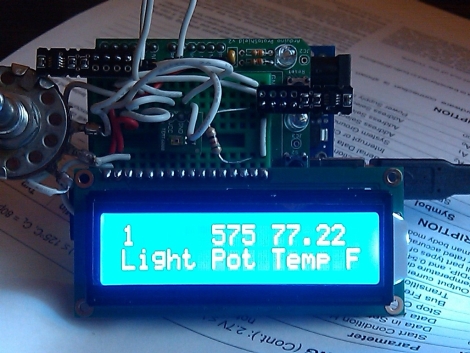
Right now the project is in the beginning stages, but he already has part of his sensor network established. He hooked up a TMP421-based temperature module along with a TEMT6000 ambient light sensor to his Arduino, which displays the data on a small LCD screen he purchased. More sensors are on order, so we should expect to see more progress in the coming weeks.

Hopefully when everything is completed we will see a full set of schematics and code so that anyone can buld their own server room monitoring network from his designs.


Google’s Secret Perk? A Private Hackerspace

google_hackerspace

Working for Google has always had many perks, and most of them are pretty well known. Google employees enjoy free food, on-site workout facilities, and one free day a week to work on whatever they like – but you knew that already. One Google perk however, has been kept pretty quiet until just recently.

Google has provided a hackerspace on their campus for about four years now, which is open to any employee that meets some pretty strict requirements. A written test is given before an employee can access the facilities, and even then they must be deemed worthy of working on particular pieces of equipment.

The idea behind the hackerspace was to help Google stay rooted in the philosophy that, “all good things start in the garage”. While a lot of the employees embark on fun personal projects, several pieces of familiar Google technology were born in the workshop. For instance, the Google Streetview “trikes” were created there, along with a few smartphone prototypes, autonomous car components, and even some secret projects Google declines to speak about at the moment.

It’s an unbelievably cool job perk, and we would be lying if we said we weren’t jealous. For now, we will just have to be happy with stale coffee from the break room.

[via the Adafruit Blog]

[Image via AP]

Watch Hacking, One Day At A Time

watch_a_day

If there is one thing hackers return to time and time again, it is clock/watch hacking. There are always creative ways to tell time, and with several “hackable” wristwatches on the market, there is bound to be no shortage of neat timepiece hacks.

[hudson] from NYC Resistor has decided to take on a fun challenge for the next month revolving around his programmable inPulse watch. Over the upcoming 30 27 days, he will design, program, and publish a watch face for the timepiece. He already has 3 days behind him, and the results are pretty interesting. The concepts are creative and functional, though due to time constraints they sometimes end up a little less polished than he would like.

All of the code is available on his Bitbucket page if you have an inPulse watch and would like to play along or improve on his work.

We think it’s a pretty cool project, and we are eager to see what he produces each day. Stick around to see a quick video showing off one of his 3D watch faces.

Continue reading “Watch Hacking, One Day At A Time”

can_bus_hacking

Enhance Your Key Fob Via CAN Bus Hacking

[Igor] drives a 4th generation Volkswagen Golf, and decided he wanted to play around with the CAN bus for a bit. Knowing that the comfort bus is the most accessible and the safest to toy with, he started poking around to see what he could see (Google translation).

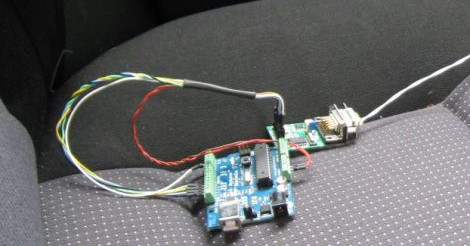
He pulled the trim off one of the rear doors and hooked into the comfort bus with an Arudino and a CAN interface module. He sniffed the bus’ traffic for a bit, then decided he would add some functionality to the car that it was sorely lacking. The car’s windows can all be rolled down by turning the key in any lock for more than a few seconds, however this cannot be done remotely. The functionality can be added via 3rd party modules or through manipulating the car’s programming with some prepackaged software, but [Igor] wanted to give it a go himself.

He programmed the Arduino to listen for longer than normal button presses coming from the remote. Once it detects that he is trying to roll the windows up or down, the Arduino issues the proper window control commands to the bus, and his wish is the car’s command.

It’s a pretty simple process, but then again he has just gotten started. We look forward to seeing what else [Igor] is able to pull off in the future.  In the meantime, continue reading to see a quick video of his handiwork.

If you are interested in seeing what you might be able to do with your own car, check out this CAN  bus sniffer we featured a while back.

Continue reading “Enhance Your Key Fob Via CAN Bus Hacking”

netcast_hack

Hacking LG’s Netcast

LG released a line of Internet-connected TVs in both the US and Europe that utilize Yahoo TV widgets to bring interactive content to the living room. While it sounds like a great idea in theory, users have been disappointed to find that LG has approved a measly 15 widgets since the TVs were released.

OpenLGTV.org.ru user [xeros] has started working on a project that aims to enable more useful content as well as homebrew widgets. The project is known as OpenLGTV BCM, and not only covers LG television sets, but all sets based on the Broadcom platform.

A ton of progress has been made already, as they have been able to install their own busybox environment as well as open the sets to accept more widgets via some clever signature spoofing. The ultimate goal for the project is to completely divorce the sets from the Yahoo platform and replace it with their own open marketplace.

It’s a great start, and we can’t wait to see what sort of progress they make as time goes on.

[Thanks, T]

Vintage AM Radio Restoration

radio_restoration

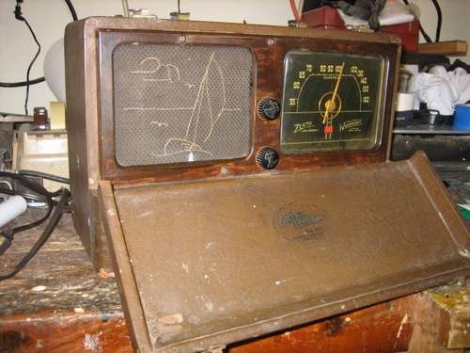
Instructables user [knife141] enjoys restoring vintage electronics in his spare time, especially old radios. AM radios tend to pique his curiosity the most, and in this tutorial, he discusses the restoration of an old radio from the early 1940s.

While people would likely assume that the vacuum tubes in a radio this old are the source of poor performance, he has found that most units he repairs suffer from bad capacitors. He says that the old electrolytic, paper, and wax caps used in these radios were never meant to last more than a few decades, let alone 70 years.

He always starts the process off by discharging the caps and replacing the power cord, both as a safety measure. He was pretty sure the capacitors were bad in this radio, so he swapped all of them out, regardless of condition. All of the internal wiring was then checked over, and any damaged cables were replaced or covered with heat shrink tubing.

With that done, he powered on the radio and was happy to find that the distortion he previously experienced was completely eliminated. With the electronics taken care of, he tackled the radio’s asbestos insulation by encapsulating it with varnish. Attention was then turned to the exterior, where he cleaned and buffed the leather, refinished the face plate, and polished the dial’s cloudy glass.

While it’s not exactly a hack, we always like seeing vintage electronics given new life, and we’re always cool with saving these sorts of things from rotting in a landfill.

Can Crusher Keeps Track Of Your Recycling Efforts

arduino_can_crusher

Instructables user [MRHint] was inspired by his friends’ recycling efforts, and decided to start recycling as well. The one thing he noticed was that they typically had no idea how many cans they had stored up, nor how much their bags of cans weigh. He figured that he could somewhat automate the crushing process while keeping an accurate can count using a handful of electronics and some elbow grease.

He started by designing a can crushing rig that would use an old windshield wiper motor he had sitting around the house. The motor is connected to a pulley, which drives a set of threaded rods connected to his movable crushing panel. When the motor is started, the panel is drawn against a stationary board, crushing the can.[MRHint] also had an unused Arduino hanging around, so he used it to control the crusher as well as keep track of how many times the crusher had been run.

From what we hear the whole setup works pretty well, but as with any project he sees plenty of room for improvement. Future changes may include a more powerful motor and a chain/sprocket setup in place of the belt and pulley he currently uses. Do you have any other suggestions for [MRHint]? Let us know in the comments.