This Is Not-A-Camera

not a camera

What’s this? A 2-Dimensional wooden camera cut-out? Nope. We lied — it’s actually a digital camera squeezed into 1/2″ sheet of walnut!

[Olivia Barr the Third] originally made this for her 101-year-old grandmother [Olivia Barr the First], who recently got into photography in her late 90’s! [Olivia]  wanted to make her a digital camera that was light and easy to use. She succeeded and has started an art project over at notacamera.tumblr.com — Spy photography? Kind of?

The small 3″ x 3.5″ camera packs an HD video camera with 16-bit mono audio, and is able to take 1280 x 960 stills. It uses a microSD card, a 3.6v 250mAh battery and has a power button, status LEDs and even a USB port.  It was laser cut out of 3 sheets of walnut board and glued together, sandwiching the components in place.

Just for fun, she’s also made a “selfie” version which is laser etched onto a piece of mirror for easy framing of your face.

Handmade Acrylic Skeleton Clock Is An Impressive Feat Of Scroll Sawing

Handmade Acrylic Skeleton Clock

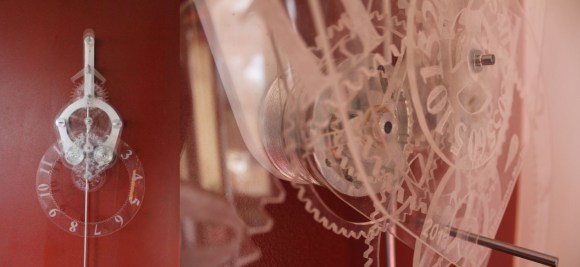
For one of his mechanical engineering school projects, [Ben Murton] decided to design and build a clock from scratch — and while it may look like it was laser cut… He cut it out all by hand.

It’s a cross between the mechanical workings of an old Grandfather clock and a Skeleton clock — the goal was to have all movements visible to see how the clock operates. He designed it using Autodesk Inventor, and has provided the files online for anyone to use — He notes it would be especially easy to make if you have a laser cutter or CNC router!

Anyway, the clock is made out of 3mm thick acrylic, 5mm brass shafts, nylon string, some heavy weights (lead), and some nuts and screws. After printing out his CAD templates, [Ben] carefully used a scroll saw to cut out every gear and linkage — We’re impressed.

Continue reading “Handmade Acrylic Skeleton Clock Is An Impressive Feat Of Scroll Sawing”

What If You Experienced Lag In Real Life?

If you’re a gamer, lag is one of your worst enemies. But what would it be like if you experienced lag in real life? Imagine how frustrating that would be!

Introducing Living With Lag — a cute experiment put on by an internet provider called Ume. Using an Oculus Rift development kit, a Raspberry Pi, noise cancelling headphones and a webcam, Ume’s thrown together a fun social experiment. The webcam captures both audio and video and repeats it to the Oculus Rift via the Pi at a variable delay to show the effects of slow internet speeds.

They attempt four different scenarios. Ping pong is pretty much impossible. Dance class is just embarrassing. And attempting to cook or eat is absolutely hilarious. They even try bowling, which also proves more difficult than you could imagine!

Stick around to see for yourself.

Continue reading “What If You Experienced Lag In Real Life?”

Solderless Pogo-Pins For Flashing Routers

Solderless Router Pins

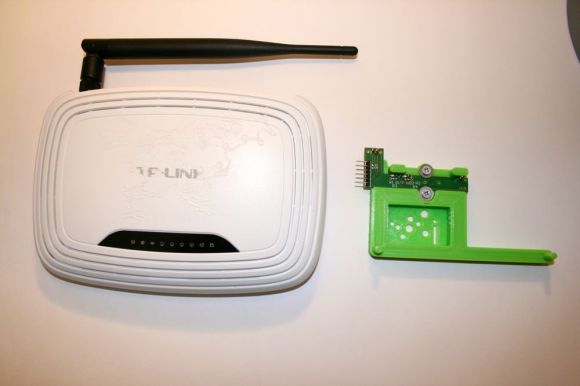
Low-cost wireless routers are a dime a dozen these days — but what happens if you need to flash the firmware? Normally you’d have to solder in a serial connection in order to access it, but [Luka Mustafa] had another idea — pogo-pins!

It’s actually quite easy to make a small PCB with pogo-pins and then use a 3D printed bracket or alignment jig in order to make connection. They currently only have designs for a few TP-Links (WR740 and WR741ND) on their GitHub, but more will be added soon. They’ve also included instructions on how to restore firmware on any of these devices with their handy-dandy pogo-pin PCB.

[Luka] is one of the guys behind IRNAS (the acronym is in Slovenian), a non-profit open-source company that makes lots of cool projects. They believe in open-source and sharing technology in order to empower the world.

And if you’ve royally bricked your router it could be possible to unbrick it with a Raspberry Pi!

Replicator 1 Receives A PID Controlled Heated Chamber

Replicator 1 PID Heated Enclosure

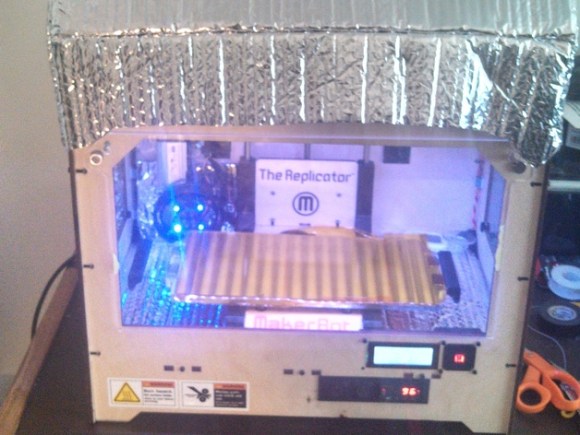
Improving 3D print quality is a bit of a black magic — there are tons of little tweaks you can do to your printer to help it, but in the end you’re just going to have to try everything. Adding a heated build enclosure however is one of those things almost guaranteed to improve the print quality of ABS parts!

And for good reason too — heated build enclosures are one of the outstanding “patented 3D printing technologies” — It’s why you don’t see any consumer printers with that feature. Anyway, [Bryan] just sent us his upgrade to his Makerbot Replicator 1, and it’s a pretty slick system. His goal was to add the heated enclosure to the printer as unobtrusively as possible — no need for people to think his printer is an even bigger fire hazard!

Continue reading “Replicator 1 Receives A PID Controlled Heated Chamber”

Opensource RhinoBOT Is Well Suited For Hacking And Sumo-Robotics!

RhinoBOT

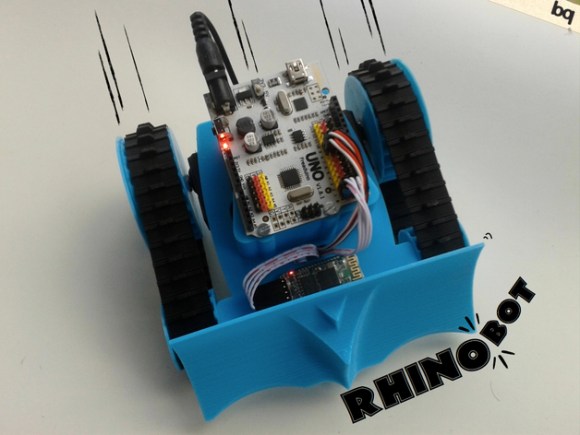
The RhinoBOT is an open source and 3D printed robot that is fun to build and easy to expand. It can be used for educational purposes or even as a sumobot!

[Miguel Carro] runs a DIY robotics blog at bq.com (Spanish — Translated) to help teach kids about robotics using a fun cartoon character named Andy. He’s released all the design files for his latest printbot, the RhinoBOT on thingiverse.com. Using an Arduino UNO, an IR sensor, two rotational servos, an LED, batteries and a few pieces of hardware, you can build your very own RhinoBOT! That is — if you have a 3D printer.

The fun doesn’t stop there though, as [Miguel’s] also created a phone app to let you control your RhinoBOT wirelessly!  And since not all the outputs on the UNO are used, y0u can add extra functionality with a bit of creativity — how about being able to move that dozer! To see what it can do, and to start thinking about what you could do with it, stick around after the break to see it in action!

Continue reading “Opensource RhinoBOT Is Well Suited For Hacking And Sumo-Robotics!”

Flying Robots Jam Out In A Robotic Orchestra

Flying Robot Symphony

[KMel Robotics] is at it again, this time stealing our hearts with a flying robotic orchestra. It’s an amazing feat of technology and music combined.

We first saw something like this with the swarm playing the James Bond theme, which was impressive in itself — the orchestra has just become a bit more advanced with this latest piece.

Most of the instruments are playable by adding weighted levers with special landing pads for the hexrotors to bounce off of, but we think our favorite instrument is the stringed one — another robot adjusts the tension of the wire to change the pitch, much like a tremolo on a guitar. Couple this with an electric amp and you have some very sleek sounds.

Another instrument of note are the drums, which use a deconstructed and hacked together piano action to play the notes. Stick around to hear the sounds of our new robotic overlords!

Continue reading “Flying Robots Jam Out In A Robotic Orchestra”