COTS Components Combine To DIY Solar Power Station

They’re marketed as “Solar Generators” or “Solar Power Stations” but what they are is a nice box with a battery, charge controller, and inverter inside. [DoItYourselfDad] on Youtube decided that since all of those parts are available separately, he could put one together himself.

The project is a nice simple job for a weekend afternoon. (He claims 2 hours.) Because it’s all COTS components, it just a matter of wiring everything together, and sticking into a box.  [DoItYourselfDad] walks his viewers through this process very clearly, including installing a shunt to monitor the battery. (This is the kind of video you could send to your brother-in-law in good conscience.)

Strictly speaking, he didn’t need the shunt, since his fancy LiFePo pack from TimeUSB has one built in with Bluetooth connectivity. Having a dedicated screen is nice, though, as is the ability to charge from wall power or solar, via the two different charge controllers [DoItYourselfDad] includes. If it were our power station, we’d be sure to put in a DC-DC converter for USB-PD functionality, but his use case must be different as he has a 120 V inverter as the only output. That’s the nice thing about doing it yourself, though: you can include all the features you want, and none that you don’t.

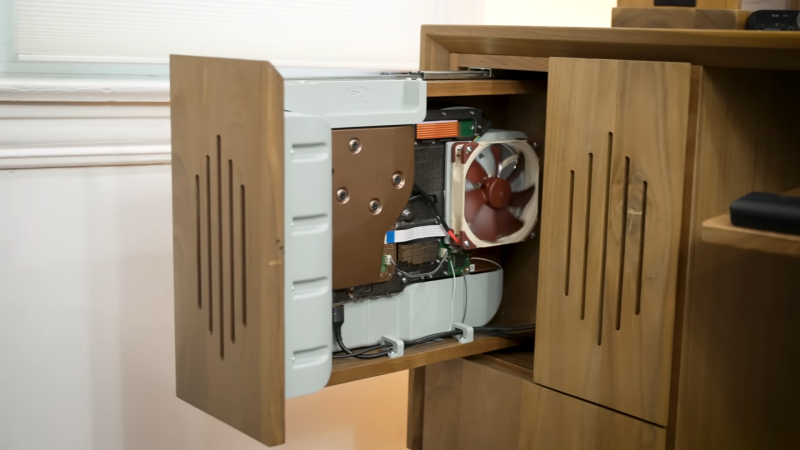
We’re not totally sure about his claim that the clear cargo box was chosen because he was inspired by late-90s Macintosh computers, but it’s a perfectly usable case, and the build quality is probably as good as the cheapest options on TEMU.

This project is simple, but it does the job. Have you made a more sophisticated battery box, or other more-impressive project? Don’t cast shade on [DoItYourselfDad]: cast light on your work by letting us know about it!. Continue reading “COTS Components Combine To DIY Solar Power Station”

Compound Press Bends, Punches And Cuts Using 3D Printed Plastic

It’s not quite “bend, fold or mutilate” but this project comes close– it actually manufactures a spring clip for [Super Valid Designs] PETAL light system. In the video (embedded below) you’ll see why this tool was needed: by-hand manufacturing worked for the prototype, but really would not scale.

Two examples of the spring in question, embedded in the 3D printed light socket. There’s another pair you can’t see.

The lights themselves might be worthy of a post, being a modular, open source DMX stage lighting rig. Today though we’re looking at how they are manufactured– specifically how one part is manufactured. With these PETAL lights, the lights slot into a base station, which obviously requires a connection of some sort. [Super Valid Designs] opted for a spring connector, which is super valid.

It’s also a pain to work by hand: spring steel needed to be cut to length, hole punched, and bent into the specific shape required. The hand-made springs always needed adjustment after assembly, too, which is no good when people are giving you money for objects. Even when using a tent-pole spring that comes halfway to meeting their requirements, [Super Valid Designs] was not happy with the workflow. Continue reading “Compound Press Bends, Punches And Cuts Using 3D Printed Plastic”

Threaded Insert Press Is 100% 3D Printed

Sometimes, when making a 3D printed object, plastic just isn’t enough. Probably the most common addition to our prints is the ubiquitous brass threaded inset, which has proven its worth time and again over the years in providing a secure screw attachment point with less hassle than a captive nut. Of course to insert these bits of machined brass, you need to press them in, and unless you’ve got a very good hand with a soldering iron it’s usually a good idea to use a press of some sort. [TimNummy]  shows us that, ironically enough, making such a press is perfectly doable using only printed parts. Well, save for the soldering iron, of course.

He calls it the Superserter. Not only is it 100% printed plastic, but the entire design fits on a single 256 mm by 256 mm bed. In his case it was done on the Bambulab X1C, but it’s a common enough print bed size and can be printed without any supports. It’s even sized to fit the popular Gridfinity standard for a neat and tidy desk and handy bin placement for the inserts.

[TimNummy] clearly spent some time thinking about design for 3D printed manufacturing in order to create an assembly that does not need linear rails, sliders, or bearings as other press projects often do. The ironic thing is that if that same amount of effort went into other designs, it might eliminate the need for threaded inserts entirely.

If you haven’t delved into the world of threaded inserts, we put up a how-to-guide a few years ago. If you’re wondering if you can get away with just printing threads, the answer is “maybe”– we highlighted a video comparing printed threads with different inserts a while back to get you started thinking about the design limitations there.

Continue reading “Threaded Insert Press Is 100% 3D Printed”

Is The Atomic Outboard An Idea Whose Time Has Come?

Everyone these days wants to talk about Small Modular Reactors (SMRs) when it comes to nuclear power. The industry seems to have pinned its hopes for a ‘nuclear renaissance’ on the exciting new concept. Exciting as it may be, it is not exactly new: small reactors date back to the heyday of the atomic era. There were a few prototypes, and a lot more paper projects that are easy to sneer at today. One in particular caught our eye, in a write-up from Steve Wientz, that is described as an atomic outboard motor.

It started as an outgrowth from General Electric’s 1950s work on airborne nuclear reactors. GE’s proposal just screams “1950s” — a refractory, air-cooled reactor serving as the heat source for a large turboprop engine. Yes, complete with open-loop cooling. Those obviously didn’t fly (pun intended, as always) but to try and recoup some of their investment GE proposed a slew of applications for this small, reactor-driven gas turbine. Rather than continue to push the idea of connecting it to a turboprop and spew potentially-radioactive exhaust directly into the atmosphere, GE proposed podding up the reactor with a closed-cycle gas turbine into one small, hermetically sealed-module. Continue reading “Is The Atomic Outboard An Idea Whose Time Has Come?”

Saving Green Books From Poison Paranoia

You probably do not need us to tell you that Arsenic is not healthy stuff. This wasn’t always such common knowledge, as for a time in the 19th century a chemical variously known as Paris or Emerald Green, but known to chemists as copper(II) acetoarsenite was a very popular green pigment. While this pigment is obviously not deadly on-contact, given that it’s taken 200 years to raise the alarm about these books (and it used to be used in candy (!)), arsenic is really not something you want in your system. Libraries around the world have been quarantining vintage green books ̶f̶o̶r̶ ̶f̶e̶a̶r̶ ̶b̶i̶b̶l̶i̶o̶p̶h̶i̶l̶i̶es ̶m̶i̶g̶h̶t̶ ̶b̶e̶ ̶t̶e̶m̶p̶t̶e̶d̶ ̶t̶o̶ ̶l̶i̶c̶k̶ ̶t̶h̶e̶m̶  out of an abundance of caution, but researchers at The University of St. Andrews have found a cheaper method to detect the poison pigment than XRF or Raman Spectroscopy previously employed.

The hack is simple, and in retrospect, rather obvious: using a a hand-held vis-IR spectrometer normally used by geologists for mineral ID, they analyzed the spectrum of the compound on book covers. (As an aside, Emerald Green is similar in both arsenic content and color to the mineral conichalcite, which you also should not lick.)  The striking green colour obviously has a strong response in the green range of the spectrum, but other green pigments can as well. A second band in the near-infrared clinches the identification.

A custom solution was then developed, which sadly does not seem to have been documented as of yet. From the press release it sounds like they are using LEDs and photodetectors for color detection in the green and IR at least, but there might be more to it, like a hacked version of common colour sensors that put filters on the photodetectors.

While toxic books will still remain under lock and key, the hope is that with quick and easy identification tens of thousands of currently-quarantined texts that use safer green pigments can be returned to circulation.

Tip of the hat to [Jamie] for the tip off, via the BBC.

Run A Lawnmower On Diesel With Hot Bulb Hack

If you’re into automotive hacks and don’t watch [Robot Cantina], you are missing out. This hack has [Jimbo] taking a break from automotive hacking to butcher a poor, innocent Tecumseh lawnmower to run diesel fuel (or anything else) by converting the motor into a hot bulb engine. (Video embedded below.)

The secret is a long stack of anti-fouling adapters, which are essentially extension tubes that move the spark plug out of the combustion chamber to keep it from getting crudded up in an engine that’s burning too much oil. In this case, burning is what’s happening inside the anti-fouling adapters: by stacking seven of them, [Robot Cantina] is able to create a hot-bulb– volume that stays hot enough between strokes to induce spontaneous combustion of the fuel-air mix.

Hot-bulb engines were popular for certain tractors (the Lanz Bulldog being the most famous) and stationary engines from the late 19th century until Rudolf Diesel’s eponymous invention drove them out of their niche completely sometime after WWII.

Continue reading “Run A Lawnmower On Diesel With Hot Bulb Hack”

2025 Pet Hacks Contest: Fort Bawks Is Guarded By Object Detection

One of the difficult things about raising chickens is that you aren’t the only thing that finds them tasty. Foxes, raccoons, hawks — if it can eat meat, it probably wants a bite of your flock. [donutsorelse] wanted to protect his flock and to be able to know when predators were about without staying up all night next to the hen-house. What to do but outsource the role of Chicken Guardian to a Raspberry pi?

Object detection is done using a YOLOv8 model trained on images of the various predators local to [donutorelse]. The model is running on a Raspberry Pi and getting images from a standard webcam. Since the webcam has no low-light capability, the system also has a motion-activated light that’s arguably goes a long way towards spooking predators away itself. To help with the spooking, a speaker module plays specific sound files for each detected predator — presumably different sounds might work better at scaring off different predators.

If that doesn’t work, the system phones home to activate a siren inside [donutorelse]’s house, using a Blues Wireless Notecarrier F as a cellular USB modem. The siren is just a dumb unit; activation is handled via a TP-Link smart plug that’s hooked into [donutorelse]’s custom smart home setup. Presumably the siren cues [donutorelse] to take action against the predator assault on the chickens.

Weirdly enough, this isn’t the first time we’ve seen an AI-enabled chicken coop, but it is the first one to make into our ongoing challenge, which incidentally wraps up today.