A Childhood Dream, Created And Open Sourced

Some kids dream about getting a pony, others dream about a small form factor violin-style MIDI controller. [Brady Y. Lin] was one of the latter, and now, with the skills he’s learning at Northwestern, he can make that dream a reality — and share it with all of us as an open source hardware project.

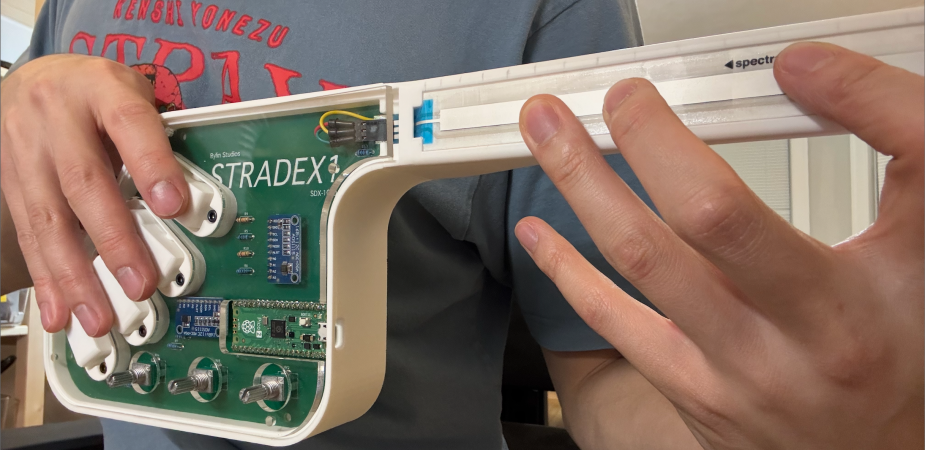
The dream instrument’s name is Stradex1, and it’s a lovely bit of kit. The “fretless” neck is a SoftPot linear potentiometer being sampled by an ADS1115 ADC — that’s a 16-bit unit, so while one might pedantically argue that there are discreet frets, there’s 2^15 of them, which is functionally the same as none at all. Certainly it’s enough resolution for continuous-sounding pitch control, as well as vibrato, as you can see at 3:20 in the demo video below. The four buttons that correspond to the four strings of a violin aren’t just push-buttons, but also contain force sensors (again, sampled by the 16-bit ADC) to allow for fine volume control of each tone.

A few other potentiometers flesh out the build, allowing control over different MIDI parameters, such as what key [Brady] is playing on. The body is a combination of 3D printed plastic and laser-cut acrylic, but [Brady] suggests you could also print the front and back panels if you don’t happen to have a laser cutter handy.

This project sounds great, and it satisfies the maker’s inner child, so what’s not to love. We’ve had lots of MIDI controllers on Hackaday over the years — everything from stringless guitars  to wheel-less Hurdy-Gurdies to say nothing of laser harps galore — but somehow, we’ve never had a MIDI violin. The violin hacks we have featured tend to be either 3D printed or comically small.

If you like this project but don’t feel like fabbing and populating the PCB, [Brady] is going to be giving one away to his 1000th YouTube subscriber. As of this writing, he’s only got 800, so that could be you!

Continue reading “A Childhood Dream, Created And Open Sourced” →
2G Gone? Bring It Back Yourself!

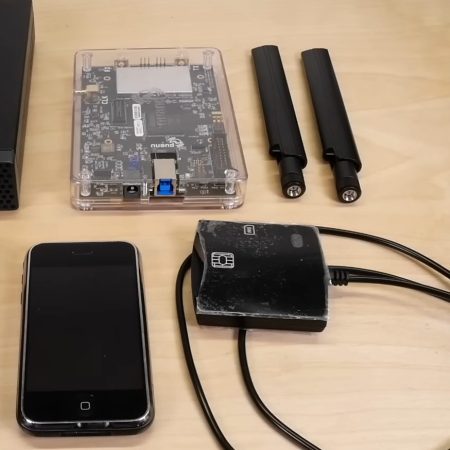
Some parts of the world still have ample 2G coverage; for those of in North America, 2G is long gone and 3G has either faded into dusk or beginning its sunset. The legendary [dosdude1] shows us it need not be so, however: Building a Custom 2G GSM Cellular Base Station is not out of reach, if you are willing to pay for it. His latest videos show us how.

Before you start worrying about the FCC or its equivalents, the power here is low enough not to penetrate [dosdude]’s walls, but technically this does rely in flying under the radar. The key component is a Nuand BladeRF x40 full-duplex Software Defined Radio, which is a lovely bit of open-source hardware, but not exactly cheap. Aside from that, all you need is a half-decent PC (it at least needs USB-3.0 to communicate with the SDR, the “YateBTS”  software (which [dosdude1] promises to provide a setup guide for in a subsequent video) and a sim card reader. Plus some old phones, of course, which is rather the whole point of this exercise.

The 2G sunset, especially when followed by 3G, wiped out whole generations of handhelds — devices with unique industrial design and forgotten internet protocols that are worth remembering and keeping alive. By the end of the video, he has his own little network, with the phones able to call and text one another on the numbers he set up, and even (slowly) access the internet through the miniPC’s network connection.

Unlike most of the hacks we’ve featured from [dosdude1], you won’t even need a soldering iron, never mind a reflow oven for BGA. 

Continue reading “2G Gone? Bring It Back Yourself!” →

GuitarPie Uses Guitar As Interface, No Raspberries Needed

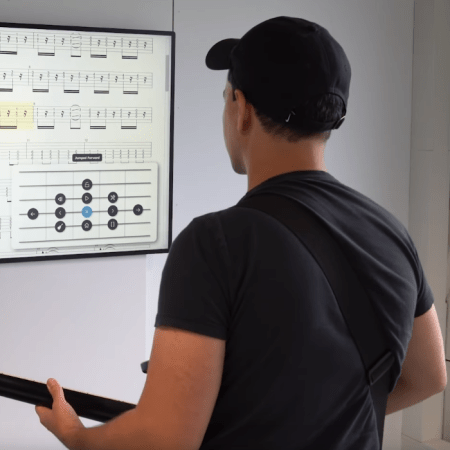
We’ve covered plenty of interesting human input devices over the years, but how about an instrument? No, not as a MIDI controller, but to interact with what’s going on-on screen. That’s the job of GuitarPie, a guitar-driven pie menu produced by a group at the University of Stuttgart.

The idea is pretty simple: the computer is listening for one specific note, which cues the pie menu on screen. Options on the pie menu can be selected by playing notes on adjacent strings and frets. (Check it out in action in the video embedded below). This is obviously best for guitar players, and has been built into a tablature program they’re calling TabCTRL. For those not in the loop, tablature, also known as tabs, is an instrument-specific notation system for stringed instruments that’s quite popular with guitar players. So TabCTRL is a music-learning program, that shows how to play a given song.

With this pairing, you can rock out to the tablature, the guitarist need never take their hands off the frets. You might be wondering “how isn’t the menu triggered during regular play”? Well, the boffins at Stuttgart thought of that– in TabCTRL, the menu is locked out while play mode is active. (It keeps track of tempo for you, too, highlighting the current musical phrase.) A moment’s silence (say, after you made a mistake and want to restart the song) stops play mode and you can then activate the menu. It’s well a well-thought-out UI. It’s also open source, with all the code going up on GitHub by the end of October.

The neat thing is that this is pure software; it will work with any unmodified guitar and computer. You only need a microphone in front of the amp to pick up the notes. One could, of course, use voice control– we’ve seen no shortage of hacks with that–but that’s decidedly less fun. Purists can comfort themselves that at least this time the computer interface is a real guitar, and not a guitar-shaped MIDI controller. Continue reading “GuitarPie Uses Guitar As Interface, No Raspberries Needed” →

The WindRunner unloading a blade, image Radia.

Giant Airplane Goes Long On Specialization

While not everyone agrees on the installation of wind turbines in their proverbial back yards, one thing not up for debate is that there is a drive to build them bigger, and bigger. Big turbines means big blades, and big blades need to be transported… somehow. If air freight is going to stay relevant to the industry, we’re gonna need a bigger airplane.

A startup called Radia has a plan for that plane, and it is a doosie. The “WindRunner” would clock in at a massive 108 meters (354 feet) long, but with a wingspan of just 80 m (262 ft). That’s very, very long, but it might not be the largest airplane, depending how you measure it. Comparing to the 88 m wingspan for the late, lamented An-225 Mriya, you can expect a lower payload capacity, but heavy payloads aren’t the point here. Wind turbine blades really aren’t that heavy. They’re big, or they can be — the WindRunner is designed to fit a single 105 m blade within its long fuselage, or a pair of 90 m blades.

Continue reading “Giant Airplane Goes Long On Specialization” →

Yes, Gemini, A Wii Server Is Possible

When [Reit Tech] needed something to do with an old Nintendo Wii, he turned to Google. When the AI overview told him it could not be used as a server, he had his mission: prove that clanker wrong. It already runs Doom, so what else is there to do?

Of course should not that hard: Linux has been available on the Wii for years now. In fact there are several; he settles on “Arch, btw”, after trying Debian, Ubuntu, and even NetBSD. “Of course it runs NetBSD”– but NetBSD didn’t work with his USB network adapter, which is sadly as predictable as the hardware running NetBSD.

OK, it’s not vanilla Arch; it’s the Wii-Linux Continuation Project, based on ArchPOWER fork that compiles Arch for PPC. As the young YouTuber was surprised to discover, despite not being a PC or particularly powerful, the Wii has a PowerPC CPU. (He might be younger than the console, so we’ll give him a pass.) Wii-Linux couldn’t run the USB adapter either (appropriate apologies were offered to NetBSD), but it turns out the internal Ethernet adapter was available all along.

As a file server, python-based Copyparty worked flawlessly, but the rust-based Minecraft server he picked was not particularly usable. A little optimization would fix that, since you can serve Minecraft from an ESP32 and the Wii absolutely has more horsepower than that. Doubtless he could have loaded a web-server, and proved Google’s AI summary wrong, but the iPad-induced ADHD we all suffer from these days kicks in, so he settled for posting a screenshot of someone else’s blog, hosted on a Wii from NetBSD. So the LLM was wrong from the get-go, but the tour of “what home-brew loaded OSes still work in 2025” was certainly educational.

We could hunt that Wii-based blog down for you, but we’d be reluctant to link to it anyway: while the AI summary is wrong, and you can use the Wii as a server, that doesn’t mean it makes a good one. We’d don’t feel the need to inadvertently DDOS some poor unsuspecting shmuck’s Nintendo, so we’ll let you try and find it yourself.

Just be warned that all of this Wii hacking may not rest on the best of foundations. Continue reading “Yes, Gemini, A Wii Server Is Possible” →

Blocky tread, yellow hub-- yep, it looks like LEGO

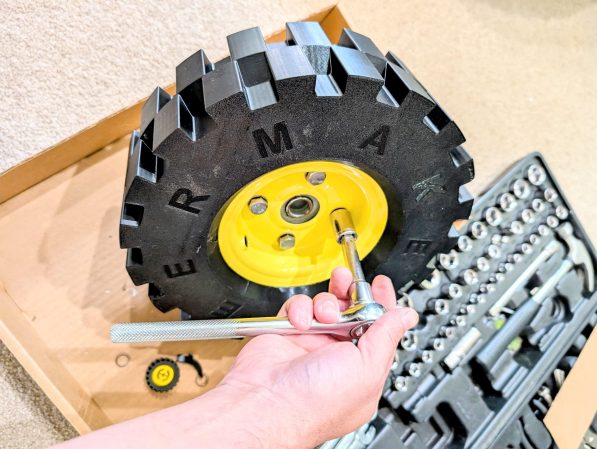
10″ LEGO Tyre Is Practical Nostalgia

If there’s one thing that has come to define the generations after the baby boom, it’s probably nostalgia. It’s heavily marketed and weaponized by the market: yearning for better, simpler times seems to be a core thread of the consumer economy these days. [Makerneer] combined his xilennial love of LEGO bricks with the flat tires on his log splitter to produce a 10″ TPU tyre will never go flat, and provide a dopamine release every time he sees it.

The tyre is a custom model to fit his particular rims, but he does provide STEP and F3D files if you’d like to try modifing it for your own purpose — they’re at Step 6 of the Instructable. Props to [Makerneer] for truly open-sourcing the design instead of just tossing STL files online. His build log also takes the time to point out the ways he had to modify the LEGO tyre profile to make it amenable to 3D printing: notably chamfering some of the tread pattern to eliminate bridging, which is a bit of a no-no with TPU.

As you can see in the (unfortunately vertical) demo video below, it’s a bit quite a bit squishier than a regular run-flat tyre, but that was part of [Makerneer]’s design goal. He didn’t like how rigid the non-pneumatic tyres he’d tried were, so endevoured to design something himself; the whole LEGO thing was just for fun. If you wanted to replicate this tyre with a bit less skoosh, you need only tune the infill on your print.

While only time will tell how long this LEGO-inspired add-on will continue adding whimsy to [Makerneer]’s log-splitting, we have tests to show it will outperform any other plastic he might have printed. This project is probably more practical than a 3D printed bicycle tyre, which doesn’t even have the side benefit of whimsy. Continue reading “10″ LEGO Tyre Is Practical Nostalgia” →

How Many Phones Sport A 5 And 1/4 Diskette Drive? This One.

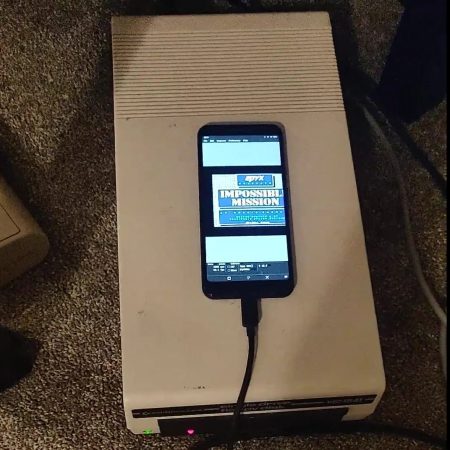
It all started with a sarcastic comment right here on Hackaday.com: ” How many phones do you know that sport a 5 and 1/4 inch diskette drive?” — and [Paul Sanja] took that personally, or at least thought “Challenge accepted” because he immediately hooked an old Commodore floppy drive to his somewhat-less-old smartphone. 

The argument started over UNIX file directories, in a post about Redox OS on smartphones— which was a [Paul Sajna] hack as well. [Paul] had everything he needed to pick up the gauntlet, and evidently did so promptly. The drive is a classic Commodore 1541, which means you’ll want to watch the demo video at 2x speed or better. (If you thought loading times felt slow in the old days, they’re positively glacial by modern standards.) The old floppy drive is plugged into a Google Pixel 3 running Postmarket OS. Sure, you could do this on Android, but a fully open Linux system is obviously the hacker’s choice. As a bonus, it makes the whole endeavor almost trivial.

Continue reading “How Many Phones Sport A 5 And 1/4 Diskette Drive? This One.” →