
Vertical Solar Panels Are Out Standing

If you’re mounting solar panels, everybody knows the drill, right? Point them south, angled according to latitude. It’s easy. In a video which demonstrates that [Everyday Dave] is truly out standing in his field, we hear a different story. [Dave] has a year’s worth of data in his Solar Panel Showdown that suggests there are good reasons to mount your panels vertically.

Specifically, [Dave] is using bifacial solar panels– panels that have cells on both sides. In his preferred orientation, one side faces South, while the other faces North. [Dave] is in the Northern Hemisphere, so those of you Down Under would have to do the opposite, pointing one face North and the other South.

Since [Dave] is far from the equator, the N/S vertical orientation beats the pants off of East-West facing panels, especially in winter. What’s interesting is how much better the bifacial panels do compared to the “standard” tilted orientation. While peak power in the summer is much better with the tilted bifacial panels (indeed, even the tilted single-sided panels), in winter the vertical N/S panels blow them out of the water. (Especially when snow gets involved. Vertical panels don’t need sweeping!)
Continue reading “Vertical Solar Panels Are Out Standing” →

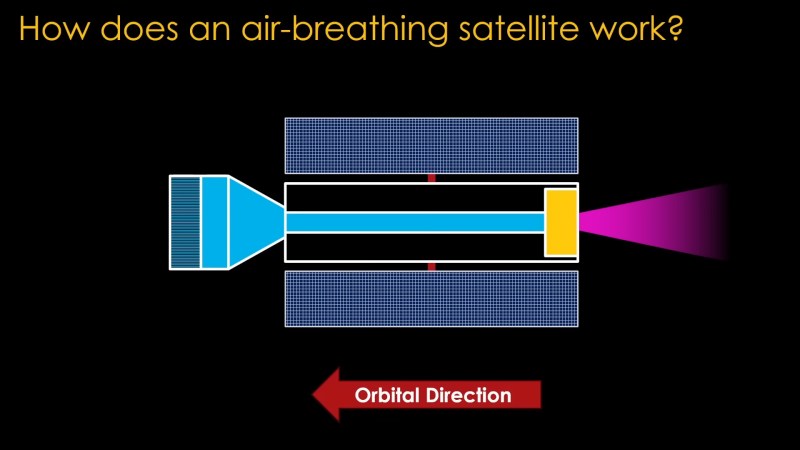
Diagram of an air-breathing satellite

It’s A Bird! It’s A Plane! It’s… An Air Breathing Satellite?!

The big problem with Low Earth Orbit is, oddly enough, air resistance. Sure, there’s not enough air to breathe in space, but there is enough to create drag when you’re whipping around the planet at 28,000 km/h (17,000 mph) or more. Over time, that adds up to a decaying orbit. [Eager Space] recently did a video summarizing a paradoxical solution: go even lower, and let the air work for you.

So called air-breathing satellites would hang out in very low earth orbit– still well above the Karman line, but below 300 km (186 miles)– where atmospheric drag is too dominant for the current “coast on momentum” satellite paradigm to work. There are advantages to going so low, chiefly for communications (less latency) and earth observation (higher resolutions). You just need to find a way to fight that drag and not crash within a couple of orbits.

It turns out this space isn’t totally empty (aside from the monoatomic oxygen) as missions have been at very low orbits using conventional, Xenon-fueled ion engines to counter drag. The xenon runs out pretty quick in this application, though, and those satellites all had fairly short lifetimes.

That’s where the air-breathing satellites come in. You don’t need a lot of thrust to stabilize against drag, after all, and the thin whisps of air at 200 km or 300 km above ground level should provide ample reaction mass for some kind of solar-electric ion engine. The devil is in the details, of course, and [Eager Space] spends 13 minutes discussing challenges (like corrosive monoatomic oxygen) and various proposals.

Whoever is developing these satellites, they could do worse than talk to [Jay Bowles], whose air-breathing ion thrusters have been featured here several times over the years.

Continue reading “It’s A Bird! It’s A Plane! It’s… An Air Breathing Satellite?!” →

3D Printed “Book” Demonstrates Mechanical Actions

A book of mechanical actions is a wondrous thing — mechanically inclined children have lost collective decades pouring over them over the generations. What could possibly be better? Why, if the mechanisms in the book were present, and moved! That’s exactly what [AxelMadeIt] produced for a recent video.

Being just four pages, you might argue this is but a pamphlet. But since it takes up a couple inches of shelf space, it certainly looks like a book from the outside, which is exactly what [AxelMadeIt] was going for. To get a more book-like spine, his hinge design sacrificed opening flat, but since the pages are single-sided, that’s no great sacrifice.

At only 6 mm (1/4″) thick, finding printable mechanisms that could actually fit inside was quite a challenge. If he was machining everything out of brass, that would be room for oodles of layers. But [Axel] wanted to print the parts for this book, so the mechanisms need to be fairly thick. One page has a Roberts linkage and a vault-locking mechanism, another has planetary gears, with angled teeth to keep them from falling out. Finally, the first page has a geneva mechanism, and an escapement, both driven by a TPU belt drive.

All pages are driven from an electric motor that is buried in the last page of the “book”, along with its motor, battery, and a couple of micro-switches to turn it on when you open the book and off again when you reach the last page. Rather than a description of the mechanisms, like most books of mechanical actions, [Axel] used multi-material printing to put lovely poems on each page. A nice pro-tip is that “Futura”, a font made famous by flying to the moon, works very well when printed this way. If you just want to watch him flip through, jump to 8:00 in the video.

This reminds us of another project we once featured, which animated 2100 mechanical mechanisms. While this book can’t offer near that variety, it makes up for it in tactility.

Continue reading “3D Printed “Book” Demonstrates Mechanical Actions” →

Redox on desktop.

Who Wants A Rusty Old Smartphone?

If we’re talking about oxidized iron… probably nobody. If we’re talking about Rust the programming language, well, that might be a different story. Google agrees, and is working on bringing the language into Android. That’s not enough for [Paul Sanja], who has the first Redox OS smartphone.

It’s alive!

Redox OS is a Unix-like operating system written entirely in Rust, and somehow we haven’t covered it until now. Unlike Asterinas, a project to recreate the Linux kernel in Rust, Redox has few pretensions of being anything but its own thing, and that’s great! On desktop, Redox has a working windowing system and many utilities, including a basic browser in the form of NetSurf.

It’s claims to be source-compatible with Linux and BSD programs, and partially POSIX compliant. A certain someone around here might want to try it as a daily driver. The header image is a desktop screenshot, because there’s more to see there and it fits our aspect ratio.

On smartphones, it… boots. Some smartphones, anyway. It’s actually a big first step. That booting is possible is actually thanks to the great work put in by the Postmarket OS team to get Uboot working on select android devices. That uboot loader doesn’t need to load the Linux-based Postmarket OS. It can be used for anything compatible. Like, say, Redox OS, as [Paul] shows us.

Of course, Redox OS has no drivers for the touchscreen or anything else, so at the moment that rusty smartphone can only boot to a login screen. But thanks to Rust, you can rest assured that login screen hasn’t got any memory leaks! Jokes aside, this is a great start and we’re hoping to see more.

Redox is a promising project on mobile or desktop, and its development seems a much better use of time and effort than fighting over Rust in the Linux kernel.

Blue Alchemist Promises Rocket Fuel From Moon Dust

Usually when an alchemist shows up promising to turn rocks into gold, you should run the other way. Sure, rocket fuel isn’t gold, but on the moon it’s worth more than its weight in the yellow stuff. So there would be reason to be skeptical if this “Blue Alchemist” was actually an alchemist, and not a chemical reactor under development by the Blue Origin corporation.

The chemistry in question is quite simple, really: take moon dust, which is rich in aluminum silicate minerals, and melt the stuff. Then it’s just a matter of electrolysis to split the elements, collecting the gaseous oxygen for use in your rockets. So: moon dust to air and metals, just add power. Lots and lots of power.

Melting rock takes a lot of temperature, and the molten rock doesn’t electrolyse quite as easily as the water we’re more familiar with splitting. Still, it’s very doable; this is how aluminum is produced on Earth, though notably not from the sorts of minerals you find in moon dust. Given the image accompanying the press release, perhaps on the moon the old expression will be modified to “make oxygen while the sun shines”.

Hackaday wasn’t around to write about it, but forward-looking researchers at NASA, expecting just such a chemical reactor to be developed someday, proposed an Aluminum/Liquid Oxygen slurry monopropellant rocket back in the 1990s.

That’s not likely to be flying any time soon, but of course even with the Methalox rockets in vogue these days, there are appreciable cost savings to leaving your oxygen and home. And we’re not biologists, but maybe Astronauts would like to breathe some of this oxygen stuff? We’ve heard it’s good for your health.

Full Scale Styrofoam DeLorean Finally Takes Flight

It’s 2025 and we still don’t have flying cars — but we’ve got this full-scale flying DeLorean prop from [Brian Brocken], and that’s almost as good. It’s airborne and on camera in the video embedded below.

We’ve written about this project before; first about the mega-sized CNC router [Brian] used to carve the DeLorean body out of Styrofoam panels, and an update last year that showed the aluminum frame and motorized louvers and doors.

Well, the iconic gull-wing doors are still there, and still motorized, and they’ve been joined by a tire-tilting mechanism for a Back To The Future film-accurate flight mode. With the wheels down, the prop can use them to steer and drive, looking for all the world like an all-white DMC-12.

The aluminum frame we covered before is no longer in the picture, though. It’s been replaced by a lighter, stiffer version made from carbon fibre. It’s still a ladder frame, but now with carbon fiber tubes and “forged” carbon fiber corners made of tow and resin packed in 3D printed molds. There’s been a tonne of work documented on the build log since we last covered this project, so be sure to check it out for all the details.

Even in unpainted white Styrofoam, it’s surreal to see this thing take off; it’s the ultimate in practical effects, and totally worth the wait. Honestly, with talent like [Brian] out there its a wonder anyone still bothers with CGI, economics aside.

Thanks to [Brian] for the tip! If you have a project you’ve hit a milestone with, we’d love to see it, even if it doesn’t trigger the 80s nostalgia gland we apparently all have embedded in our brains these days. Send us a tip!

Continue reading “Full Scale Styrofoam DeLorean Finally Takes Flight” →

March To The Beat Of Your Own Piezoelectric Drum

Drums! You hit them, and they vibrate. It’s kind of fun. Piezoelectric elements can create electric current when they vibrate. [Will Dana] put two and two together to try and charge his phone on his YouTube channel WillsBuilds embedded below.

It worked… about as well as you might expect. Which is to say: not very well. The random piezo elements [Will] glues to his drum almost certainly aren’t optimized for this use case. Adding weight helps, but it doesn’t look like a tuned system. Even if it was, piezoelectric generators aren’t terribly efficient by nature, and the (small) losses from the required bridge rectifiers aren’t helping. An energy-harvesting chip might have worked better, but it probably wouldn’t have worked well.

Since he cannot produce enough voltage in real time, [Will] opts to charge a capacitor bank that he can dump into the phone once it gets enough charge in it to register with the phone’s circuitry. It takes about 30 minutes drumming to charge the capacitors in parallel, before switching to series to get the voltage up to discharge. The capacitors drain in about a quarter second, probably to no measurable result– but the phone does read as “charging”, which was the goal.

Did it work? Technically, yes. The phone was “charging”. Is it practical? Certainly not. Is it a hack? Undeniably so.

Continue reading “March To The Beat Of Your Own Piezoelectric Drum” →