Plasma Cutter On The Cheap Reviewed

If you have a well-equipped shop, it isn’t unusual to have a welder. Stick welders have become a commodity and even some that use shield gas are cheap if you don’t count buying the bottle of gas. But plasma cutters are still a bit pricey. Can you get one from China for under $300? Yes. Do you want one that cheap? [Metal Massacre Fab Shop] answers that question in the video below.

First impressions count, and having plasma misspelled on the unit (plasme) isn’t promising. The instructions were unclear, and some of the fittings didn’t make him happy, so he replaced them with some he had on hand. He also added some pipe tape to stop any leaking.

The first test was a piece of quarter-inch steel at 35 amps. The machine itself is rated to 50 amps. Sparks ensued, and with a little boost in amperage, it made a fair-looking cut. At 50 amps, it was time to try a thicker workpiece. It made the cut, although it wasn’t beautiful. The leaking regulator and the fact that he can’t run the compressor simultaneously as the cutter didn’t help.

From the look of it, for light duty, this would be workable with a little practice and maybe some new fittings. Unsurprisingly, it probably isn’t as capable as a professional unit. Still could be very handy to have.

It is possible to convert a welder into a plasma cutter. A handheld unit like this probably won’t benefit from a Sharpie.
Continue reading “Plasma Cutter On The Cheap Reviewed”

Waveform Generator Teardown Is Nearly Empty

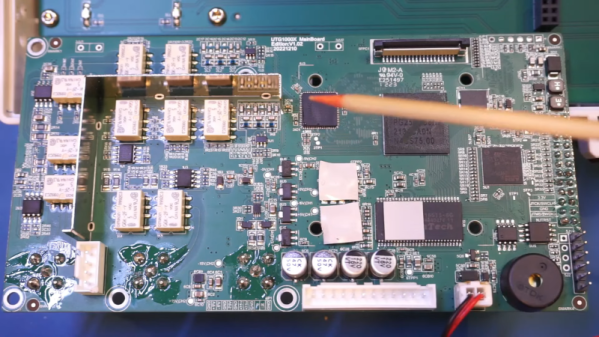
We always enjoy [Kerry Wong]’s insightful teardowns, and recently, he opened up a UTG1042X arbitrary waveform generator. Getting inside was a bit of a challenge since there were no visible screws. Turns out, they were under some stickers. We always dislike that because it is very difficult to get the unit to go back together.

Once open, the case reveals it is almost completely empty. The back panel has a power supply, and the front panel has all the working circuitry. The box seems to be for holding the foot and preventing the device from getting lost on your bench.

The power supply is unremarkable. There are a few odd output voltages. The main board is a bit more interesting, especially after removing the heat sink. There are two channels, but the board isn’t laid out, with a lot of segregation between the two channels. That makes sense with the output sections clustered together and the digital section with the CPU, FPGA, and the DAC in close proximity.

The other side of the board connects to a very simple display board. It would be interesting to compare this to a circa-1980s AWG, which would have been far more complicated.

Making a waveform generator with a microprocessor and a DAC isn’t hard. The hard part is the output stages and maximizing the operating speed.

Continue reading “Waveform Generator Teardown Is Nearly Empty”

Voice Control For A Vintage Heathkit Radio

Most modern ham rigs have a voice activated transmission (VOX) mode, although we don’t know many people who use it often. When a transmitter is in VOX mode, it starts transmitting when you talk, and then, when you pause for a second or two, the transmitter turns off. Many old ham transmitters, though, didn’t support VOX, so Heathkit sold the VX-1 “electronic voice control” to add VOX to older transmitters. [Jeff Tranter] shows us inside a clean-looking unit.

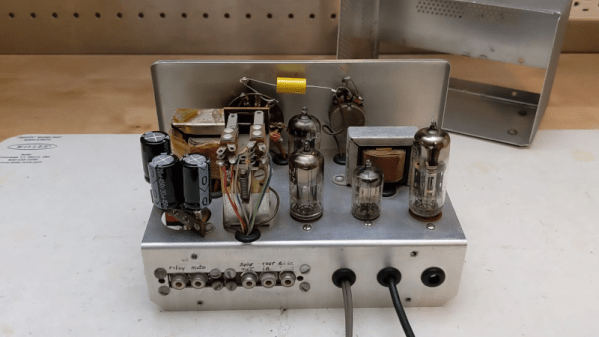
These devices were sold from 1958 to 1960 and used tubes and a selenium rectifier. The device is connected between the microphone and the transmitter. It also sat between the receiver and the speaker to mute audio while transmitting. The original unit had a screw terminal to connect to the outside world, and some of the screws had live line voltage on them. The unit [Jeff] examines is modified to have phono jacks along with a few other repairs.

The wiring looks like a tube radio. Tubes are above the chassis, and point-to-point wiring is underneath. There is also an unusual sealed selenium rectifier. [Jeff] shows how the device works using just a receiver. A few minor repairs were needed.

If you are interested in getting your ham license, most modern radios support VOX out of the box — no rhyme intended. We do, however, love that old Heathkit gear.

Continue reading “Voice Control For A Vintage Heathkit Radio”

Danish Vintage LRC Meter Reveals Inside

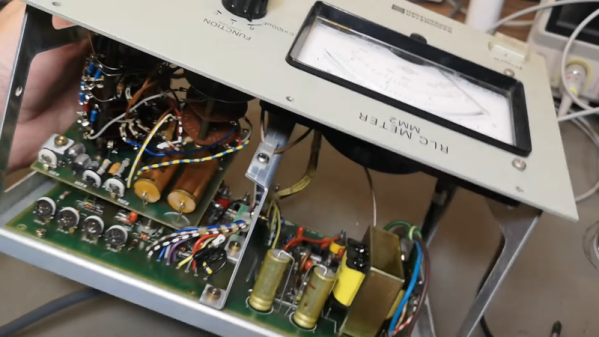
Modern test equipment is great, but there’s something about a big meter with a swinging needle and a mirror for parallax correction that makes a device look like real gear. [Thomas] shows us a Danish LCR meter (or, as it says on the front, an RLC meter). The device passes AC through the component and uses that to determine the value based on the setting of a range switch. It looks to be in great shape and passed some quick tests. Have a look at it in the video below.

An outward inspection shows few surprises, although there is an odd set of terminals on the back labeled DC bias. This allows you to provide a DC voltage in case you have a capacitor that behaves differently when the capacitor has a DC voltage across it. Continue reading “Danish Vintage LRC Meter Reveals Inside”

A Slew Of AI Courses To Get Yourself Up To Speed

When there’s a new technology, there’s always a slew of people who want to educate you about it. Some want to teach you to use their tools, some want you to pay for training, and others will use free training to entice you to buy further training. Since AI is the new hot buzzword, there are plenty of free classes from reputable sources. The nice thing about a free class is that if you find it isn’t doing it for you, there’s no penalty to just quit.

We noticed NVIDIA — one of the companies that has most profited from the AI boom — has some courses (not all free, though). Generative AI Explained, and Augment your LLM Using Retrieval Augmented Generation caught our eye. There’s also Building a Brain in 10 Minutes, and Introduction to Physics-informed Machine Learning with Modulus. These are all quite short, though.

Continue reading “A Slew Of AI Courses To Get Yourself Up To Speed”

Delays And Timers In LTSpice (no 555)

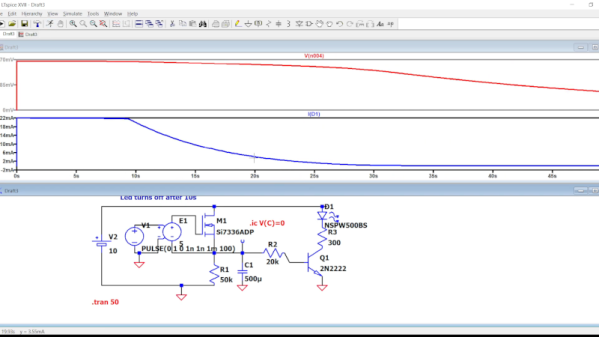
If you need a precise time, you could use a microcontroller. Of course, then all your friends will say “Could have done that with a 555!” But the 555 isn’t magic — it uses a capacitor and a comparator in different configurations to work. Want to understand what’s going on inside? [Mano Arrostita] has a video about simulating delay and timer circuits in LTSpice.

The video isn’t specifically about the 555, but it does show how the basic circuits inside a timer chip work. The idea is simple: a capacitor will charge through a resistor with an exponential curve. If you prefer, you can charge with a constant current source and get a nice linear charge.

You can watch the voltage as the capacitor charges and when it reaches a certain point, you know a certain amount of time has passed. The discharge works the same way, of course.

We like examining circuits for learning with a simulator, either LTSpice or something like Falstad. It is easier than breadboarding and encourages making changes that would be more difficult on a real breadboard. If you want a refresher on LTSpice or current sources, you can kill two birds with one stone.

Continue reading “Delays And Timers In LTSpice (no 555)”

No Lathe? Build Your Own

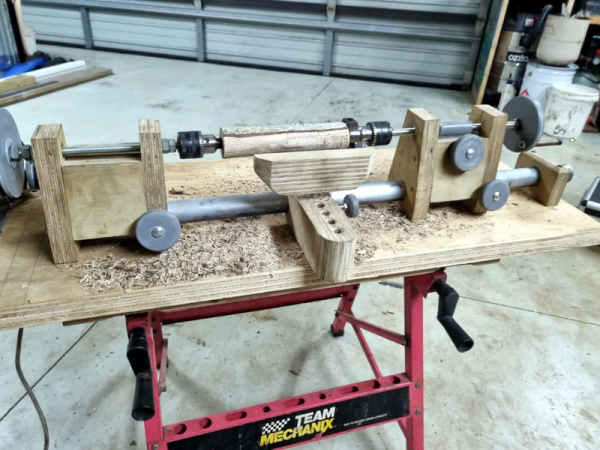
If you need to make round things, you probably need a lathe. Can you build one as nice as one you can buy? Probably not. But can you build one that will work and allow you to do more things than having no lathe at all? [Mikeandmertle] say absolutely! You can see the contraption in operation in the video below.

The build is decidedly functional-looking and only requires a few parts. Most of the components are unremarkable, save for a threaded bar, a metal pipe, some bearings, and a few threaded inserts. Well, there’s also a drill chuck and two lathe centers. Those don’t have to be very expensive, but they may well be the bulk of what you have to spend to make this project.

Continue reading “No Lathe? Build Your Own”