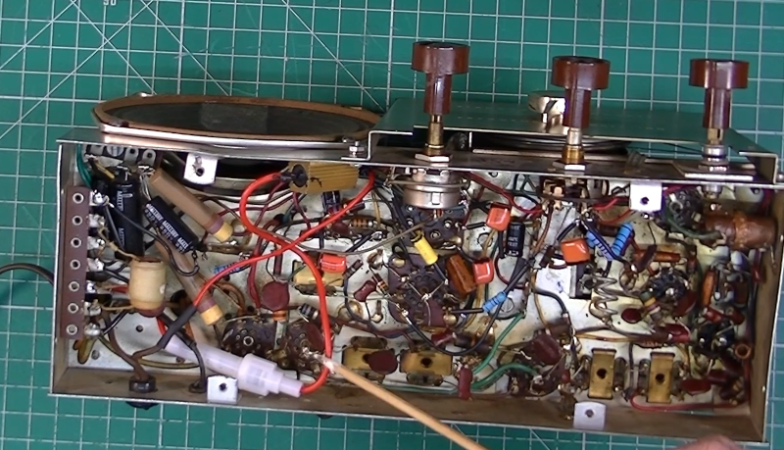
A 1962 Test Gear Teardown

Although it sounds like some Star Trek McGuffin, a Q-Meter is a piece of test gear that measures the Q factor of a tuned circuit. [Thomas] got a Boonton meter from 1962 that wasn’t in very good shape, but it was a fun teardown, as you can see in the video below. The meter had signs of a prior modification or repair, but still a nice peek into some vintage gear.

The meter could measure up to 260 MHz (or megacycles in 1962 parlance) and had some unusual features, including an oddly wired AC transformer and a “voltage stabilizer” to ensure a constant AC voltage at the input. We have to admit, we miss the days when our test equipment had gears inside. Then again, we don’t miss the tubes and the high-voltage stuff. Because of the high frequency, the unit even has an oddball acorn tube that you rarely see.

You may notice the meter has a mirror in a strip on the face. This is a common feature of high-precision analog meter movements. The idea is that you move your head until the needle hides its own reflection in the mirror to avoid parallax errors in your reading.

This isn’t the first Q meter we’ve seen; in fact, one was pretty similar but a bit older. While you can get a lot of new gear cheap these days, there’s still something to be said for vintage test equipment.

Continue reading “A 1962 Test Gear Teardown”

Forgotten Internet: Giving (or Getting) The Finger

Hey, you know that guy in accounting, Marco? If you want to find out more about him, you’d probably go surf LinkedIn or maybe a social media site. Inside a company, you might look on instant messaging for a profile and even find out if he is at his desk or away. But back in the 1970s, those weren’t options. But if Marco was on the computer system, maybe you could finger him. While that sounds strange to say today, Finger was a common service provided by computer services at the time. It was like a LinkedIn profile page for the 1970s.

Based on RFC 742, Finger was the brainchild for [Les Earnest]. From a user’s point of view, you put a few files in your home directory (usually .project and .plan; both hidden files), and when someone “fingered” you, they’d see some human-friendly output about your account like your name and office location, if you were logged in or not, and the contents of your project and plan files.

Modern versions may also show your public PGP key and other data. You could usually put a file in your home directory called .nofinger if you wanted to stop people from fingering you.

Continue reading “Forgotten Internet: Giving (or Getting) The Finger”

Inside Vacuum Fluorescent Displays

VFDs — vacuum fluorescent displays — have a distinctive look, and [Anthony Francis-Jones] is generally fascinated with retro displays. So, it makes sense that he’d build a VFD project as an excuse to explain how they work. You can see the video below.

VFDs are almost miniature CRTs. They are very flexible in what they display and can even use color in a limited way. The project [Anthony] uses as an example is an indicator to show the video number he’s currently making.

Continue reading “Inside Vacuum Fluorescent Displays”

Parcae: A Trio Of Spy Satellites

Did you ever hear of a satellite called Parcae (pronounced like park-eye)? If you haven’t, don’t feel bad—it was, after all, a top-secret project only revealed in July 2023. [Ivan Amato] not only heard about it, but also wrote a fascinating peek into the cloak-and-dagger world of cold-war spy satellites for this month’s IEEE Spectrum.

According to [Ivan], the satellite helped the United States to keep track of Russian submarines and was arguably the most capable orbiting spy platform ever. Or, at least, that we get to hear about.

Continue reading “Parcae: A Trio Of Spy Satellites”

Testing At Scale

We’ve said it before: building one-offs is different from building at scale. Even on a small scale. There was a time when it was rare for a hobbyist to produce more than one of anything, but these days, access to cheap PC boards makes small production runs much more common. [VoltLog], for example, is selling some modules and found he was spending a lot of time testing the boards. The answer? A testing jig for his PC board.

Big factories, of course, have special machines for bulk testing. These are usually expensive. [VoltLog] found a place specializing in creating custom test jigs using 3D printing.

They also have some standard machines. He did have to modify his PCB to accommodate special test points. He sent the design files to the company, and they produced a semi-custom testing jig for the boards in about a month.

Continue reading “Testing At Scale”

Your VAX In A Cloud Is Ready

For many people of a certain age, the DEC VAX was the first computer they ever used. They were everywhere, powerful for their day, and relatively affordable for schools and businesses. These minicomputers were smaller than the mainframes of their day, but bigger than what we think of as a computer today. So even if you could find an old one in working order, it would be a lot more trouble than refurbishing, say, an old Commodore 64. But if you want to play on a VAX, you might want to get a free membership on DECUServe, a service that will let you remotely access a VAX in all its glory.

The machine is set up as a system of conferences organized in notebooks. However, you do wind up at a perfectly fine VAX prompt (OpenVMS).

Continue reading “Your VAX In A Cloud Is Ready”

DIY Strontium Aluminate Glows In The Dark

[Maurycyz] points out right up front: several of the reagents used are very corrosive and can produce toxic gasses. We weren’t sure if they were trying to dissuade us not to replicate it or encourage us to do so. The project in question is making strontium aluminate which, by the way, glows in the dark.

The material grows strongly for hours and, despite the dangers of making it, it doesn’t require anything very exotic. As [Maurycyz] points out, oxygen and aluminum are everywhere. Strontium sounds uncommon, but apparently, it is used in ceramics.

For the chemists among us, there’s an explanation of how to make it by decomposing soluble nitrate salts. For the rest of us, the steps are to make aluminum hydroxide using potassium alum, a food preservative, and sodium hydroxide. Then, it is mixed with nitric acid, strontium carbonate, europium, and dysprosium. Those last elements determine the color of the glow.

A drying step removes the acid, followed by dissolving with urea and water. The heat of the reaction wasn’t enough to form the final product, but it took time with an oxy-propane torch to form blobs of strontium aluminate. The product may not have been pure, because it didn’t glow for hours like commercial preparations. But it did manage to glow for a few minutes after light exposure.

We try to limit our chemistry to less toxic substances, although ferric chloride can make a mess. You could probably track down the impurities with a gas chromatograph. What we really want is a glow-in-the-dark car antenna.