The Macintosh Plus Sounds Great If You Do Exactly This With It

The Macintosh Plus is not exactly known as particularly relevant in the worlds of chiptune or electronic music more broadly. That’s not to say it can’t do anything that sounds cool, however. As [Action Retro] demonstrates,  it’s got some really impressive tricks up its sleeve if you know what you’re doing.

The video centers around “Music Mouse”, a piece of software created by Laurie Spiegel for the Macintosh Plus all the way back in 1986. Spiegel saw the Macintosh Plus as a potential instrument for musical expression, with the then-innovative mouse as the key human interface.

[Action Retro] shows off the software, which is able to create rather pleasing little melodies with little more than a swish and a swash across the mousepad. The software makes smart use of scales so you’re not forever dodging around dissonant notes, so it’s quite easy to play something beautiful. He then makes things more interesting by pairing the Macintosh Plus with his favorite guitar pedal—the Old Blood Noise Endeavors Sunlight. It’s a dynamic reverb that really opens up the sonic landscape when paired with the Mac Plus. If you’re looking for a weird avant-garde setup to take on stage at your next noise show, this has to be it.

We’re usually used to seeing Nintendo and Commodore products in the retro computer music space. The Mac makes a nice change. Video after the break.

Continue reading “The Macintosh Plus Sounds Great If You Do Exactly This With It”

Robots Collaborate To Localize Themselves Precisely

Here’s the thing about robots. It’s hard for them to figure out where to go or what they should be doing if they don’t know where they are. Giving them some method of localization is key to their usefulness in almost any task you can imagine. To that end, [Guy Elmakis], [Matan Coronel] and [David Zarrouk] have been working on methods for pairs of robots to help each other in this regard.

As per the research paper, the idea is to perform real-time 3D localization between two robots in a given location. The basic idea is that the robots take turns moving. While one robot moves, the other effectively acts as a landmark. The robots are equipped with inertial measurement units and cameras in a turret, which they use to track each other and their own movements. Each robot is equipped with a Raspberry Pi 4 for processing image data and computing positions, and the two robots communicate via Bluetooth to coordinate their efforts.

It’s an interesting technique that could have some real applications in swarm robotics, and in operations in areas where satellite navigation and other typical localization techniques are not practical. If you’re looking for more information, you can find the paper here. We’ve seen some other neat localization techniques for small robots before, too. Video after the break.

Continue reading “Robots Collaborate To Localize Themselves Precisely”

It Turns Out, A PCB Makes A Nice Watch Dial

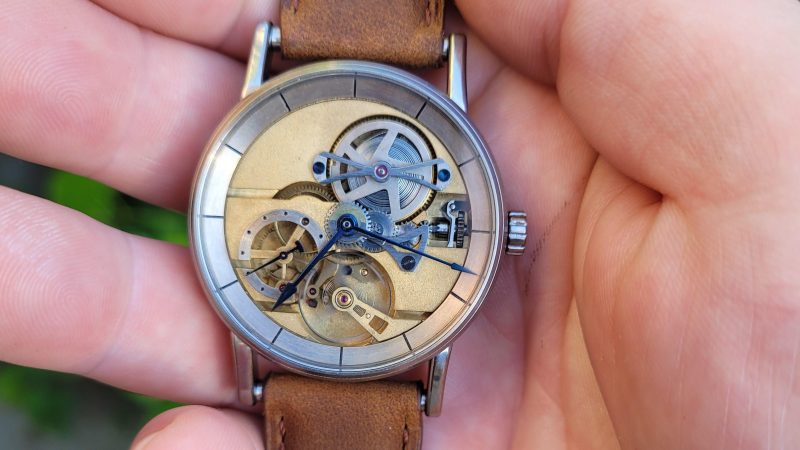
Printed circuit boards are typically only something you’d find in a digital watch. However, as [IndoorGeek] demonstrates, you can put them to wonderful use in a classical analog watch, too. They can make the perfect watch dial!

Here’s the thing. A printed circuit board is fundamentally some fiberglass coated in soldermask, some copper, maybe a layer of gold plating, and with some silk screen on top of that. As we’ve seen a million times, it’s possible to do all kinds of artistic things with PCBs; a watch dial seems almost obvious in retrospect!

[IndoorGeek] steps through using Altium Designer and AutoCAD to layout the watch face. The guide also covers the assembly of the watch face into an actual wrist watch, including the delicate placement of the movement and hands. They note that there are also opportunities to go further—such as introducing LEDs into the watch face given that it is a PCB, after all!

It’s a creative way to make a hardy and accurate watch face, and we’re surprised we haven’t seen more of this sort of thing before. That’s not to say we haven’t seen other kinds of watch hacks, though; for those, there have been many. Video after the break.

Continue reading “It Turns Out, A PCB Makes A Nice Watch Dial”

You Can Get A Precision Instrument-Guided Landing Even In Antarctica

Traditional airports spend big money to install instrument landing systems (ILS) to guide planes in safely. In places like Antarctica, though, it’s simply not possible to permanently install a massive antenna array for localization, particularly with all the ice shifting about on the regular. As covered by Flightradar24, the solution to this is to use a transponder landing system (TLS) instead.

Comparatively compact! Credit: ANPC

A TLS tracks planes by using multilateration—basically, transponder signals are picked up by multiple antennas and the time delays are used to figure out the position of the aircraft. It then sends the guidance signals a plane would normally expect to receive from an ILS transmitter array, for horizontal and vertical guidance. These signals appear to the plane to be coming from antennas located as per a typical ILS array, with the TLS able to generate signals from ‘virtual emanation points” as needed. This allows the TLS to generate different landing approaches to suit different planes and conditions. From the pilot and aircraft side, it’s all perfectly transparent.

In Antarctica’s McMurdo station, landings are handled by a TLS system that barely takes up more space than a single shipping crate. The system can be set up in just a few hours, unlike a traditional ILS which takes significant installation work spanning weeks or months at best. At the moment, though, the landing strip at McMurdo is stable enough that the system only needs periodic realignment every three years or so.

You might assume that if you’re approaching Antarctica by plane, everything would be on manual. However, the creature comforts of modern airports are available even at one of the the most southerly airports on Earth!


A very tiny keyboard with RGB backlighting.

Tiny Custom Keyboard Gets RGB

Full-size keyboards are great for actually typing on and using for day-to-day interfacing duties. They’re less good for impressing the Internet. If you really want to show off, you gotta go really big — or really small. [juskim] went the latter route, and added RGB to boot!

This was [juskim]’s attempt to produce the world’s smallest keyboard. We can’t guarantee that, but it’s certainly very small. You could readily clasp it within a closed fist. It uses a cut down 60% key layout, but it’s still well-featured, including numbers, letters, function keys, and even +,-, and =. The build uses tiny tactile switches that are SMD mounted on a custom PCB. An ATmega32U4 is used as the microcontroller running the show, which speaks USB to act as a standard human interface device (HID). The keycaps and case are tiny 3D printed items, with six RGB LEDs installed inside for the proper gamer aesthetic. The total keyboard measures 66 mm x 21 mm.

Don’t expect to type fast on this thing. [juskim] only managed 14 words per minute. If you want to be productive, consider a more traditional design.

Continue reading “Tiny Custom Keyboard Gets RGB”

The Famous Computer Cafe Has Now Been Archived Online

You might think that TV stations or production houses would be great at archiving, but it’s not always the case. Particularly from the public access perspective. However, if you’re a fan of The Famous Computer Cafe, you’re in luck! The beloved series has now been preserved on The Internet Archive!

If you’re not familiar with the show, it was a radio program broadcast from 1983 to 1986. It was pumped out of a variety of radio stations in southern and central California in the period. The creators making sure to keep a copy of each episode in reel-to-reel tape format. For years, these tapes were tragically lost, until archivist [Kay Savetz] was able to recover some of them from a recent property sale. From there, a GoFundMe paid for digitization, and the show has been placed on The Internet Archive with the blessings of the original creators.

This is quite the cultural victory, particularly when you observe the list of guests on the show. Timothy Leary, Bill Gates, Jack Tramiel, and even Douglas Adams made appearances in the recovered recordings. Sadly, though, not all the tapes have been recovered. Episodes with Gene Roddenberry, Robert Moog, and Ray Bradbury are still lost to time.

If you fancy a listen, 53 episodes presently exist on the archive. Take a trip back in time and hear from some technological visionaries—and futurists—speaking their minds at the very beginning of the microcomputer era! If you find any particularly salient gems, don’t hesitate to drop them on the tip line.

Portable PS4 Is Easier To Move Than A Regular One

The PlayStation 4 was a popular enough console, but it was a home console. If you wanted to play at a friend’s house, you had to unplug all your cables and haul the whole lot over there. Unless, that is, you built something along the lines of [Rudd van Falier]’s Portable GameStation.

It’s not a super-complicated build, but it is a well-executed one. It combines laser cut acrylic with 3D-printed brackets to produce a housing that looks clean, sharp, and of almost commercial quality. That’s the benefit of laser-cutting—it avoids all the ugly problems of layer lines. From there, [Rudd] simply set about stuffing the PS4 motherboard inside, along with placing the relevant ports and vents in the housing where needed. A screen with inbuilt speakers was then attached to complete the build. The one thing it’s missing is a set of batteries for playing it on the bus. This thing needs mains power to run.

We’d love to see [Rudd] take another stab at the concept, making it fully independent from cables. It’s definitely possible. Who wouldn’t want to play some Persona 5 Royal on the train, anyway? Video after the break.

Continue reading “Portable PS4 Is Easier To Move Than A Regular One”