Building A C-3PO You Can Really Talk To

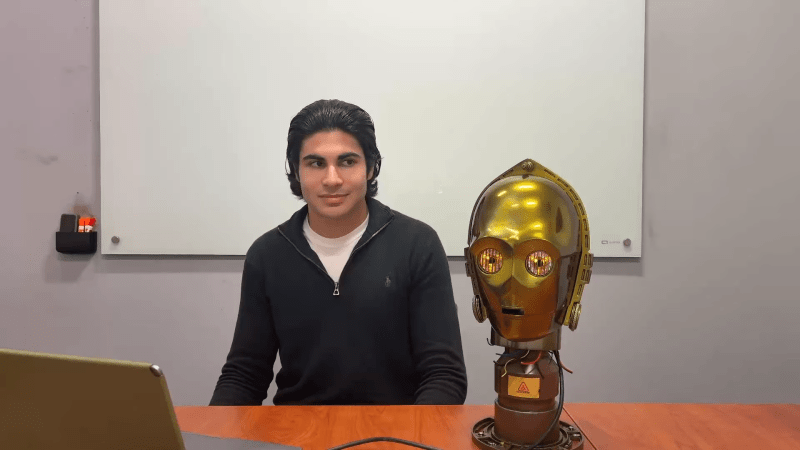
C-3PO is one of the more famous movie robots out there. However, we don’t see a lot of replicas built, perhaps because in speech and mannerisms, he’s quite hard to replicate. Of course, that feat has become much more achievable with modern AI tech, as [Samuel Potozkin] demonstrates.

We’re not looking at a full C-3PO build here, it’s just the head—but for the project’s purposes, that’s all that was really required. The build relies on a Raspberry Pi 5 as the brains of the droid. It’s running a mic hooked up to a real time speech to text engine, and that text is then sent to a large language model for interpretation. Responses are then generated, passed through a processing layer to capture C-3PO’s general tone and vibe, and then handed off to a text-to-speech synth to imitate the iconic voice, played via speaker. The end result is a C-3PO you can actually talk to, which is something that might have knocked a few socks off when the movie first launched in 1977. In-depth materials for the build can be had via Google Drive and on Github.

This ersatz C-3PO isn’t an exact dupe of the movie ‘bot.  The protocol droid is a little slow to respond, and the patter isn’t quite on point, even if the voice synth makes a good effort at mimicking the original. Overall, it’s a little… robotic… something you wouldn’t say of the character in the movies. Still, it’s a great effort, and something we haven’t really seen much of before. If you like more classic droid replicas, though, we’ve featured those too. Video after the break.

Continue reading “Building A C-3PO You Can Really Talk To”

R2D2 Gets New Brains

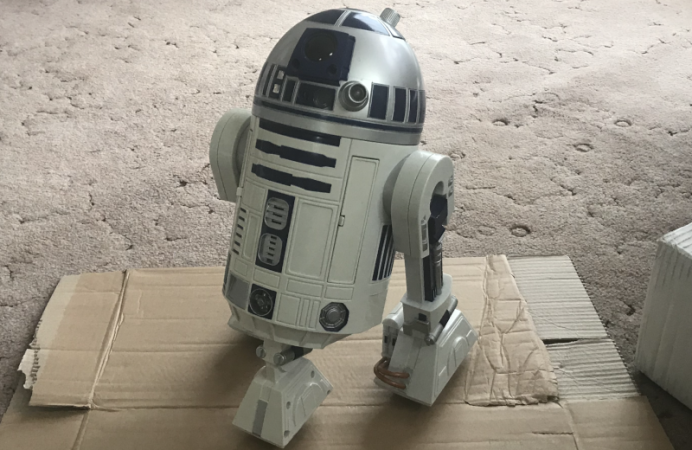
While it is fun to get toys that look like your favorite science fiction props, it is less fun when the electronics in them don’t measure up to the physical design. [Steve Gibbs] took a Hasbro R2D2 toy robot and decided to give it a brain upgrade along with enhanced sensors. You can see a video of the robot doing its thing and some build details below.

In this case, the toy from Hasbro was not working at all, so [Steve] saved it from the dumpster. Instead of a repair, he decided to just gut it and rebuild it with modern electronics. The ultrasonic sensor on the forward toe is a dead giveaway.

The robot responds to voice commands better than the original and can play sound effects and clips from Star Wars. You can also control the robot with a phone app. The new or upgraded sensors include microphones, a PIR sensor, a photoresistor to sense light, a smoke and CO2 sensor, a computer vision camera, and, of course, the ultrasonic range finder.

Some motors and the original speaker are in use, but R2 now sports additional LEDs and servos. All the extras required some surgery on the plastic body. Instead of regular batteries, the ‘bot now uses a LiPo battery, so the old battery compartment was cut out to make more room.

Continue reading “R2D2 Gets New Brains”

X-wing Aircraft Are Trickier Than They Look

The iconic X-wing ship design from Star Wars is something many a hobbyist have tried to recreate, and not always with success. While [German engineer] succeeded in re-imagining an FPV quadcopter as an X-wing fighter, the process also highlighted why there have been more failures than successes when it comes to DIY X-wing aircraft.

For one thing, the X-wing shape is not particularly aerodynamic. It doesn’t make a very good airplane. Quadcopters on the other hand rely entirely on precise motor control to defy gravity in a controlled way. It occurred to [German engineer] that if one tilts their head just so, an X-wing fighter bears a passing resemblance to a rocket-style quadcopter layout, so he set out to CAD up a workable design.

When flying at speed, the aircraft goes nearly horizontal and the resemblance to an X-wing fighter is complete.

One idea that seemed ideal but ultimately didn’t work was using four EDF (electric ducted fan) motors mounted in the same locations as the four cylindrical engines on an X-wing. Motors large enough to fly simply wouldn’t fit without ruining the whole look. A workable alternative ended up being the four props and brushless motors mounted on the ends of the wings, like you see here.

The unit still needed a lot of fine tuning to get to a properly workable state, but it got there. It takes off and lands vertically, like a classical quadcopter, but when flying at speed it levels out almost completely and looks just like an X-wing as it screams by. It’s in sharp contrast to the slow, methodical movements of this Imperial Shuttle drone.

There are also a couple design elements in [German engineer]’s build we thought were notable. The spring-loaded battery door (all 3D-printed, including the spring) looks handy and keeps the lines of the aircraft clean. And since it’s intended to be flown as an FPV (first person view) aircraft, the tilting camera mount in the nose swings the camera 90 degrees during takeoff and landing to make things a little easier on the pilot.

3D models for the frame (along with a parts list) are up for anyone who wants to give it a shot. Check it out in the video, embedded below.

Continue reading “X-wing Aircraft Are Trickier Than They Look”

Let The Wookie Win With This DIY Holochess Table

If you have seen Star Wars, you know what is being referenced here. Holochess appeared as a diversion built into the Millennium Falcon in the very first movie, way back in 1977. While not quite as iconic a use of simulated holograms as tiny Princess Leia begging for hope, it evidently struck a chord with [Maker Mac70], given the impressive effort he’s evidently gone through to re-create the game table from the film.

The key component of this unit is a plate from Japanese firm ASKA3D that scatters light from displays inside the table in just such a way that the diverging rays are focused at a point above its surface, creating the illusion of an image hovering in space. Or in this case, hovering at the surface of a acrylic chessboard. Granted, this technique only works from one viewing angle, and so is not a perfect recreation of a sci-fi holoprojector. But from the right angle, it looks really good, as you can see in the video below.

There are actually six SPI displays, driven by an Arduino GIGA, positioned and angled to project each character in the game. Placing two of the displays on 3D printed gantries allows them to move, allowing two creatures to battle in the center of the table. As [Maker Mac70] admits, this is quite a bit simpler than the Holochess game seen in the film, but it’s quite impressive for real world hardware.

If this all seems a little bit familiar, we covered an earlier floating display by [Maker Mac70] last year. This works on similar principles, but uses more common components which makes the technique more accessible. If chess isn’t your forte, why not a volumetric display that plays DOOM? If you’re interested in real holograms, not Sci-Fi, our own [Maya Posch] did a deep dive you may find interesting. Continue reading “Let The Wookie Win With This DIY Holochess Table”

A Transparent BB-8 Build Using Christmas Ornaments

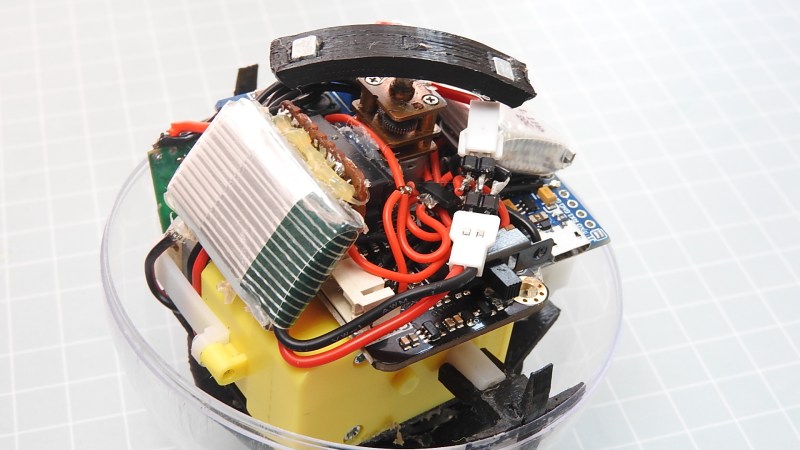
The cool thing about the droids of Star Wars is that they’re not that hard to recreate in real life. R2-D2 is a popular choice, but you can even build yourself a neat little BB-8 if you’re so inclined. [Piyush] has built a particularly compelling example that’s transparent, which lets you see the internals and how it all works.

The build makes creative use of a pair of Christmas ornaments. They are perhaps the cheapest and easiest way to source a clear plastic sphere. One serves as the “head”, while the other serves as the larger spherical body. Inside, an Arduino Pro Micro is running the show. It’s hooked up to a L293D motor driver which runs the drive motors and the reaction wheel motor which provides stability, while a separate MOSFET is on hand to run the gear motor which controls the head.

There’s also an HC-05 module for Bluetooth communication, and a BNO055 sensor for motion tracking and ensuring the robot stays the right way up. 3D printed components are used prodigiously to cram everything together tightly enough to fit. There’s even a printed charging base to juice up the little droid. Controlling the robot is as simple as using a smartphone with an app created in the MIT App Inventor.

If you’ve never built a spherical rolling robot before—and few of us have—this design is a great reference for your own work. We’ve seen a few BB-8s over the years, most of which dropped shortly after the movie was released. Continue reading “A Transparent BB-8 Build Using Christmas Ornaments”

Creators demonstrating their Jedi Watch

Walkie Talkies, Jedi Style: Building A Communicator

Playing Star Wars Outlaws sparked an idea with [3DSage]: why not recreate the game’s wrist communicator as a functioning gadget? Inspired by the relatively simplistic design, he and his friend Ben set out to build their own device to take to Galaxy’s Edge in Disneyland. Armed with an arsenal of tools—3D printers, CNC machines, and soldering irons—he aimed to turn imagination into reality.

After ordering multiple walkie-talkies, they meticulously tested each one for audio quality, circuit board size, and compatibility with custom components. The ‘world’s tiniest walkie-talkie’ had potential but demanded creative modifications, including disassembling and resoldering components. They crafted their own circuit board and designed a 3D printed housing to fit both electronics and style. For the finishing touch, they weathered the device with paints and even glow-in-the-dark accents, making it authentic to the Star Wars universe. Even Chewbacca himself gave one a thumbs-up!

Weathering goes a long way towards creating a convincing prop — it can turn a bundle of pipes and some foam blocks into a movie-ready WWII machine gun.

Continue reading “Walkie Talkies, Jedi Style: Building A Communicator”

Star Wars-Inspired Cosplay Prop Uses Old Vintage Camera

Lots of people make replica lightsabers from Star Wars or tricorders from Star Trek. Not so many people have tried to recreate the binoculars from The Last Jedi, but [The Smugglers Room] whipped up a pretty rad pair from old parts.

It’s more of an inspired build rather than screen-accurate, but they’re still pretty neat. A Bell & Howell camera was the basis for the binoculars used in the film, in fact, and this build starts with the same tri-lens model. Found vintage objects are often used in sci-fi with some modifications, but more commonly in lower-budget productions. Star Wars can do it too, though, it seems.

Turning them into binoculars requires the construction of a viewfinder, which was made out of hand-cut Sintra PVC foam board. Lots of leather wrap had to be removed from the camera, too, which offered a happy accident—it left a heavily-weathered aluminum surface that looked great for a Star Wars prop. A few random controls were then added to disguise the camera as an advanced pair of futuristic binoculars. LED lighting was also installed internally to make the build glow as if it actually contained some powered sci-fi optics. It also got a hand-made leather strap for that rugged aesthetic so fitting for the film.

It’s not a functional build; we’d love to see someone build a set of AR or rangefinder binoculars that still look the part. However, this would be a great addition to any Poe Dameron costume you might have planned for the next upcoming Comic Con.

Here’s our question, though. Does it suck you out of your suspension of disbelief when filmmakers use found objects as the basis for props? Or is it a neat thing when you spot such an example? Video after the break.

Continue reading “Star Wars-Inspired Cosplay Prop Uses Old Vintage Camera”