Touch Panels Make This Christmas Tree Interactive

The city of Liverpool, famously known as both the home port of the Titanic and the birthplace of The Beatles, also seems to have a thing for interactive public art installations. Witness this huge interactive Christmas tree that can be played by passersby.

The display in the city’s busy Williamson Square was commissioned by a municipal business group and built by [Adrian McEwen]. The idea was to adorn the 10-meter natural tree with large geometric ornaments covered with Neopixel strips. [Adrian] documents the build process in some detail, including that fact that over 170 meters of WS2812b strips went into the ornaments for the tree. While the strips themselves at IP68 rated, the connections needed when attaching them to the custom-made frames were not, and that had to be overcome with ample application of heat-shrink tubing. OctoWS2811 adapter boards were dangled about the tree to control the lights and connected together with garlands of Ethernet cables. Pressure sensors were used to control the lights when the EMI from the beefy power supplies needed to run everything proved too much for the original touch sensors. After a lot of bench testing and a few long nights working with the city crew to hang the display, passing Liverpudlians can now play the tree and enjoy the Christmas season.

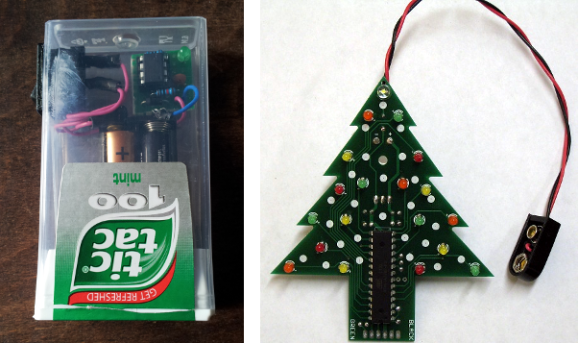
Would you rather a smaller display for your own Christmas tree? This somewhat hyperactive indoor light show might be what you’re looking for.

Continue reading “Touch Panels Make This Christmas Tree Interactive”

Christmas Bauble Is Neither Spherical Nor Runs Arduino

[Jordan Wills] was tasked by his company, Silicon Labs, to build some Christmas Baubles to give away to co-workers. While the commissioned units were designed to be simple battery and LED affairs, he decided to make one of his own with bells and whistles. His Mario themed Christmas Ornament uses a Silicon Labs FM972 micro controller, capacitive sensing, PWM controlled 8 bit audio, and blinky lights.

The interesting part is some of the construction techniques that he used. The finger-joint style cube is built from circuit boards. Electrical connections between panels were routed using solder wicking copper braid. That’s a interesting trick which we’ll keep in mind along with some of our favorite creative structural uses of PCB.

The top of the cube has four LED’s which light up the Mario “Question Mark” symbols on the four sides of the cube while the base contains all of the electronics. The outside of the base piece was a large copper plane to act as the capacitive sensing element. This meant all electronics needed to be surface mounted with tracks laid out on one side – which posed some layout challenges. Adding the Capacitive sense function was a cinch thanks to support from the in-house design team. PWM output from the micro controller takes care of audio, and the output is routed through a buffer to boost the signal. A bandpass filter then cleans up the PWM output before feeding it to the speaker.

Continue reading “Christmas Bauble Is Neither Spherical Nor Runs Arduino”

Christmas Lights And Ships In A Bottle

Thanksgiving was last week, and Christmas has been invading department stores for two or three months now, and that can only mean one thing: it’s time to kill a tree, set it up in your living room, and put a few hundred watts of lights on it. All those lights, though; it’s as if Christmas lights were specifically invented as fodder for standup comedians for two months out of the year. Why can’t someone invent wireless Christmas lights?

We don’t know if it’s been invented, but here’s a Kickstarter campaign that’s selling that same idea. It’s called Aura, and it’s exactly what it says on the tin: wireless Christmas lights, controllable with a smartphone. If it works, it’s a brilliant idea.

Continue reading “Christmas Lights And Ships In A Bottle”

Christmas Tweetball

photo

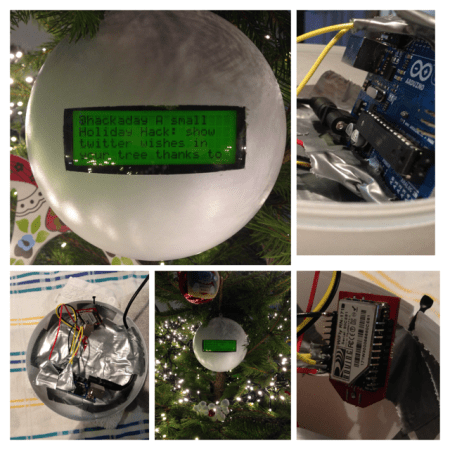
The holidays are long over, but we’re still getting a smattering of holiday themed hacks. For this one, the [Han’s] family decided to make a Christmas bauble that relays their tweets to them!

They call it the Tweetbal which is Dutch for — well — Tweetball! Whenever someone tweets with the hashtag #tweetbal it gets displayed on the 20×4 serial LCD display. They’re using an Arduino Uno with an RN-XV WiFly module to receive and send the tweets to the display. A large white plastic ornament ball houses it all secured very firmly with our favorite adhesion method — duct tape. It’s a pretty simple project, but a great holiday hack if we do say so ourselves — plus it could be easily used for non-holiday purposes — like a desktop trinket twitter feed!

Stick around after the break to see its tweeting capabilities in action.

Continue reading “Christmas Tweetball”

Fubarino Contest: Morse Code Christmas Baubles

fubarion-contest-christmas-morse-code

Fubarino Contest entries are starting to roll in at a faster rate. If you’re working on one you only have a few hours left! Submissions are due before 12:00am Pacific Time! This bit of inspiration is a two-fer. Both entries decided to use Morse Code to spell out the Hackaday URL.

First up, [Tariq] is getting into electronic design because his friend’s 8-year-old son [Yago] is really interested in Math and Science. The device he was working on is a little portable Morse Code message flasher (don’t miss part 2). The idea is that [Yago] can carry it around and pretend it’s a spy device containing a secret message. It might as well be since your average Joe probably wouldn’t notice the irregular flashing and if they did they wouldn’t be able to decode it without some help. The device is built around an ATtiny85. Normally it displays a Christmas greeting for [Yago]. But at the end of the cycle, or at power-up, it flashes the Hackaday URL at an extreme rate. Can anyone actually decode this without putting it on a logic analyzer?

The second offering is in the form of a blinky Christmas tree. [Jim] built the Arduino-compatible ornament for the holidays. It does a great job of flashing a bunch of different patterns, and it wasn’t too much work for him to make it flash the URL.


This is an entry in the Fubarino Contest. Submit your entry before 12/19/13 for a chance at one of the 20 Fubarino SD boards which Microchip has put up as prizes!

Tannenbaum Ticker, Even Though The Markets Close For Christmas

Maybe we’re a little bitter because we held on to our pumpkin futures well into November, but we’ve got to respect [Nick]’s stock ticker ornament. It’s an Internet-connected Christmas ornament that queries stock prices and displays the change with an RGB LED.

The build uses a Propeller Platform USB and the Propeller E-Net Module to pull stock quotes down from Google. With the attached source, selecting any traded company is easy enough; all that’s needed is to select a company is changing a line in the code. The Propeller pulls the quote every 30 seconds during the trading day, and parses it into a ‘percent changed’ format. The ornament glows red if the change is more than a 4% negative change, green for within 0.2% of open, and blue if more than a 4% positive change.

[Nick] is more of a ‘set it and forget it’ investor, so this ornament is a handy, passive way to keep an eye on his investments. Check out the demo vid after the break.

Continue reading “Tannenbaum Ticker, Even Though The Markets Close For Christmas”

Electronic Ornament Will Definitely Put [Dave] On Santa’s “naughty” List

mischievous-xmas-ornament

[Dave Vandenbout] says that his sister has gotten big on Christmas traditions, and decided that the whole family should start making ornaments for the tree each year. Not one to let a chance to tinker with electronics pass him by, [Dave] started brainstorming the perfect electronic ornament for their tree.

He settled on the Christmas tree design you see above, which will eventually hold 15 RGB LEDs. On the back of the board, he is planning on mounting a PIC 18F27J53 microcontroller, which will take care of the LED display along with his other more mischievous components.

You see, undeterred by his sister’s holiday spirit, [Dave] wants to arm the ornament with a foul mouth, and have it attempt to shake other ornaments off the tree. To do this, he’s installing a vibrating motor on the back of the PCB, along with a speaker and MicroSD card to provide the ornament’s sound bites.

To be honest, we think his idea is pretty entertaining, we can only imagine the look grandma will give when the cute, light up Christmas tree ornament blurts out, “Eat me Santa!”

We just hope he sends some video our way once he wraps up the project.