Exoskeleton Lift

Homemade Superhero: [James’] DIY Exoskeleton

We’re not just a bunch of monkeys with typewriters here at Hackaday; we don our hacker hat whenever our schedules allow. Or, in the case of Hackaday’s own [James Hobson]—aka [The Hacksmith]—he dons this slick exoskeleton prototype instead,turning himself into a superhero. Inspired by the exoskeleton from the film Elysium, this project puts [James] one step closer to the greater goal of creating an Iron Man-style suit.

For now, though, the exoskeleton is impressive enough on its own. The build is a combination of custom-cut perforated steel tubing and pneumatic cylinders, attached to a back braces of sorts. In the demonstration video, [James] stares down 170 pounds of cinder block affixed to a barbell, and although he’s no lightweight, you can tell immediately from his reaction how much assistance the exoskeleton provides as [James] curls the makeshift weights over and over. And that’s only at half pressure. [James] thinks he could break the 300 pound mark of lifting if he didn’t break his legs first.

There’s plenty of behind-the-scenes footage of the build process to be had, so make sure you stick around after the jump for a sizable helping of videos, and check out [The Hacksmith’s] website for more of his projects.

Continue reading “Homemade Superhero: [James’] DIY Exoskeleton”

Voices From The Past: Recovering Audio From Wire Recordings

wire recorder setup[Nick]’s grandfather was quite the old school hacker. In the 1940s, he built his own wire recorder and microphone to capture everything from his children’s Chirstmas wishes to his favorite songs and programs from the radio. Only 20 or so spools have survived and were doomed to silence until [Nick] was able to find a vintage wire recorder, restore it, and feed digitized audio into Audacity.

Once he restored one of the two machines that he was able to get his hands on, [Nick] was in business. Since his grandfather also rolled his own spools, [Nick] had to build a playback spindle that would hold them. His uncle found an old mechanical counter to do the job, which [Nick] secured to the workbench. He fed the output from the wire recorder’s playback head into a guitar pre-amp, effectively digitizing the audio for recording in Audacity.

After playing all the spools, he adjusted the levels where necessary and cleaned up the recordings. His biggest challenge was feeding the wires back on to their original spools, which he managed with an electric drill and a rubber grommet. Be sure to check out the mp3 clips on [Nick]’s page. If you’re in the mood for old audio hacking stories, here’s one about building a tape recorder in 1949.

Extrinsic Motivation: Off-grid Solar System Monitoring Solution

3700201407712010539

This solar monitoring project was entered in The Hackaday Prize and didn’t make the semifinal cut, but it is worth featuring on the site because we think that it is pretty cool. The idea started all the way back in May of 2013 when [Michel] was planning to attempt to bring his house totally off the grid in an effort to become as independent from the local Utility company as possible. After a bit of calculating, he figured out that the solar cells on the roof could potentially provide about 80% of the power needed, which of course took into account the lack of sun during the winter months in his area.

[Michel] posts a lot of the technical details on the Hackaday.io page and lists the components that were required to set up this system. At night, a lighting mechanism shows whether the building is being run off of the Photovoltaic (PV) System or if it is getting power from the grid. He states in the projects logs why it is important to monitor the solar cells and provides some amazing graphs of the data that was recorded through the energy-intelligence platform that he integrated into his home. An example can be seen posted below. A few quick specs of the project include the solar field being made of 16 solar modules providing 4300 Wp (Watts – peak) of electrical power. The system comes with a comprehensive remote control as well. We like this idea a lot. Now, would you install something like this up on your own home or office? Let us know in the comments.


SpaceWrencherThis project is an official entry to The Hackaday Prize that sadly didn’t make the quarterfinal selection. It’s still a great project, and worthy of a Hackaday post on its own.

Continue reading “Extrinsic Motivation: Off-grid Solar System Monitoring Solution”

Purely Mechanical Display Uses 804 Balls To Create A Kinetic Display

Whoa. That’s all we have to say about this art installation.

Oops, did we say art? Don’t let that three letter word scare you, because this project called Breaking Wave is nothing short of an absolutely incredible, fully mechanical, machine.

It’s kind of hard to tell in the picture, but there are 804 rusty spheres hanging from cables which make up the pixels of this display. Each of those cables could be attached to a servo for a very simple, digital-to-analog display — it’d be expensive, but you could display anything. But no, that’s not how this works. Instead of each of those cables is wrapped around a different size drum or roller, which are all connected to a large central hub motor driving a cam.

As the beastly hub-motor spins, the display morphs and changes shapes. It is all pre-programmed manually by varying the sizes of the rollers and the lengths of the cables, a mind numbing task of its own. What’s more, because it is three dimensional, you can only see the patterns if you’re standing in the right place at the right time.

Continue reading “Purely Mechanical Display Uses 804 Balls To Create A Kinetic Display”

3D Printed Bump Keys

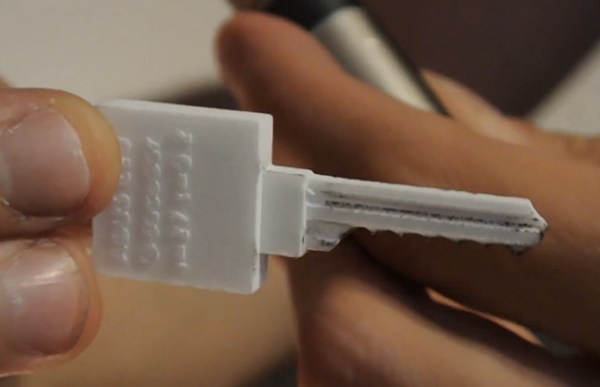
Getting past a locked door is easy if you have the right tools. It’s just a matter of knowing how to adjust the pins inside to an even level while turning the mechanism at the same time when everything is perfectly in place. That’s the beauty of a bump key. You never have to see the actual key or what it looks like. And with a simple hit to the back of the key, and bumping it just enough, the lock can magically be opened.

Lock picking items like this can be ordered online for a couple of dollars, or as [Jos Weyers] and [Christian Holler] showed in a recent Wired article, alternatively you can print your own at home. The video of these 3D printed keys (which can be viewed below) attempts to prove that a person can unlock a door with plastic, which was a little bit surprising to us because it seems like the edges would break off right away. But as it turns out, a thin plastic bump key can be made and does function. Not sure how long these keys can last though, but sometimes all you really need is a one time use when trying to open a specific, tricky lock.

As the article states, “Weyers and Holler aren’t trying to teach thieves and spies a new trick for breaking into high-security facilities; instead, they want to warn lockmakers about the possibility of 3-D printable bump keys so they might defend against it.” Although this information is geared towards lockmakers, we see our Hackaday readers finding this data useful as well. Organizers of hackerspaces who hold regular lock-picking events might want to print their own keys and teach classes centered around security. The uses for this are boundless in regards to educating the public about how locks truly work.

Continue reading “3D Printed Bump Keys”

The ChalkJET: An Ink Jet Printer For The Streets

Need to do some guerrilla street advertising? What you need is the ChalkJET 9000, an ink jet printer on wheels.

Using two Arduino Duemilanoves for the brains, this little cart features eight cans of spray chalk which can be individually actuated. Small solenoids pull down on levers in order to spray the cans. Encoders on the wheels of the cart keep track of the spacing in between each pixel as the cart gets dragged along.

A small LCD mounted on the handle allows you to select which text you would like to print, but it doesn’t look like manual entry of new words is possible — You’ll need to load up a library while connected to a computer before hitting the streets!

Continue reading “The ChalkJET: An Ink Jet Printer For The Streets”

Google[x]’s Project Wing

wing

Autonomous delivery is the way of the future. Soon, flocks of flying hover crafts will glide through the air like acrobatic birds of flight bringing home items to those who need them. Whether those objects be food, or electronics, or clothes, pretty much anything under the weight limit of these devices can be sent to people anywhere nearby.

Now, Google has stepped into the ring saying that they are interested in delivering products to individuals in the next few years through an innovation they are calling Project Wing. It aspires to reduce the friction of moving things around. Google released a video introducing the idea which shows a man calling up a service asking for some food for his dog. Instantly, a small delivery vehicle took off from the ground and flew to the intended destination dropping off a package containing delicious doggy treats.

Google clearly states in the video that this type of system is still years away from a readily available consumer product, but it is the first prototype that the company wants to stand behind. Google has marketed the design pretty well so far, and the musical use of [Norman Greenbaum]’s classic 1969 rock song ‘Spirit in the Sky’ was an obvious, yet totally awesome addition to the video. We are curious how services similar to this will affect postal delivery jobs in the future, and also what the legal ramifications will be, but all that information will surely be discussed very soon. In the meantime though, Google has released an interest form that will take the names and emails of those who would like to partner with them in an effort to bring autonomous product delivery to the world.

Continue reading “Google[x]’s Project Wing”