Potting Electronics With Silicone

If you want to improve the reliability of your electronics, just cover them in silicone or epoxy. Potting, as this technique is called, protects your project from impact and loose wires, but most of the time ends up as a gloppy mess. [Charles] figured out an awesome way to make pro-looking potted electronics using silicone and a few supplies from the emergency room.

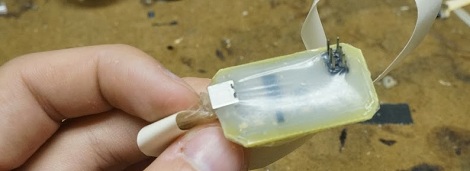
On one of [Charles]’s trips to the ER, a nurse put Tegaderm on a wound and he noticed his skin could breathe. Figuring Tegaderm would also allow silicone to breathe, he asked for a sample and went back to the lab. After putting a few globs of silicone on a PCB, [Charles] wrapped the whole thing in Tegaderm. Much to his surprise, the silicone cured and made a smooth, glossy protective covering on his board.

[Charles] put up a Picassa album of his Tegaderm/silicone potted electronics, and we’ve got to say they’re looking very professional. This technique could also be applied to [Charles]’ glass PCB touch sensor, allowing for the creation of clear (or at least tranlucent) PCBs.

After the break, you can check out [Charles] potting his ATtinyISP board in silicone with Tegaderm. One word of warning, though: don’t use a silicone that uses acetic acid to cure – that’s a death sentence to electronics. Luckily, there’s an easy test to see if your particular brand of silicone produces acetic acid while curing. Just squeeze a bit of silicone on a piece of scrap, and if it smells like vinegar after a while, don’t use it.


Continue reading “Potting Electronics With Silicone”

Book Scanner Kits Now Available

[Daniel Reetz] wants you to be able to scan books. This has been a goal of his for quite some time, and now he’s bringing a kit into play. We’ve always liked book scanners here, many of us have extensive libraries or even peculiar selections we would like to share. [Daniel] is starting off with a short run of these scanners. Once all the bugs are worked out, there should be plenty available for everyone. The kit includes the frame, LED lighting, bicycle levers, and cables. You have to add glass, books, and a camera.

Of course, if you still want to design and build your own, there are TONS of variations available in the forums at DIYbookscanner.org.

[via Adafruit]

Continue reading “Book Scanner Kits Now Available”

Wi-Fli Copter Broken? Harvest The Parts!

[Nick] was somewhat disappointed when the Wi-Fly helicopter he bought his son broke in less than 10 minutes. The main gear that turns the rotor split in half, rendering the copter WiFi enabled trash. [Nick] however decided that he didn’t want to waste an opportunity and harvested the receiver parts.  To test them out, he wired them up to the controller for an R/C truck. This gave him a WiFi truck with a nifty android interface. It actually works pretty well, as you can see in the video below. [Nick] points out that, while this works fine, he could ultimately repurpose this fancy little WIFI controlled 3v switch to whatever he wants. He mentions garage doors and lights (and terminators), so this might be an opportunistic way for him to get into some fun home automation.

Continue reading “Wi-Fli Copter Broken? Harvest The Parts!”

What’s Inside A Lightning Arrestor?

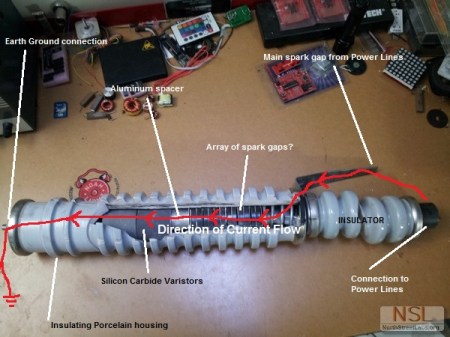
What is inside one of those things? The folks over at Northstreetlabs have set out to answer just that question. You’ve seen these things before, and if you’re uneducated on the subject like myself, you just assumed they were there to stop a possible connection from a power line to the pole/building to which it is attached. Apparently that is part of their purpose. When presented with lightning, however, they turn to conductors allowing the lightning to pass to ground.

You can see their teardown in video form, as well as an explanation of how exactly they work on their site.

[Bill Porter] Repairs A Science Museum Exhibit

For those who are unfamiliar, “Freeze Frame” is the name of a common display in science museums. It is a small dark room with a single wall covered in phosphorescent material. Opposite of this wall is a flash on a timer. You enter the room, strike a pose and wait for the flash, then view your shadow preserved on the wall behind you.

[Bill] was saddened to see the display at his local science museum had been decommissioned long ago. All that was left was a dark room with a phosphorescent coated wall. Some industrious employees had rigged up some LED pens for people to “draw with light”, but in [Bill’s] opinion this wasn’t as impressive.  He promptly volunteered to rebuild the display himself and we commend him, both on the fantastic job he did as well as his service to his local community. Great job [Bill], keep up the good work.

Waterproofing An RC Plane

A few years ago, the EasyStar RC plane took the remote control community by storm, launching dozens of clone ready to fly planes that found their way onto many fields, rooftops, and trees. [hammydude] wanted to take his EasyStar with him while also playing around with his jetski, so he did the reasonable thing: he waterproofed his remote control plane.

The EasyStar is made of foam, but that doesn’t mean it’s ready to land on a lake. To prevent any damage to the electronics, servos, and pushrods, [hammy] slightly modified the fuselage of his plane and potted the electronics in silicone glue. Now this excellent RC plane is capable of landing on calm water with a slow self-destruction.

[hammy] has flown his EasyStar seaplane in salt water, but that is a terrible environment for the exposed brushless motor. Before packing it in for the day, [hammy] pours a bit of fresh water over the motor and throttles up for a minute or two. This seems to be good enough for the bearings in the motor; in the video after the break, you can see [hammy] submerge his plane in the water and take it for a short test flight. There’s some great in-flight shots taken from the EasyStar – surely an awesome way to enjoy a trip to the shore.

Continue reading “Waterproofing An RC Plane”

Hackerspace Intro: Foothills Community Workshop In Granite Falls NC


[Rich Goldner] sent in this walkthrough of the Foothills Community Workshop in Granite Falls N.C. Taken during their open house, [Rich] gives us the grand tour showing off the different areas including the HAM station, electronics station, collective work areas, the machine shop, and wood shop.

Though you can see some of the areas are still being put together, their space looks really cool. They have about 3,500 square feet in an old mill. They started with four very enthusiastic individuals who rented the space and set out to build a workshop. Since then, they’ve added 17 more people. Not too bad considering the town population there is only about 5,000.
Continue reading “Hackerspace Intro: Foothills Community Workshop In Granite Falls NC”