AI Assistant Uses ESP32

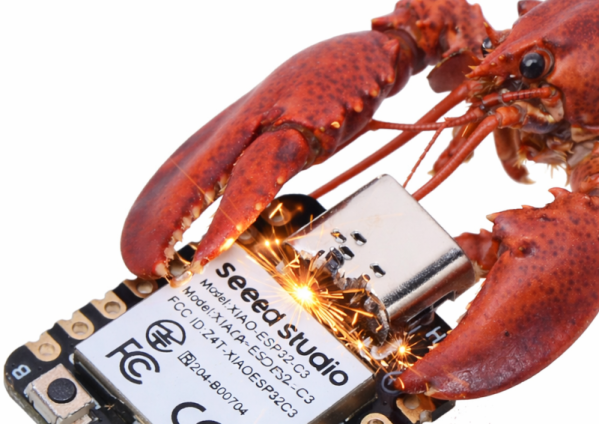
Having an AI assistant is all the rage these days, but AI assistants usually don’t know about your automation setups and may have difficulty dealing with tasks asynchronously. Enter zclaw. It gives you the option to have a personal assistant on an ESP32 backed by Anthropic, OpenAI, or OpenRouter. The whole thing fits in 888KB, and while it doesn’t host the LLM, it does add key capabilities to monitor and control devices connected to the ESP32.

You communicate with the assistant via telegram. You can say things like “Remember the garage sensor is on GPIO 4.” Then later you might say: “In 20 minutes, check the garage sensor and if it is high, set GPIO 5 low.” It has an RTOS for scheduling tasks and is aware of the timezone and common periods. Memory persists across reboots, and you can pick different personas.

Continue reading “AI Assistant Uses ESP32”

A grim reaper knocking on a door labelled "open source"

What About The Droid Attack On The Repos?

You might not have noticed, but we here at Hackaday are pretty big fans of Open Source — software, hardware, you name it. We’ve also spilled our fair share of electronic ink on things people are doing with AI. So naturally when [Jeff Geerling] declares on his blog (and in a video embedded below) that AI is destroying open source, well, we had to take a look.

[Jeff]’s article highlights a problem he and many others who manage open source projects have noticed: they’re getting flooded with agenetic slop pull requests (PRs). It’s now to the point that GitHub will let you turn off PRs completely, at which point you’ve given up a key piece of the ‘hub’s functionality. That ability to share openly with everyone seemed like a big source of strength for open source projects, but [Jeff] here is joining his voice with others like [Daniel Stenberg] of curl fame, who has dropped bug bounties over a flood of spurious AI-generated PRs.

It’s a problem for maintainers, to be sure, but it’s as much a human problem as an AI one. After all, someone set up that AI agent and pointed at your PRs. While changing the incentive structure– like removing bug bounties– might discourage such actions, [Jeff] has no bounties and the same problem. Ultimately it may be necessary for open source projects to become a little less open, only allowing invited collaborators to submit PRs, which is also now an option on GitHub.

Combine invitation-only access with a strong policy against agenetic AI and LLM code, and you can still run a quality project. The cost of such actions is that the random user with no connection to the project can no longer find and squash bugs. As unlikely as that sounds, it happens! Rather, it did. If the random user is just going to throw their AI agent at the problem, it’s not doing anybody any good.

First they came for our RAM, now they’re here for our repos. If it wasn’t for getting distracted by the cute cat pictures we might just start to think vibe coding could kill open source. Extra bugs was bad enough, but now we can’t even trust the PRs to help us squash them!

Continue reading “What About The Droid Attack On The Repos?”

MicroGPT Lets You Peek With Your Browser

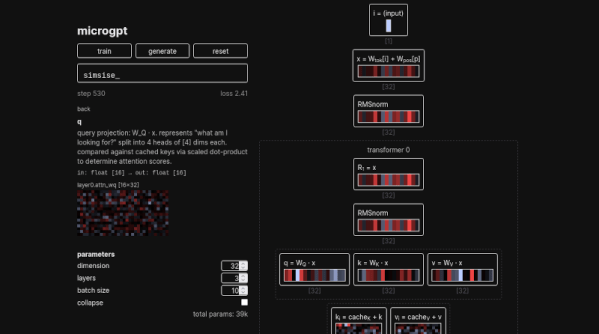
Regardless of what you think of GPT and the associated AI hype, you have to admit that it is probably here to stay, at least in some form. But how, exactly, does it work? Well, MicroGPT will show you a very stripped-down model in your browser. But it isn’t just another chatbot, it exposes all of its internal computations as it works.

The whole thing, of course, is highly simplified since you don’t want billions of parameters in your browser’s user interface. There is a tutorial, and we’d suggest starting with that. The output resembles names by understanding things like common starting letters and consonant-vowel alternation.

At the start of the tutorial, the GPT spits out random characters. Then you click the train button. You’ll see a step counter go towards 500, and the loss drops as the model learns. After 500 or so passes, the results are somewhat less random. You can click on any block in the right pane to see an explanation of how it works and its current state. You can also adjust parameters such as the number of layers and other settings.

Of course, the more training you do, the better the results, but you might also want to adjust the parameters to see how things get better or worse. The main page also proposes questions such as “What does a cell in the weight heatmap mean?” If you open the question, you’ll see the answer.

Overall, this is a great study aid. If you want a deeper dive than the normal hand-waving about how GPTs work, we still like the paper from [Stephen Wolfram], which is detailed enough to be worth reading, but not so detailed that you have to commit a few years to studying it.

We’ve seen a fairly complex GPT in a spreadsheet, if that is better for you.

Microsoft Uses Plagiarized AI Slop Flowchart To Explain How Git Works

It’s becoming somewhat of a theme that machine-generated content – whether it’s code, text or graphics – keeps pushing people to their limits, mostly by how such ‘AI slop’ is generally of outrageously poor quality, but as in the case of [Vincent Driessen] there’s also a clear copyright infringement angle involved. Recently he found that Microsoft had bastardized a Git explainer graphic which he had in 2010 painstakingly made by hand, with someone at Microsoft slapping it on a Microsoft Learn explainer article pertaining to GitHub.

As noted in a PC Gamer article on this clear faux pas, Microsoft has since quietly removed the graphic and replaced it with something possibly less AI slop, but with zero comment, and so far no response to a request for comment by PC Gamer. Of course, The Internet Archive always remembers.

What’s probably most vexing is that the ripped-off diagram isn’t even particularly good, as it has all the hallmarks of AI slop graphics: from the nonsensical arrows that got added or modified, to heavily mutilated text including changing ‘Time’ to ‘Tim’ and ‘continuously merged’ into ‘continvuocly morged’. This makes it obvious that whoever put the graphic on the Microsoft Learn page either didn’t bother to check, or that no human was involved in generating said page.

Continue reading “Microsoft Uses Plagiarized AI Slop Flowchart To Explain How Git Works”

The Requirements Of AI

The media is full of breathless reports that AI can now code and human programmers are going to be put out to pasture. We aren’t convinced. In fact, we think the “AI revolution” is just a natural evolution that we’ve seen before. Consider, for example, radios. Early on, if you wanted to have a radio, you had to build it. You may have even had to fabricate some or all of the parts. Even today, winding custom coils for a radio isn’t that unusual.

But radios became more common. You can buy the parts you need. You can even buy entire radios on an IC. You can go to the store and buy a radio that is probably better than anything you’d cobble together yourself. Even with store-bought equipment, tuning a ham radio used to be a technically challenging task. Now, you punch a few numbers in on a keypad.

The Human Element

What this misses, though, is that there’s still a human somewhere in the process. Just not as many. Someone has to design that IC. Someone has to conceive of it to start with. We doubt, say, the ENIAC or EDSAC was hand-wired by its designers. They figured out what they wanted, and an army of technicians probably did the work. Few, if any, of them could have envisoned the machine, but they can build it.

Does that make the designers less? No. If you write your code with a C compiler, should assembly programmers look down on you as inferior? Of course, they probably do, but should they?

If you have ever done any programming for most parts of the government and certain large companies, you probably know that system engineering is extremely important in those environments. An architect or system engineer collects requirements that have very formal meanings. Those requirements are decomposed through several levels. At the end, any competent programmer should be able to write code to meet the requirements. The requirements also provide a good way to test the end product.

Continue reading “The Requirements Of AI”

Living In The (LLM) Past

In the early days of AI, a common example program was the hexapawn game. This extremely simplified version of a chess program learned to play with your help. When the computer made a bad move, you’d punish it. However, people quickly realized they could punish good moves to ensure they always won against the computer. Large language models (LLMs) seem to know “everything,” but everything is whatever happens to be on the Internet, seahorse emojis and all. That got [Hayk Grigorian] thinking, so he built TimeCapsule LLM to have AI with only historical data.

Sure, you could tell a modern chatbot to pretend it was in, say, 1875 London and answer accordingly. However, you have to remember that chatbots are statistical in nature, so they could easily slip in modern knowledge. Since TimeCapsule only knows data from 1875 and earlier, it will be happy to tell you that travel to the moon is impossible, for example. If you ask a traditional LLM to roleplay, it will often hint at things you know to be true, but would not have been known by anyone of that particular time period.

Chatting with ChatGPT and telling it that it was a person living in Glasgow in 1200 limited its knowledge somewhat. Yet it was also able to hint about North America and the existence of the atom. Granted, the Norse apparently found North America around the year 1000, and Democritus wrote about indivisible matter in the fifth century. But that knowledge would not have been widespread among common people in the year 1200. Training on period texts would surely give a better representation of a historical person.

The model uses texts from 1800 to 1875 published in London. In total, there is about 90 GB of text files in the training corpus. Is this practical? There is academic interest in recreating period-accurate models to study history. Some also see it as a way to track both biases of the period and contrast them with biases found in data today. Of course, unlike the Internet, surviving documents from the 1800s are less likely to have trivialities in them, so it isn’t clear just how accurate a model like this would be for that sort of purpose.

Instead of reading the news, LLMs can write it. Just remember that the statistical nature of LLMs makes them easy to manipulate during training, too.


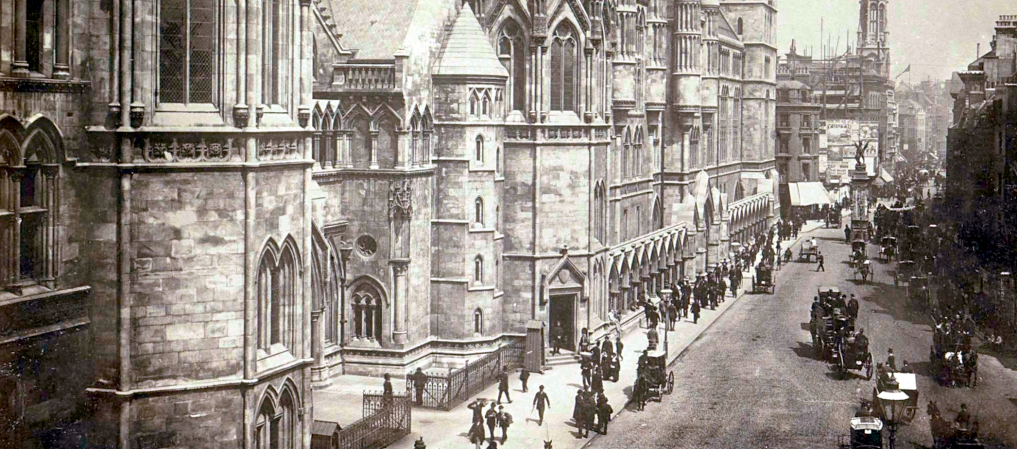
Featured Art: Royal Courts of Justice in London about 1870, Public Domain

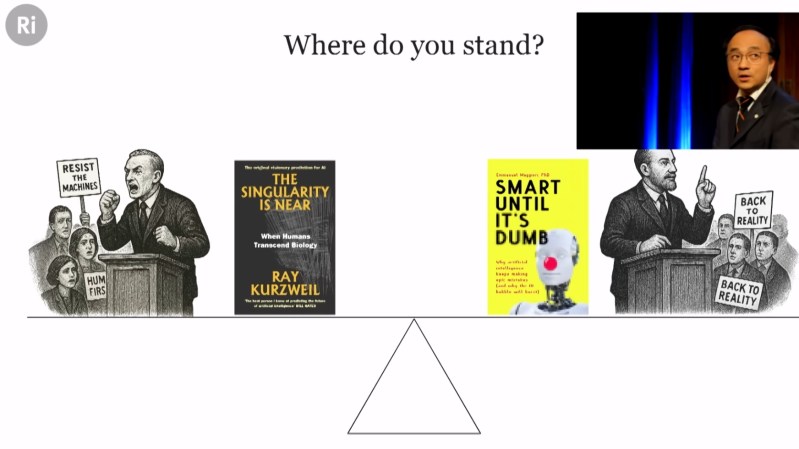
AI. Where do you stand?

[Yang-Hui He] Presents To The Royal Institution About AI And Mathematics

Over on YouTube you can see [Yang-Hui He] present to The Royal Institution about Mathematics: The rise of the machines.

In this one hour presentation [Yang-Hui He] explains how AI is driving progress in pure mathematics. He says that right now AI is poised to change the very nature of how mathematics is done. He is part of a community of hundreds of mathematicians pursuing the use of AI for research purposes.

[Yang-Hui He] traces the genesis of the term “artificial intelligence” to a research proposal from J. McCarthy, M.L. Minsky, N. Rochester, and C.E. Shannon dated August 31, 1955. He says that his mantra has become: connectivism leads to emergence, and goes on to explain what he means by that, then follows with universal approximation theorems.

He goes on to enumerate some of the key moments in AI: Descartes’s bête-machine, 1617; Lovelace’s speculation, 1842; Turing test, 1949; Dartmouth conference, 1956; Rosenblatt’s Perceptron, 1957; Hopfield’s network, 1982; Hinton’s Boltzmann machine, 1984; IBM’s Deep Blue, 1997; and DeepMind’s AlphaGo, 2012.

He continues with some navel-gazing about what is mathematics, and what is artificial intelligence. He considers how we do mathematics as bottom-up, top-down, or meta-mathematics. He mentions about one of his earliest papers on the subject Machine-learning the string landscape (PDF) and his books The Calabi–Yau Landscape: From Geometry, to Physics, to Machine Learning and Machine Learning in Pure Mathematics and Theoretical Physics.

He goes on to explain about Mathlib and the Xena Project. He discusses Machine-Assisted Proof by Terence Tao (PDF) and goes on to talk more about the history of mathematics and particularly experimental mathematics. All in all a very interesting talk, if you can find a spare hour!

In conclusion: Has AI solved any major open conjecture? No. Is AI beginning to help to advance mathematical discovery? Yes. Has AI changed the speaker’s day-to-day research routine? Yes and no.

If you’re interested in more fun math articles be sure to check out Digital Paint Mixing Has Been Greatly Improved With 1930s Math and Painted Over But Not Forgotten: Restoring Lost Paintings With Radiation And Mathematics.

Continue reading “[Yang-Hui He] Presents To The Royal Institution About AI And Mathematics”