“Strong Enough To Lift A Person, Yet Gentle Enough To Embrace A Child.”

Tentacles have inspired fear and respect in humans long before anime came into the scene. Sailors shivered in their timbers at the thought of the great Kraken, or that octopus from 20,000 Leagues Under the Sea. It’s no surprise to know that humans have been trying to harness this fear and respect in technological form since the mid-20th century at least.

The fascinating world of tentacle robots has come a long way. It used to be that every breakthrough in tentaclebot technology had to be justified with either a military or misogynistic application, as demonstrated in this remarkable MIT project from 1968.

Thankfully our society has moved on since those misguided times, and while there is still the ever-present military-industrial complex to push for tentacled combat-omatons, forward-thinking people on the domestic front like [festo] demonstrate that at least some of us want to use tentacle robots for peace, love and food handling.

Catch the video after the break.


Continue reading ““Strong Enough To Lift A Person, Yet Gentle Enough To Embrace A Child.””
Timelapse Circuit For Point And Shoot Cameras

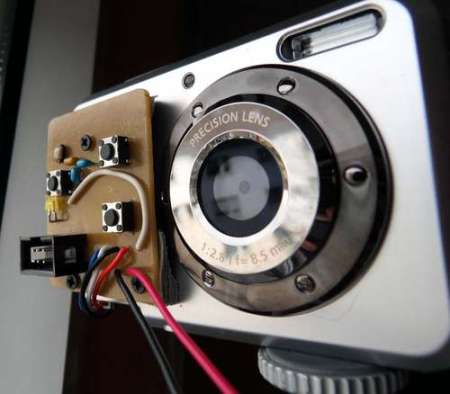
[Andyk75] has done some fantastic work documenting his timelapse addition to his digital camera.  Most of the more expensive models of cameras have a remote shutter release, but the point and shoot jobs usually don’t. He decided to add the ability to turn the camera on, then shoot a picture, then turn it back off. Pretty smart, since these things tend to eat batteries pretty quickly if left on.  He is using an ATtiny24 for the brains, but the circuit should be pretty adaptable to others. The final piece has several features, like the ability to change the length of time between shots and automatically shut down when it gets too dark outside to continue. He has posted the schematics as well as the board layouts if you can find them amongst the ads in instructibles. You can check out a video of a sunset taken with this camera after the break.

Continue reading “Timelapse Circuit For Point And Shoot Cameras”

Retro Adapter For Canon SLR

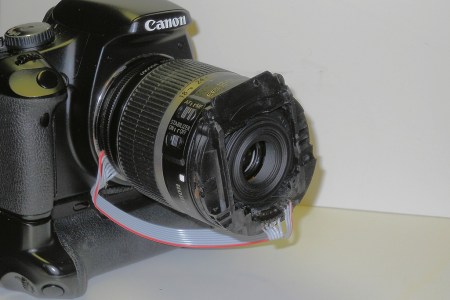
[calculon] was able to modify a “dumb” adapter to allow his Canon SLR to use the aperture and focus on a retro lens.  With his new flip mounted wide angle lens he was able to achieve some pretty neat macro shots.  By cutting away some of the cheaper ring he was able to feed the wire through and glue it onto the the cameras contact points.  The wire was then attached to the inputs on the “new” lens. With a new adapter running about $375 not only was this a neat little hack but it was also a money saver. You can see some more of his photos on his flicker

Beginner Concepts: Powering Your Projects

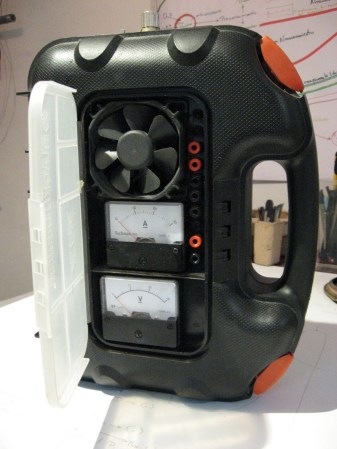
Powering your gadgets generally seems like a necessary evil. To help with this [Felipe La Rotta] made a really nice bench power supply using a PC power supply and a LM317 adjustable voltage regulator. PC power supplies are an example of a switched power supply(more on that later).  The LM317 is a type of linear voltage regulator that allows for adjusting the output voltage by varying some resistors. Whats the best way to power your circuits? well that depends…

Continue reading “Beginner Concepts: Powering Your Projects”

Electromechanical Computer Built From Relays

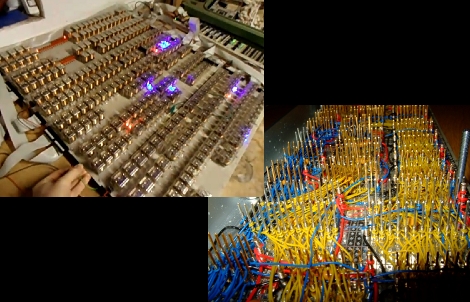
This is Zusie, a computer built out of electromechanical relays. [Fredrik Andersson] picked up a lot of about 100 telephone exchange circuit boards, each with about 16 relays on them. After getting to know a heat gun really well he ended up with 1500 working relays with which to play. The machine runs slowly, it iss noisy, but it definitely works. After the break you can see it running and assembly code program that he wrote.

The instruction set is based on boards running microcode. These store the operational commands for each instruction the processor has available to it and they run in parallel with the rest of the operations.

We’re always surprised to see that these home-built processors work. Mostly because of the complexity involved in assembling them. How hard is it to find a shorting connection or a malfunctioning relay? Those problems aren’t limited to this application either, what do you do if a transistor-logic CPU has a malfunctioning chip?

Continue reading “Electromechanical Computer Built From Relays”

Breadboarding RAM

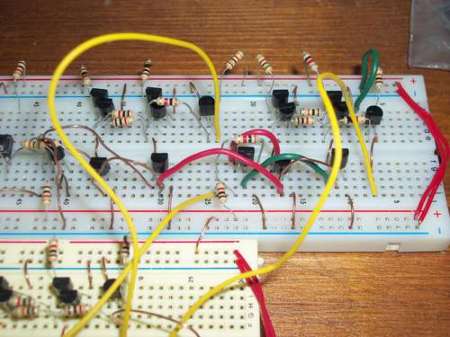
If you’ve ever wanted to dive in and take a look at how memory hardware is implemented here is a good example of how to implement some latching circuits with ether BJT or CMOS transistors. BJTs require biasing resistors which increases the complexity and power consumption when compared to CMOS. If power consumption isn’t an issue you could certainly make some really fast logic.

Most modern on chip RAM is made using SRAM because it only takes six transistors to implement(vs eight) and is pretty fast. When it comes to density DRAM can get one bit of storage by using a single transistor and capacitor(putting the capacitor underneath he transistor can save even more space). All that said, latches and flip flops are still a very useful (and common) tool when working with digital circuits.

Making Point Contact Transistors

[youtube=http://www.youtube.com/watch?v=vmotkjMSKnI&w=470]

[Jeri Ellsworth] is back at it again. We seem to cover her work a lot here. Her latest video above covers how she created a point contact transistor from a 1N34 germanium cat whisker diode. After opening the glass casing on the diode, she uses sharpened phosphor bronze metal from common electrical connectors as the collector and emitter. A 330 microfarad capacitor charged to 20 volts and then discharged though a 680 ohm resistor to the base and collector leads forms the collector region. Her test jig is a simple oscillator circuit such that a properly formed transistor will start the circuit oscillating and make and audible sound. We look forward to more esoteric knowledge of electronic devices being brought to our attention.