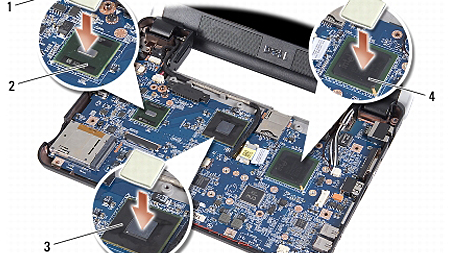
Meet the DIY Dvorak keyboard. I’m feeling nostalgic this week, and I was surprised that we’ve never mentioned this simple, but useful hack. Heresy history lesson: the qwerty keyboard was created to slow down typing – because old typewriters jammed too easily. The Dvorak keyboard is more efficient because the letters that are most often used are positioned closer to the fingers natural position. [Anders] swapped the keys on his Swedish thinkpad, and even customized the map a bit further to his own taste.
computer hacks1422 Articles
computer hacks
Printer Networked Light Control

[Andy] sent in his ‘Network Something‘ hack. For his proof of concept, he used a parallel port printer network adapter to create a set of network controllable LEDs. The virtual printer was implemented with a set of shift registers and a set of nand gates. (and a power regulator). Old print servers can be had pretty cheap – my HP $8 on ebay. Definitely an interesting way to get inexpensive network control of your projects.
Note: We’ll be making some server changes today and tomorrow, so comments will be offline for a bit. They’ll be back.
Keybot – Serial Controllable Keyboard Interface

[john] sent in his uncles Keybot project. The device accepts input (a parallel port in this case) and generates standard keyboard output. It allows a computer to create its keyboard input for itself or another machine. Personally, I go for serial consoles, but it’s a good study of our old friend the keyboard. (If legos are more your thing, you could do something like this.)
Reactable: Visual, Interactive Synth

[imajes] brought this sweet project to my attention. The table is reactive thanks to the combination of a projector and a video camera below the surface. The position and unique pattern of each block on the table is used to manipulate the operations of the synth. The software is open source – so you can build your own. (And it’ll run on linux, mac and windows) Check out the videos for a good demonstration. I’m thinking that one of these could be built on a budget using lumenlab/overhead LCD technology.
Optical Recognition LED Control
I probably shouldn’t find this as worthy as I do. It’s the optical recognition equivalent of wiring up a LED to a switch,, but it just appeals to me. [Ashish], one of our favorite optical recognition hackers of late, sent along this product of his boredom. If only he’d give us some source and a wiring diagram…
Got something interesting to share? Visit the tips line.
Watercooled LED Backlit LCD

[john] mentioned this on the LCD LED backlight post. Given the date on the posts, I was surprised that we haven’t seen it before. He replaced the CCFL lamp with 32 1 watt luxeon LEDs mounted on a custom copper water cooling block. The result is bright enough to be sunlight viewable in his car.
RS-232 Serial Laser Link

[ashish] sent in this one via the tips line. (Ed Note: link rot. Try this one.) It’s a project to create a laser based RS-232 link. It’s based on cheap laser pointers, a MAX232 and a photo-resistor to receive the signal.