Superconference Interview: Alan Yates

In 2015, virtual reality was the future, which means we should all have it right now. One of the most technologically impressive VR sets is the HTC Vive, an amazing piece of kit that’s jam-packed with sensors and has some really cool tech going on inside it.

One of the developers of the HTC Vive and the ever-important ‘Lighthouse’ position sensors is [Alan Yates]. He’s of Valve and gave a talk at last year’s Superconference on Why the Lighthouse Can’t Work. Being able to determine the absolute position of the Valve’s headset is hard, but absolutely necessary for VR. Anything else would be an incomplete VR experience at best, and give you nausea at worst.

We sat down with [Alan] after his talk last year, and now that interview is up. You can check that out below.

Continue reading “Superconference Interview: Alan Yates”

SHACamp 2017, A Personal Review

There are a series of stages to coming down from a festival. After the hectic rush of travel there are the several days of catching up on lost sleep and picking up the threads of your life again, then once a semblance of order has been regained there’s that few weeks of emptiness. Your life will never be the same again, it’s all so mundane.

I'm pleased to say the Hackaday and Tindie stickers were very popular.
I’m pleased to say the Hackaday and Tindie stickers were very popular.

It’s now a couple of weeks since the SHACamp 2017 hacker festival in the Netherlands was in full swing, and the write-up below has slowly taken shape over that time amid the other work of being a Hackaday scribe and editor. It’s early morning here in Southern England as I write this, so on the equivalent day while I was at SHACamp at this time I would have been carrying a large pack of stickers for distribution on the swapping table through the rising sunlight of a camp still largely asleep after the previous night’s revelry. Past our German and Dutch immediate neighbours, down the ramp from the dyke, the cardboard tent depot on my left and the food court on my right, to the information tent. Greet the bleary-eyed volunteer at the end of their graveyard shift, and spread plenty of Hackaday and Tindie stickers on the table for the masses. And then? Find a coffee, and sally forth into the field for another day among one of the most stimulating communities on Earth. My community. Your community.

The sticker table is a good place to start if you wish to get a handle on a large hacker camp. On it you will find the logos of a cross-section of the diverse organisations and groups present. There are a few commercial ones like my Jolly Wrenchers and Tindie the puppy, there are some from voluntary organisations or interest groups, but mostly they are the logos of a continent’s — even the wider world’s in some cases —  hackspaces and makerspaces. Here you see the breadth of the attendees, as the logos of spaces from thousands of miles away you’ve never encountered before mingle. This isn’t quite a global gathering, but there is a sense of global community around it.

How Do You Describe a Hacker Camp?

You shall find us by our clearly superior yet dangerous to barefoot pedestrians fused right-angled mains connector.

So before I take you through my experience of SHA, it’s best to start by describing a hacker camp in more general terms. When I’m describing a camp like SHA to the kind of people who don’t read Hackaday, I put it as similar to the music festivals they are used to but without the bands. Instead the audience provides the entertainment through the work they bring to the event or do at the event, and through a comprehensive program of talks and lectures. Oh — and this is the bit that makes their eyes open wide — every structure on site from the smallest one-man tent to the largest marquee has mains power and high-speed Internet. Sometimes people grasp what SHA is from this description, sometimes they don’t.

Different groups, be they individual hackspaces, people from a particular country, or other special interest groups, congregate in villages, collections of tents, marquees, and gazebos in which they set up whatever cool stuff they’ve brought along. My tent with its Hackaday flag was in a village composed of a mix of British hackspaces up on the dyke, which [Michael] from MK Makerspace had marked with a sign consisting of a huge BS1363A mains plug. More than one person pointed out it would have been better lying flat on the ground with pins in the air, ready to catch an unwary Monty Python foot.

Continue reading “SHACamp 2017, A Personal Review”

Make A Badge When There Is No Badge Yet

What do you do when your keenly anticipated hacker camp releases details of its upcoming badge and you really want to have a go at coding for it, but there are no badges for you to try yet? If you are [Artdanion], this is not a problem, you simply build your own.

He found his requirement to interface with genuine hardware exceeded the abilities of the emulator that the SHACamp 2017 badge team had thoughtfully provided, so he reached for breakout boards for the ESP32, the MPR121 touch sensor, and the e-ink display, and assembled his own clone on a piece of stripboard. Not only did it provide him with enough to develop his own apps, he found when he brought it to the event that the public release of the official firmware ran on it with only a few configuration tweaks. He had an official event badge, that wasn’t the event badge. Is this the first time this has been done? We think it might be.

The home-made badge is an impressive piece of work, but it ties into an observation we made at the end of our review of the official version of the SHA2017 badge. The use of an ESP32 with well-designed peripherals and a solid firmware means that this is a design that is likely to form the bedrock upon which some future badges are built. [Artdanion] has proved how straightforward it is to clone, we’d like to be so bold as to make the prediction that we’ll see more developments of this platform at future events. Meanwhile this home-made badge is a neat achievement, and we can only imagine the surprise of the SHA2017 badge team on being presented with a clone of their work for reflashing.

Superconference Interview: Ben Krasnow

Ben Krasnow is a consummate prototyper. He’s built a machine that makes the perfect chocolate chip cookie, he has a ruby laser, and he produces his own liquid nitrogen in-house because simply filling up a dewar is too easy. If you need a prototype, Ben is the guy to talk to.

Ben gave a talk at last year’s Hackaday Superconference on prototyping quickly and verifying technical hypotheses. The philosophy can be summed up simply as, ‘Build First, and Ask Questions Later’. This philosophy served him well when he wanted to see if backscatter x-ray machines were actually more effective than metal detectors at TSA checkpoints. The usual bean-counter protocol for answering this question would be to find an x-ray expert, wait weeks, pay tens of thousands of dollars, and eventually get an answer. Ben simply built his own backscatter x-ray machine from parts sourced on eBay.

After the talk, we asked Ben about the limits of this philosophy of building first and asking questions later. With the physical and mental toolset Ben has, it’s actually easy to build something that can get in the ballpark of answering a question. The problem comes when Ben needs to prove something won’t work.

Answering this question is all a matter of mindset. In Ben’s view, if a prototype works, a hypothesis is verified. Even if it’s a complete accident, he’s totally okay with the results. Some of his other colleagues have an opposite mindset — if a quick and dirty prototype doesn’t work, a research hypothesis is verified.

This rapid-proof-of-concept mindset is something we see a lot in the Hackaday audience, and we know there are some of you out there who have a mind and garage that is at least as impressive as Ben’s. We’ve extended the Call for Proposals for the 2017 Hackaday Superconference. If you have a story about rapid prototyping or just making the perfect chocolate chip cookie with robots, we want to hear about it. Tickets are still available for the Superconference in Pasadena, California on November 11th and 12th.

The Latest Hacker Camp Badge Comes From BornHack

If you’re a fan of outdoor hacker camps, or if you’re a SHACamp attendee who’s still coming down from the event high, you may already know about the upcoming BornHack 2017 hacker camp on the Danish island of Bornholm, from the 22nd to the 29th of this month. It’s a smaller camp than many of the others on the calendar, but it makes up for that with a quite reasonable ticket price, a much longer duration, and a location that is a destination in itself.

Today we have news of the BornHack badge announcement, and though the details are a little sketchy it’s safe to say that there should be plenty there to keep attendees occupied. The irregularly-shaped PCB contains a Silicon Labs “Happy Gecko” EFM32 ARM Cortex M0 microcontroller, a 128×64 pixel OLED display, and the usual array of I/O lines. There is no information about its connectivity as it seems the BornHack folks prefer to run a teaser campaign, but we’d be surprised if there wasn’t some kind of wireless module on the reverse.

Barring a transportation miracle it’s unlikely that any of the Hackaday team will be making it to BornHack, but that’s our loss. It may not be one of the larger camps, but it looks to offer no less of the atmosphere you’d expect from a European hacker camp. At the time of writing there are still BornHack tickets to be had, so head on over to their website if you fancy a week at a hacker camp on a Danish island.

Superconference Talk Deadline Extended One Week

Our Call for Proposals for the Hackaday Superconference was scheduled to close yesterday. We are extending that deadline by one week so get your proposal for a talk or a workshop in now.

We want to leave no stone unturned and are intimately familiar with the procrastination habits of busy hackers like you. Now there is no excuse. Put together your pitch now and send it our way. This is the ultimate hardware conference and we’re topics covering Engineering Heroics (how you managed to pull it together to get across the finish line), Prototyping, Research (building custom rigs for University/private industry/giggles), Product Development, Full-Stack Fabrication, and anything else you think fits the vibe of Hackaday.

Accepted talks receive free admission and access to speaker events. There are travel stipends available for exemplary proposals. We also record talks for publication after the Superconference so this is a chance to be famous on Hackaday.

It’s likely that you have an interesting story to tell. Time to get up there and tell it!


The Hackaday SuperConference is November 11-12, 2017 in Pasadena California. There are still tickets available but what remains will sell out quickly when the slate of speakers in announced. Don’t miss out, grab your ticket now.

Hands On With The SHACamp 2017 Badge

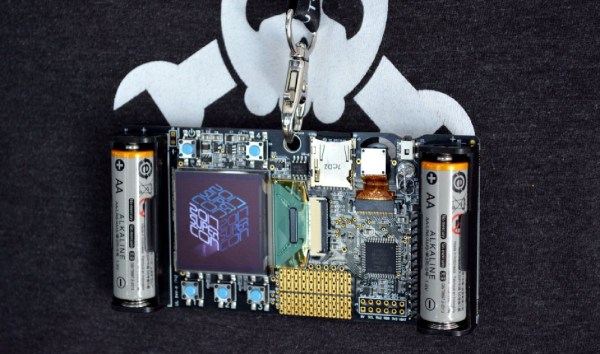
The badge has become one of the defining features of a modern hacker camp, a wearable electronic device that serves as both event computer and platform for some mild software and hardware hacking. Some events have had astoundingly sophisticated badges while others are more simple affairs, and the phenomenon has even spawned an ecosystem of unofficial badges which have nothing to do with the event in question.

The SHACamp 2017 badge is the latest to come the way of a Hackaday writer, and certainly contains enough to be taken as representative of the state of hacker camp badges in 2017. It doesn’t have a star turn like CCCCamp 2015’s software defined radio, instead it’s an extremely handy little computer in its own right.

Continue reading “Hands On With The SHACamp 2017 Badge”