Our New York City trip for the TechCrunch hackathon is just about wrapped up, and this weekend we’re hosting a hardware hackathon at the Hackaday Design Lab in Pasadena, but there’s still one more event from NYC left to cover: our drink-up in the city.
Our drink-up took over about 90% of the Antler Beer and Wine Dispensary, with the usual, not electronically enabled patrons sufficiently annoyed.
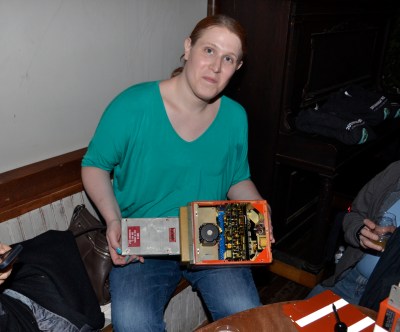 While this meetup was really just a meet-and-greet pregame for the TechCrunch hackathon, and not a proper ‘bring a hack’, that didn’t stop a few people from toting out some very cool hardware. [Katie Fortunato] trucked out a flight data recorder (or an airplane’s black box, painted orange for visibility) that is supposedly from a 747.
This flight data recorder keeps relevant data on a loop of mylar tape. We didn’t crack into that part of the black box, but we did manage to dig into the electronics. Very weird stuff in there; the control electronics have a backplane design, where each card has a connector that’s basically 2 rows of 50 or 75 female pin sockets. These cards aren’t keyed in any way, and they must be placed in the backplane in a certain order. The circuits are extremely simple; just a mix of op-amps, 74- and 54-series logic (no, we can’t figure that one out, either), buffers, and inverters. The latest date code was some time in the early 80s, and all the boards had a conformal coating on them. There’s a weird connector on the outside of the black box [Katie] promises to document on her hackaday.io profile.
Also at the event were a few folks from NYC Resistor, a few people from the IoTGotham meetup, some of the crew from littleBits. Somewhere in the pictures below is a Ms. PacMan/Galaga cabinet. Yes, I tested the bee overflow cheat, it works, but the high score was above 500,000.
Continue reading “Hardware You Might See In A Bar In New York”







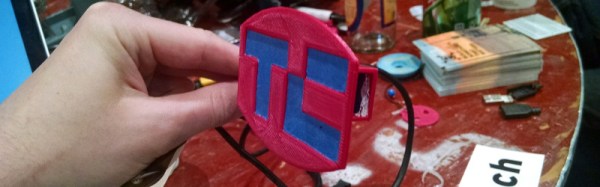
 The idea started with the concept of a dedicated device to carry a complicated password; something that you couldn’t remember yourself and would be difficult to type. [Dan] also decided it would be much better if the device didn’t need its own power source, and if the user interface was dead simple. The answer was a wrist-band made up of a USB cable and a microcontroller with just one button.
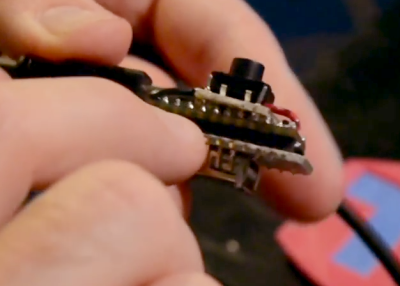
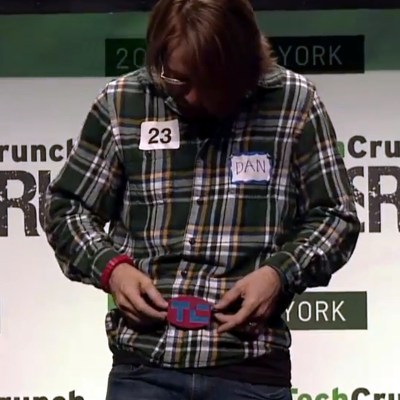
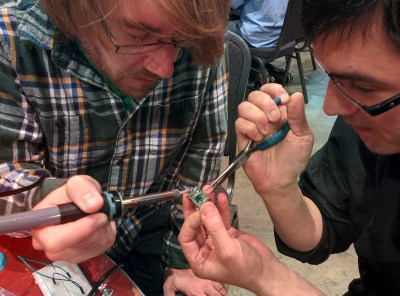 [Dan] came up with the idea to have a pair of mating boards for the Teensy 2.0. One on top hosts the button, the other on the bottom has a USB port which is used as the “clasp” of the belt buckle. One side of the USB cable plugs into the Teensy, the other into this dummy-port. Early testing showed that this was too bulky to work as a bracelet. But [Dan] simply pivoted and turned it into a belt.
 [Kenji Larsen] helped [Dan] with the PCB-sandwich. Instead of mounting pin sockets on the extra boards, they heated up the solder joints on a few of the Teensy pins and pushed them through with some pliers. This left a few pins sticking up above the board to which the button add-on board could be soldered.