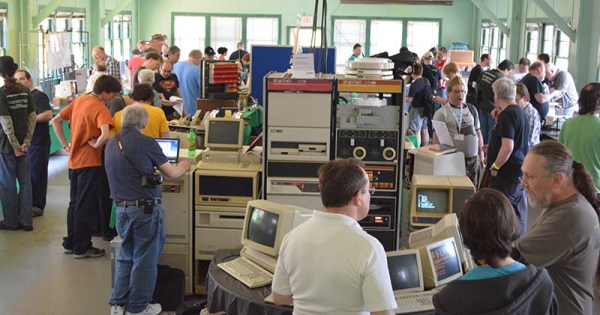
The Vintage Computer Festival East was last weekend, and now it’s time to wrap everything up. We’re going to start this off with a video of the biggest, most intolerable jerk on the planet walking around the boardwalk at Ashbury Park. Thanks to [Fran] for filming it.
That video, despite the wretched casting director, included the reveal of the PDP Straight-8, the 50-year-old minicomputer that was repaired and refurbished by [David Gesswein] just this year. You can see some pictures of that and more below, and a little more on [David]’s website.
The Amiga 1000, the original Amiga, was introduced in 1985, making this the 30th anniversary of the Commodore Amiga. Of course this needed to be represented at the Vintage Computer Festival, and [Bill Winters] and [Anthony Becker] were more than up to the task:
The guys brought with them a representation of nearly every Amiga, and also have a few neat gadgets to plug into these cool little boxes. The Amiga 1200 has been heavily upgraded with a compact flash drive. With the proper adapters and cards, this neat machine can be upgraded with Ethernet, WiFi, or just about every conceivable networking solution.
Attached to the A500 is a Gotek floppy drive emulator, a relatively standard if weird device that turns a PC floppy drive connector into a USB mass storage solution. This floppy emulator did not originally support Amiga disk formats, but with a firmware modification, everything just works. That’s a great story in itself, and something we should probably cover another time.
If you’re wondering what it was like for [Bill] and [Anthony] to dig through their garage for their exhibit, here you go.
Portable Macintoshen
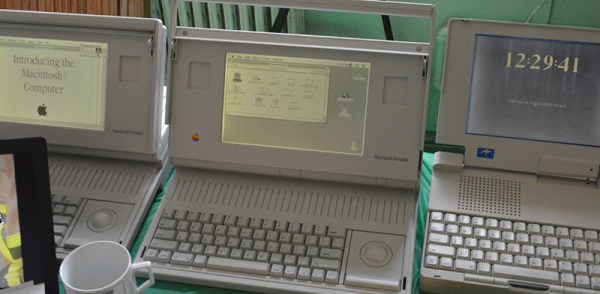
The first Macintosh was released in 1984. Macintosh users wanted a slightly more portable machine, but the first ‘luggable’ Mac wouldn’t be released until late 1989. The market was there to fill the gap, with some bizarre machines exhibited by [Matt Bergeron]:
The Outbound laptop and notebook were unlicensed clones of the Macintosh. Instead of pirating the Apple ROMs, the Outbound computers required buyers to pull the ROM chips from their Macs and install them in the slightly more portable version. This was, of course, inconvenient, and we can imagine there were more than a few ROM chips cloned.
The Dynamac was a different beast, using the entire PCB from a mac SE or SE/30. To this, the creators of the Dynamac added a custom video card and electroluminescent display that was also capable of driving an external monitor. Very cool stuff.
We’re hosting one day of hacking in New York City next week. Stretch your skills with the power of deadlines and you can be immortalized in Hackaday history. If that kind of cred doesn’t do it for you, Hackaday is bringing along $1500 in prizes and there’s another $5000 cash prize at stake as well.
Only Hackaday can bring hardware to the TechCrunch NYC Hackathon on May 2nd. We need you to make it happen. Get your free ticket now (UPDATE: Our special tickets are all sold out but you might still be able to get some in the last few ticket releases. Check back often.). From there join the comment thread on our events page to connect with the rest of us who will be there.
Break the Hardware and Software Divide
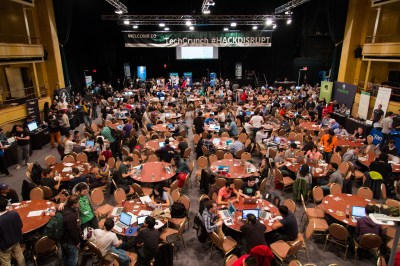
Check out these pictures of last year’s TechCrunch hackathon. There’s a ton of people, they all seem to be having fun, but when it comes down to the end, they’re pointing to the screens of their Macbooks. This year you need to break that mold and and rise to the top with a hardware product to hold up as you are awarded TechCrunch’s comically large $5000 check.
Holding a hunk of hardware with electrons running through its veins is way more hardcore than software alone. We will end the segregation of software-only and hardware-only hackathons. After all, most hardware hacks these days are also software hacks. Team up with one of the iOS/Android app groups and add hardware to the mix. We want to see at least twenty of those tables strewn with jumper wires, breakout boards, and soldering irons. And we want to see someone from the Hackaday Community win this thing. So here’s the agreement — we’ll get you in, we’ll bring the hardware, you bring the awesome.
All Work and No Play (yeah right)
Ha! Like that has ever been our mantra. This is going to be a blast and because of it the Hackaday crew is flocking to town from all over the country. Confirmed so far are [Adam], [Alek], [Amar], [Brian], [Chris], [Jasmine], [Matt], [Mike], [Rob], [Sophi], and [Theodora]. We’re there to have fun, and you’re invited.
Most of the crew will arrive in town on Thursday night and we’ll definitely be meeting up. Anyone who registers for the Hackathon is invited for these pre-game festivities. Drop a comment on the events page and we’ll PM you details about where and when. But at the event our collective skills will be available to get your project past the sticking points. Of course we also need many hands to distribute all the swag we’re bringing along.
The Vintage Computer Festival last weekend featured racks and racks of old minicomputers, enough terminals for an entire lab, and enough ancient storage devices to save a YouTube video. These storage devices – hard disks, tape readers, and 8″ disk drives – were only connected to vintage hardware, with one exception: a DEC RL02 drive connected to a modern laptop via USB.
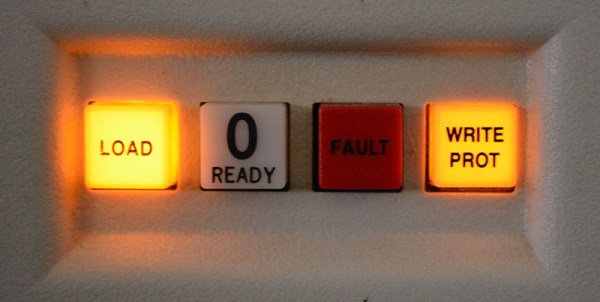
The DEC RL02 drive is the closest you’re going to get to a modern mechanical hard drive with these old machines. It’s a huge rack unit with removable platters that can hold 10 Megabytes of storage. [Chris] found one of these old drives and because he wanted to get into FPGA development, decided to create a USB adapter for this huge, old drive.
The hardware isn’t too terribly complex, with a microcontroller and an FPGA that exposes the contents of the drive over USB mass storage. For anyone trying to bootstrap a PDP-11 or -8 system, [Chris] could download disk images from the Internet, write them to the disk, and load up the contents of the drive from the minicomputer. Now, he’s using it with SimH to have a physical drive for an emulated system, but the controller really doesn’t care about what format the disk pack is in. If [Chris] formatted a disk pack with a FAT file system, he would have the world’s largest and heaviest USB thumb drive in the world.
When we get together we like to build stuff, and that’s what has been motivating us as we work toward Hackaday Prize Worldwide: Pasadena. This two-day event held May 9th and 10th in the Los Angeles area is not to be missed. We are presenting a workshop, speakers, hacking, and socializing. Drop what you’re doing and get a ticket for the low-low price of being an awesome person.
On Saturday the ninth, Hackaday opens our doors for the workshop: “Zero to Product”. [Matt Berggren] leads the workshop. He is well known for running the Hardware Developer’s Didactic Galactic up in San Francisco (a meetup that we love to attend). [Matt] comes from a hardware design background and has done it all. He’s been involved in building schematic and PCB tools, been run through the startup gauntlet, and has a ton of hardware experience including everything from FPGA layout to getting that product out the door.
The workshop covers the things you need to consider when producing production-quality, professional-level circuit boards. Don’t be afraid of this, the discussion is approachable for the newcomer as well as the experienced hacker. Of course a PCB does not a product make so the conversation will also move through component selection, enclosures, best practices, and much more.
You Can’t Miss these Talks
[Elecia White]
[Elecia] is an embedded systems expert and a Hackaday Prize judge in both 2014 and 2015. Elecia will be demonstrating a gadget designed to familiarize engineers with the capabilities of inertial various sensors like accelerometers, gyroscopes, and magnetometers.
We do have a few other speakers and lighting talks lined up but we don’t want to announce until we have final confirmation from those presenters. Please check on the event page for updates.
Show Off Your Hacks and Build More On-Site
The robot build at Hackady’s 10th Anniversary last October
We have the space, we have the people, add some food and beverage and now you’re talking. On Saturday evening we’ll warp up the talks and workshops, throw on some tunes, and pull out the projects we’ve been working in our spare time.
This casual hang-out is a great time to find answers and advice for that one problem that’s been tripping you up. We’ll make sure there’s something to fill your belly and keep you happy while you think about what you want to hack on the following day.
Sunday is Open Hack Day. Want to work on the concepts you picked up from Saturday’s workshop? Great, we can help with that! We’ll also have hardware development boards on-hand from our Hackaday Prize Sponsors, other random hackable stuff, and of course you may bring your own equipment and get down to business. Anything is fair game but we’re especially excited to see what people are building as their 2015 Hackaday Prize entries!
In case you missed the ticket link, please RSVP now. We’ll see you in May!
Last Friday the Vintage Computer Festival was filled up with more than a dozen talks, too many for any one person to attend. We did, however, check out [Bil Herd]’s talk on system architecture, or as he likes to call it, the art and science of performance through balance. That’s an hour and fifteen minute talk there; coffee and popcorn protocols apply.
The main focus of this talk is how to design a system from the ground up, without any assumed hardware, or any specific peripherals. It all starts out with a CPU, some memory (it doesn’t matter which type), and some I/O. That’s all you need, whether you’re designing a microwave oven or a supercomputer.
The CPU for a system can be anything from a 6502 for something simple, a vector processor for doing loads of math, or have a RISC, streaming, pipelined, SIMD architecture. This choice will influence the decision of what kind of memory to use, whether it’s static or dynamic, and whether it’s big or little endian. Yes, even [Bil] is still trying to wrap his head around endianness.
MMUs, I/O chips, teletypes, character displays like the 6845, and the ANTIC, VIC, and GTIA make the cut before [Bil] mentions putting the entire system together. It’s not just a matter of connecting address and data pins and seeing the entire system run. There’s interrupts, RTCs, bus arbitration, DTACK, RAS, and CAS to take care of that. That will take several more talks to cover, but you can see the one last Friday below.
The Vintage Computer Festival in Wall, New Jersey doesn’t just attract locals; [Oscar] came all the way from Switzerland to show off his PiDP-8/I. It’s a miniature minicomputer, emulated in SimH, with blinkenlights and toggle switches mounted to a Raspberry Pi Hat.
Although the PiDP-8 is emulating a machine with thousands of discrete transistors, the design is exceptionally simple. On the board is 92 LEDs, a bunch of diodes, 26 toggle switches, a driver chip, and that’s about it. All the multiplexing for the switches and LEDs is taken care of in software. On the Raspberry Pi side, [Oscar] is able to run FOCAL, OS/8, and, like a normal-sized PDP-8, can toggle in programs manually.
Instead of having connecting to the ribbon cables coming out of RK01 disk drives and DECtapes, [Oscar] is emulating those too. All the files that would reside on old Digital storage mediums are now stuffed into USB thumb drives. A USB hub is plugged into the Pi, and when one of these USB disk packs is plugged into the hub, loading an operating system or a program is just a matter of flicking a few toggle switches.
[Oscar] has been working hard to turn the PiDP-8 into a kit, and the word around the booths is that this will happen sometime this summer. The expected price for this kit is very interesting: somewhere between $100 and $150 USD. For that price, we’d expect someone to rig up an Arduino-based paper tape reader very quickly, perhaps this afternoon.