TechCrunch Disrupt: Charging A Phone With Its Own Transmitter

TechCrunch Disrupt is on this week, and that means we get to see which members of tech media don’t understand basic physics. So far, it’s writers from Engadget, The Mirror, Business Insider, TechCrunch, and four judges on the TC Disrupt stage. What is the consequence of not understanding the implications of the conservation of energy? Glowing support for a cell phone that can charge itself.

The offending Disrupt startup is Nikola Labs, and they’re gearing up to launch a Kickstarter for a very special iPhone 6 case. This case uses small, energy-harvesting antennas to gather RF energy from the cellphone tucked away in this case. This energy is then sent to a rectifier where it is converted into something the Apple Lightning connector can sip power from. According to Nikola Labs, this RF harvesting antenna takes energy from the transmissions of the iPhone 6 entombed in this case, converts it to about 5 Volts, and uses that to charge the iPhone battery.

I know that seems difficult to understand, so here’s a simple analogy: you have a flashlight with a battery and a solar cell. The solar cell recharges the battery. If this were a Nikola Labs flashlight, you would recharge it by shining the flashlight onto the solar cell.

That is the simplest explanation of what the Nikola Labs cellphone case does, and illuminates the limitations of what it can do. If the ‘energy harvesting circuit’ collects power from the device it is recharging, it will reduce the transmission power of whatever is transmitting. With the cellphone case, you’re spending transmission power (plus efficiency losses) to recharge the battery. That means poorer reception and fewer bars. In the solar-recharging flashlight analogy, the flashlight would either be dimmer, or you could only use it part of the time.

It’s also why Nikola Labs claims their case will only recover 30% of the battery life of an iPhone 6; the battery isn’t solely dedicated to a transmitter – there’s a display and a CPU to account for in the power budget.

To Nikola Labs’ credit, this is at least a novel application of the RF energy harvesting trope that has been making its way around Kickstarter and tech blogs for a few years. Nearly every other RF harvesting idea that has been pitched in recent memory decouples the transmitter (or ‘generator’, I guess) with the product or receiver. The square cube law is an evil mistress, and if you’re wondering why these devices don’t work, [ch00f], a guy with an actual engineering degree, has a great writeup of one of these products over on Drop Kicker.

The Nikola Labs cellphone case bucks this trend by looking at the shortcomings of these devices; an RF rechargeable Bluetooth tag won’t work if you place it a foot away from a WiFi router, but it just might if you tape it to the antenna. This is the idea behind Nikola Labs’ invention: harvest energy from a few millimeters away from the cell phone’s antenna. According to Nikola Labs, their engineer, [Chi-Chih Chen] has a patent in the works for this. This patent application has not been published yet.

In theory, the Nikola Labs cellphone case will actually recharge your battery, but at a price: you’d be wasting your transmission power on recharging the battery. It’s a false economy that you’ll be able to fund on Kickstarter next month for $100 USD. If you’re only looking for more battery life, walk into any gas station, buy a $10 USB power bank/battery, and have enough portable power to recharge your iPhone battery to 100%. That’s not a sexy solution, it doesn’t reference [Nikola Tesla], and it’s not snake oil that tech media is lapping up like dogs. Pity.


[Kenji Larsen] Shows Off The Ultimate Hacking Kit

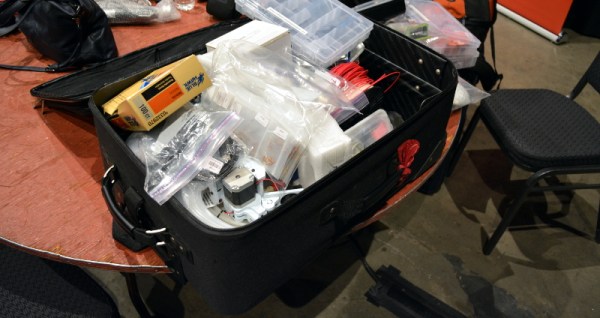
If you roll into a hardware hackathon empty-handed, you’re going to be at a disadvantage compared to those who bring equipment with which they’re already familiar. Pray that you never roll into one where [Kenji Larsen] is your competitor. Luckily, this weekend he came out to mentor for Hackaday’s hardware hacking village at the TechCrunch Disrupt hackathon and not as a competitor. In this video he shows off the huge rollerbag which he calls his “Hack Pack”. I’d say there’s a 50/50 chance his travel setup is better than your home lab.

Where do I begin (seriously, watch the video)? Perhaps best to note is how organized he is. For instance, the large plastic bag containing his battery-operated and plug-in Dremels also has conveniently sized stock like acrylic and metal. There are compartment boxes full of sensors, others contain things like passives, batteries, battery chargers, hundreds of Moteino modules, handfuls of BeagleBones Black, breakout and dev boards of every flavor. He has all the necessary tools like hemostat, x-acto blade, steel ruler, and magnifying glasses. There’s even a 3D printer in the bag — a Printrbot Simple which [Chris Gammell] played with all weekend err… learned to use as part of his role as a mentor.

We had a ton of hardware along with us, but time and again [Kenji] was there for the save on some of the less-common needs. He’s a expert when it comes to fabrication techniques and it showed. We also give him mad points for staying up overnight for all 20-hours of the build session. Thank you so much [Kenji], I think I speak for every one of the hardware hackers when I say you helped bring the event to the next level of exhilarating and exhausting fun. Please direct your own thanks, stories, and well-wishes, and follows to [Kenji’s] hacker profile.

If you weren’t able to make it to NYC this weekend, you definitely missed out. We’ll be telling the story of that all week. Those on the West Coast will have a chance next weekend at Hackaday Prize Worldwide: LA. The workshop is sold out but socializing on Saturday, and a Sunday free-build are both still available for RSVPs.

Weekend Proves Hardware Wins Hackathons

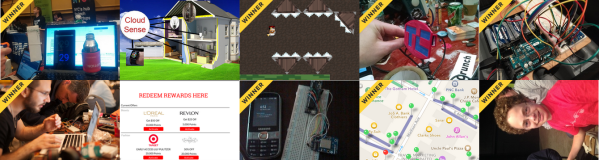
Teams hacking on hardware won big this weekend in New York. There were ten teams that answered Hackaday’s call as we hosted the first ever hardware hackathon at the Tech Crunch Disrupt NYC. These teams were thrown into the mix with all of the software hackers TC was hosting and rose to the top. Eight out of our ten teams won!

As we suspected, having something physical to show off is a huge bonus compared to those showing apps and webpages alone. Recipe for awesome: Mix in the huge talent pool brought by the hardware hackers participating, then season with a dash of experience from mentors like [Kenji Larson], [Johngineer], [Bil Herd], [Chris Gammell], and many more.

Out of over 100 teams, first runner-up went to PicoRico, which built a data collection system for the suspension of a mountain bike. The Twillio prize went to Stove Top Sensor for Paranoid, Stubburn Older Parents which adds cellphone and web connectivity to the stove, letting you check if you remembered to turn off the burns. The charismatic duo of fifteen-year-olds [Kristopher] and [Ilan] stole the show with their demonstration of Follow Plants which gives your produce a social media presence which you can then follow.

We recorded video and got the gritty details from everyone building hardware during the 20-hour frenzy. We’ll be sharing those stories throughout the week so make sure to check back!

Vintage Computer Festival Europa 16.0: The Hackaday Report

The 16th annual Vintage Computer Festival Europa (VCFe) is still ongoing this weekend in Munich, and of course Hackaday had to swing by. If you’re anywhere in Germany, you’ve still got until Sunday at 16:30 to check it out.

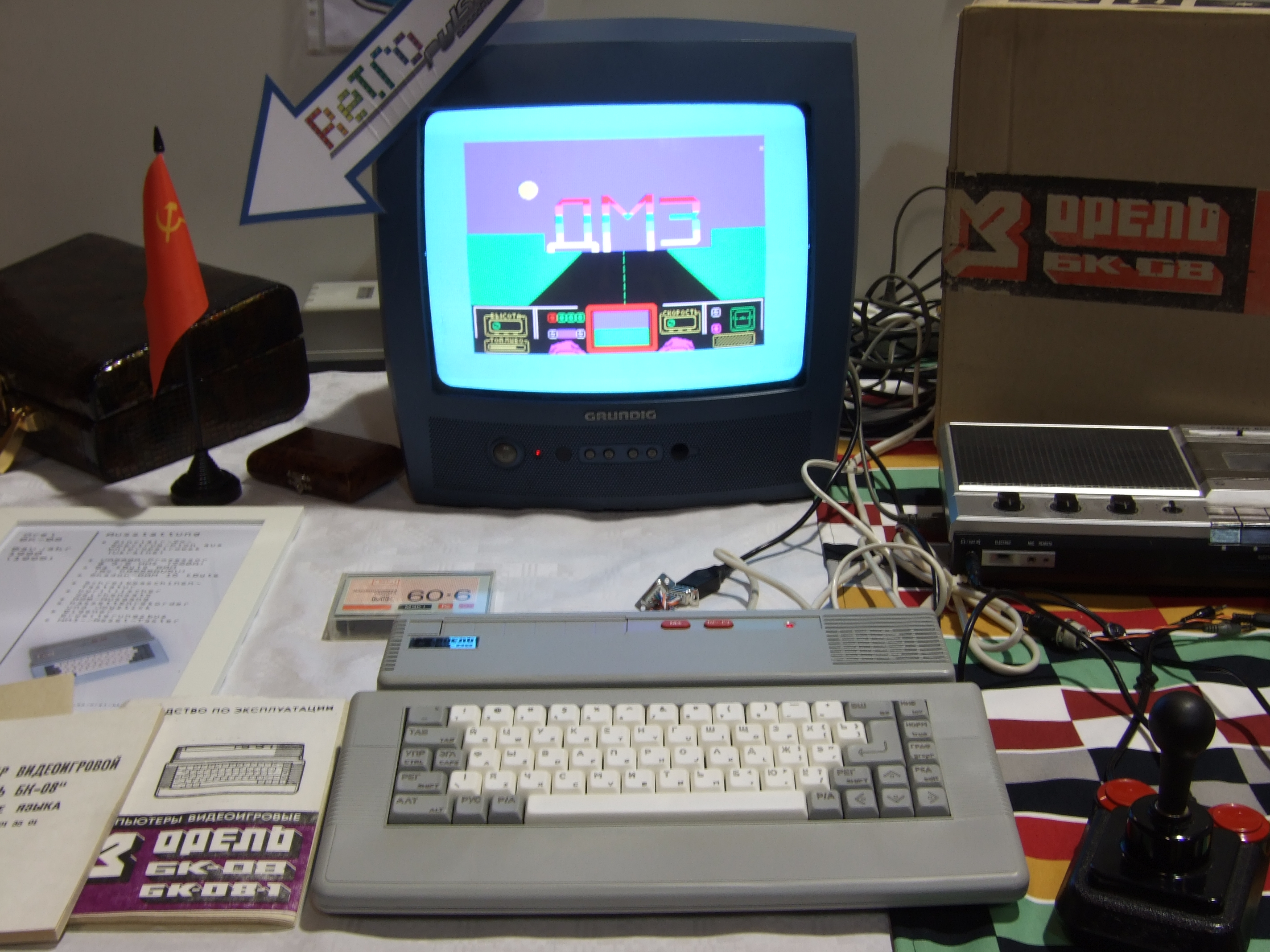
DSCF7896The theme for this year’s festival is “The East is Red Colorful” and that means vintage computers from the other side of the Iron Curtain. Here in (West) Germany, that naturally means a good representation of computers from the former Democratic Republic of Germany (DDR), but Czechoslovakia, Yugoslavia, and of course Russia were also in the house. There was far too much going on to cover it all, but here’s a few of the projects and computers that caught our eye.

Continue reading “Vintage Computer Festival Europa 16.0: The Hackaday Report” →

Hackaday Events: NY, LA, SF, LA

We are doing a lot this spring to get people elbow-deep in hardware hacking. We have so many live events coming up that we’re going to be doing Saturday morning recaps to keep you informed. Here are the upcoming events should be planning to attend if you’re nearby.

nyc-hackationToday! NYC Hardware Hackathon

We hope you didn’t miss our announcements about the Hardware Hackathon we’re putting on in New York. It starts this afternoon and runs all night and into Sunday. If you really want to get in on the hacking we might be able to help you out (hit us up on Twitter). But you can also show up on Sunday to see the results live. Tickets for that are available here.

thp-worldwide-laMay 9 & 10 Hackaday Prize Worldwide: Los Angeles

Next weekend we open up the Hackaday Design Lab of Pasadena, California for a workshop, talks, and a day of hacking. This is the Hackaday Prize Worldwide: Los Angeles. Start out on Saturday with the Zero to Product workshop which will discuss getting from design to production. Interspersed with this are a set of talks from amazing presenters before a bit of social time at night. On Sunday we open our doors for Free Build and hope to see a ton of people working on their Hackaday Prize entries. RSVP now!

2015-05-01_BAMF-meetupSaturday, May 16 BAMF Meetup

Seeing everything at Bay Area Maker Faire means a lot of time on your feet. By the end of the day the Hackaday Crew is ready to take a load off and toss back a tasty beverage. We invite you to join us on Saturday, May 16th starting at 7pm. All the cool kids will be there so please RSVP now.

It’s not compulsory, but a lot of people bring hardware they’ve been working on to show off at this meetup and you should too!

layerone-logoMay 23 & 24 LayerOne Conference

Every year our friends from NullSpace Labs organize the LayerOne Conference in Los Angeles. This is LA’s premier hardware security conference. This year Supplyframe is sponsoring the badges and Hackaday will be camped out at the Hackaday Hardware Villiage.

[Brian Benchoff] and [Mike Szczys] will be hacking their own badges while looking for awesome hacks other people are pulling off. We’ll bring plenty of swag and want to get everyone there to try at least some level of badge hack.

More Hackathon Tickets Just Made Available

We had a number of people tell us they weren’t able to get tickets to our Hackathon in New York on Saturday. A block of tickets was just made available. Head on over and grab yours right now!

We’re bringing a mini-van-load of hardware along with us for this one. Our hope is to see a hardware hacker claim the top prize of $5000, but we do have other prizes just for the teams that create something with hardware. You can team up with other creative hackers from the area, all while being wined and dined (well, fed and hydrated anyway) through the entire thing. We can’t wait to see what you can get working with just twenty-hours of build time! You can find out a bit more about the hardware we’re supplying and what we have planned over on our event page.

That’s on Saturday, but the fun actually starts this evening. Join us at 7pm this evening at Antler Wine & Beer Dispensary. We’d appreciate a quick RSVP if you’re coming, and don’t forget to bring some hardware you been working on lately. See you there!

DOTS Uses Paint To Control Raspberry Pi 2

Two tables down from us at SXSW Create the Raspberry Pi foundation had a steady stream of kids playing Minecraft on Raspberry Pi, and picking up paint brushes. The painting activity was driven by a board they spun for the event that used conductive paint to control the Raspberry Pi 2.

rear-of-the-raspberry-pi-2The board uses the HAT form factor which it a fancy name for a shield (also a clever one as it stands for “Hardware Attached on Top”). You can see the back side of the board in this image. It utilizes an extremely low-profile surface mount pin socket.

The front side exposes several circular pads of copper which build up a “connect-the-dots” game that is played by painting conductive ink on the surface. This results in an airplane being pained on the board, as well as displayed on the computer. There is a set of pads that allow the user to select what color is painted on the monitor.

We like this as a different approach to education. Kids are more than used to tapping on a touchscreen, clicking a mouse, or pounding a keyboard. But conductive ink provides several learning opportunities; the paint simply connects the inner circle with the outer circle; one of these circles is the same on every single dot (ground); anything that connects these two parts of the dot together will result in input for the computer. Great stuff!

The foundation is taking the boards to Maker Faire Bay Area next month so stop by to see these in action. You can read about the production process for the DOTS board on the Raspberry Pi website. They’re giving away a few boards to software developers who want contribute to the project. And our video interview with [Matt Richardson] is found after the break.

Continue reading “DOTS Uses Paint To Control Raspberry Pi 2” →