CES: Building Booths And Simulating Reality

My first day on the ground at CES started with a somewhat amusing wait at the Taxi Stand of the McCarran International Airport. Actually I’m getting ahead of myself… it started with a surprisingly efficient badge-pickup booth in the baggage claim of the airport. Wait in line for about three minutes, and show them the QR code emailed to you from online registration and you’re ready to move to the 1/4 mile-long, six-switchback deep line for cabs. Yeah, there’s a lot of people here for this conference.

It’s striking just how huge this thing is. Every hotel on the strip is crawling with badge-wearing CES attendees. Many of the conference halls in the hotels are filled with booths, meaning the thing is spread out over a huge geographic area. We bought three-day monorail passes and headed to the convention center to get started.

Building the Booths

[Sophi] knows [Ben Unsworth] who put his heart and soul into this year’s IEEE booth. His company, Globacore, builds booths for conferences and this one sounds like it was an exceptional amount of fun to work on. He was part of a tiny team that built a mind-controlled drag strip based on Emotive Insight brainwave measuring hardware shipped directly from the first factory production run. This ties in with the display screens above the track to form a leader board. We’ll have a keen eye out for hacks this week, but the story behind building these booths may be the best hack to be found.

Oculus

[Ben] told us hands-down the thing to see is the new Oculus hardware called Crescent Bay. He emphatically mentioned The Holodeck which is a comparison we don’t throw around lightly. Seems like a lot of people feel that way because the line to try it out is wicked long. We downloaded their app which allows you to schedule a demo but all appointments are already taken. Hopefully our Twitter plea will be seen by their crew.

In the meantime we tried out the Oculus Gear VR. It uses a Galaxy Note 4 as the screen along with lenses and a variety of motion tracking and user controls. The demo was a Zelda-like game where you view the scene from overhead. This used a handheld controller to command the in-game character with the headset’s motion tracking used to look around the playing area. It was a neat demo, I’m not quite sold on long gaming sessions with the hardware but maybe I just need to get used full-immersion first.

Window to another Dimension
DSC_0317

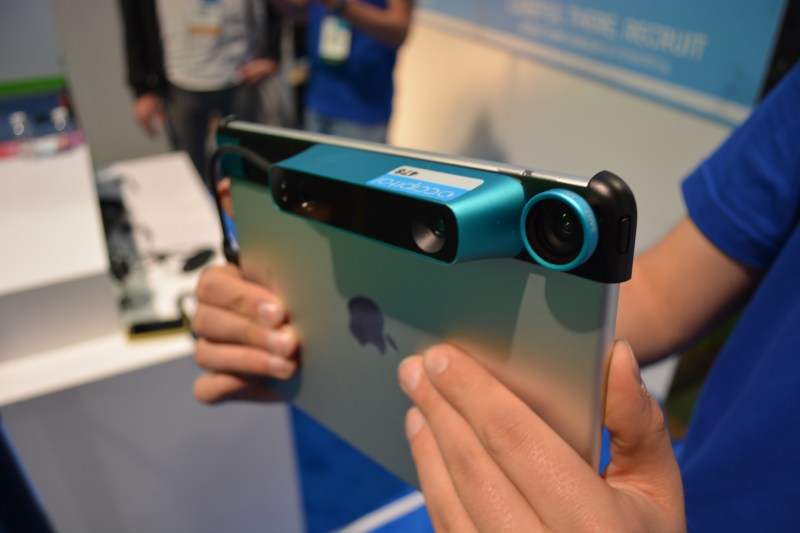
The midways close at six o’clock and we made our way to the Occipital booth just as they were winding done. I’ve been 3D scanned a few times before but those systems used turntables and depth cameras on motorized tracks to do the work. This uses a depth-camera add-on for an iPad which they call Structure Sensor.

It is striking how quickly the rig can capture a model. This high-speed performance is parlayed into other uses, like creating a virtual world inside the iPad which the user navigates by using the screen as if it were a magic window into another dimension. Their demo was something along the lines of the game Portal and has us thinking that the Wii U controller has the right idea for entertainment, but it needs the performance that Occipital offers. I liked this experience more than the Oculus demo because you are not shut off from the real world as you make your way through the virtual.

We shot some video of the hardware and plan to post more about it as soon as we get the time to edit the footage.

Find Us or Follow Us
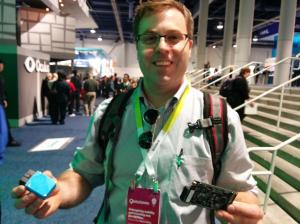
josh-can-hardwareWe’re wearing our Hackaday shirts and that stopped [Josh] in his tracks. He’s here on business with his company Evermind, but like any good hacker he is carrying around one of his passion projects in his pocket. What he’s showing off are a couple of prototypes for a CANbus sniffer and interface device that he’s build.

We’ll be at CES all week. You can follow our progress through the following Twitter accounts: @Hackaday, @HackadayPrize, @Szczys, and @SophiKravitz. If you’re here in person you can Tweet us to find where we are. We’re also planning a 9am Thursday Breakfast meetup at SambaLatte in the Monte Carlo. We hope you’ll stop by and say hi. Don’t forget to bring your own hardware!
 

31st Chaos Communications Congress

The 31st annual Chaos Communications Congress (31C3) kicked off today and you’ve already missed some great talks. If you’re not in Hamburg, Germany right now, you can watch the talks as they happen on the live stream. So stop reading this blog post right now, and check out the list of presentations. (But don’t fret if you’ve already missed something that you’d like to see. All the talks are also available after the fact.)

For those of you whose worldview is centered firmly on the You Ess of Ay, you’ll be surprised to learn that the Congresses are essentially the great-grandaddy of the US hacker conventions. If you’re one of the many (old?) US hackers who misses the early days of yore before DEFCON got too slick and professional, you’ll definitely like the CCC. Perhaps it’s the German mindset — there’s more emphasis on the community, communication, and the DIY aesthetic than on “the industry”. It’s more HOPE than DEFCON.

This is not to say that there won’t be some great hacking showcased at 31C3. It is the annual centerpiece of the European hacker scene, after all. Hardware, firmware, or software; it’s all exploited here.

Some of the talks are in German, naturally, but most are in English. If you haven’t attended before, you at least owe it to yourself to check out the live stream. Better yet, if you’re a member of an American hackerspace, you can at least set up local remote viewing for next year. Or maybe you’ll find yourself visiting Germany next Christmas.

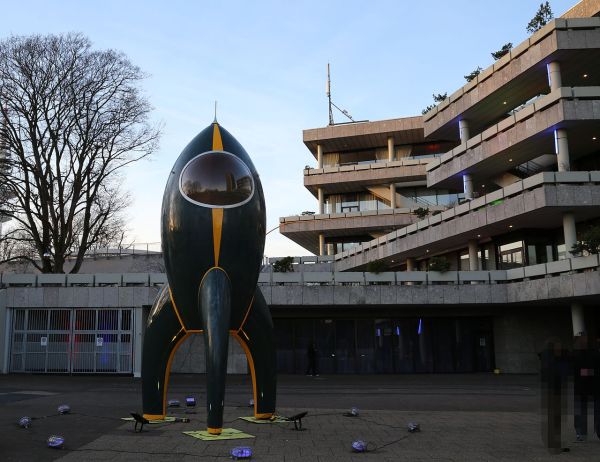
[Image: Wikipedia / Tobias Klenze / CC-BY-SA 3.0]

Student Trolls Anti-Arduino Prof With Parasite MCU

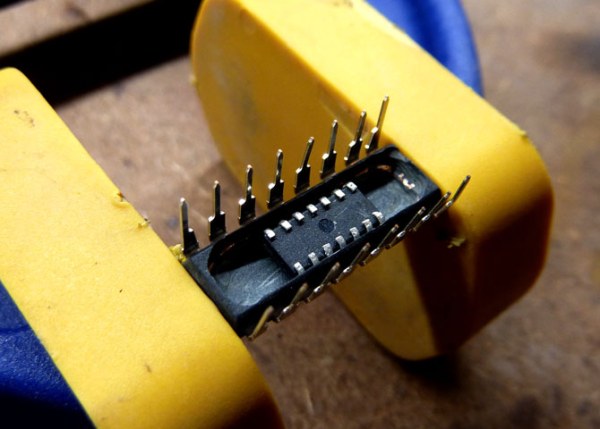
Like some of our grouchier readers, [PodeCoet]’s Digital Sub-Systems professor loathes everyone strapping an Arduino onto a project when something less powerful and ten times as complicated will do. One student asked if they could just replace the whole breadboarded “up counter” circuit mess with an Arduino, but, since the class is centered around basic logic gates the prof shot him down. Undeterred, our troll smuggled an MCU into a chip and used it to spell out crude messages.

No Arduino? No problem. It took him 4 tries but [PodeCoet] hollowed out the SN74LS47N display driver from the required circuit and made it the puppet of a PIC16F1503 controller. The PIC emulated the driver chip in every way – as ordered it showed the count up and down – except when left unattended for 15 seconds. Then instead of digits the PIC writes out “HELLO”, followed by three things normally covered by swimsuits and lastly a bodily function.

For such a simple hack it is wonderfully and humorously documented. There are annotated progress/failure pictures and video of the hack working.

It is not as elaborate as the microscopic deception in the infamously impossible 3 LED circuit, but it gets to the point sooner.

Continue reading “Student Trolls Anti-Arduino Prof With Parasite MCU”

Hack.summit(); // A Virtual Dev Conference

If you’d like to spend four days learning from and picking the brains of a big group of well-known developers and open-source wizards for the low, low cost of absolutely free, keep reading.

The hack.summit() conference is a live, global event put on by the  fine folks behind real-time programming assistance service hack.hands(). From December 1 to December 4, a wide range of speakers will present and answer democratically popularized questions over Crowdcast via Google+ Hangouts. Speakers in attendance include wiki inventor and Design Patterns pioneer [Ward Cunningham], Codeacademy founder [Ryan Bubinski], Google Glass creator [Tom Chi], Python Software Foundation’s [Alex Gaynor], and even the inimitable [Jon Skeet].

The goals for this conference are simple and admirable: to educate developers of all stripes about best practices, to encourage mentorship in the programming community, and to spread the joy of coding by supporting coding non-profits.

You can register for free simply by spreading the word through social media, but making a donation to the coding non-profit of your choice is definitely encouraged. There are many to great organizations to choose from such as  CoderDojo (an easy choice for us). A tidy summary of the event is available at the hack.summit() FAQ(PDF).

PoughkeepsieMMF

First Ever Poughkeepsie Mini Maker Faire

This past Saturday was the first Mini Maker Faire held in Poughkeepsie, NY. Although it was the first in the area, the event went extremely well having over 60 makers and countless attendees. It was held at the Poughkeepsie Day School and made use of a large percentage of the indoor area.

roboticarm

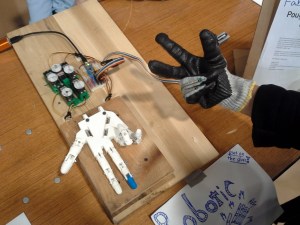
Ninth graders of the hosting school [Liam], [Johnson] and [Matt] were proudly displaying some of their projects. One of which was a robotic hand controlled by a glove the user wears. Flex sensors sewn into the glove detect how much each finger is bent. That information is read by an Arduino which then commands 5 independent servos to pull string ligaments to bend the fingers of the 3D printed robotic hand. The kids give credit to this Instructable which was the inspiration for their desire to build such a project.

No Maker Faire would be complete without some 3D printers. On hand was a father/son team that built a Mini Kossel. The design is simple and elegant, and apparently assembly is no problem for even the youngest maker. 3D printing guru [Ed] was on hand with his MakerGear M2 to show some practical uses for 3D printers. They are not just for making Yoda heads! [Ed] also gave a presentation on the matter, explaining why 3D printing is important and useful to people, even the common non-techno-nerd consumer.

Continue reading “First Ever Poughkeepsie Mini Maker Faire”

Electronica 2014 Wrap-Up

Make no mistake about it, Electronica is a real trade show, with suits everywhere, meeting rooms packed to the gills, and €4 bottles of soda. If you dig around long enough, you will find some interesting things, as I did on my excursions to the Messe with [Chris Gammell] and [Sprite_TM].

Actual cool booths

This isn’t a show and tell. The purpose of the booths are for sales people to meet with other sales people, and people who have the letter ‘C’ somewhere in their title to be concerned about things you’ll never understand. Booth displays are a plastic case with a few components in them. If you’re lucky, you’ll have some units running on a table somewhere.

This isn’t the case for all booths, though. The Linear booth wanted to demo some custom sensors, so they built the most primitive thermocouple in existence. It’s a piece of copper pipe and some barbed wire, brazed together. It won’t be an accurate thermocouple when the torch is still hot, but by calibrating it against a known temperatures and values, they can get pretty reliable temperature readings. Oh, the displays are Nixies.

Raspberries

raspberrypi_logo No, Raspberry Pi didn’t have a booth, but RS Components did, and this is where you could find Raspberries and Raspberry-related projects. I hun around the booth after [Eben] gave a talk, and this is what the future of the Raspberry Pi ecosystem will look like:
  • There will be no more form factor changes. Until the next hardware update, we’ll have the B+ and A+ form factor.
  • When is the next hardware update? Some time in 2017 or 2018. They don’t have a chip selected yet.
  • Four million units shipped. I told [Eben] the Commodore 64 shipped 25 Million, [Eben] told me [Jack Tramiel] was running his mouth when he said that. German tank problem with serial numbers and all that.
  • Lots of industrial applications. There are real, legitimate uses of a Pi in controlling million dollar machines.
  • No one has built a cluster of Pi compute modules. I believe the problem is finding vertical SO-DIMM connectors.

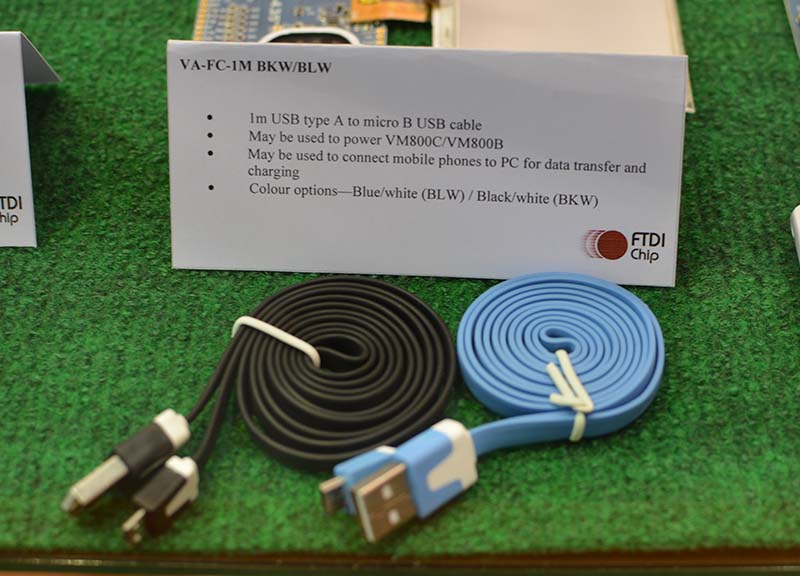
The latest from the FTDI display case

DSC_0031

Free Stuff

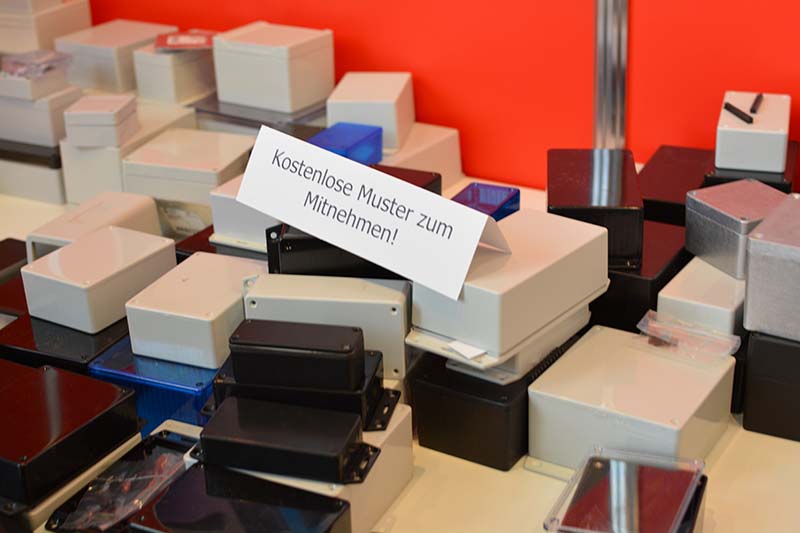
Show up at the end of Electronica, and you’ll quickly figure out the people at booths don’t want to ship their stuff home. This was the Hammond Enclosures booth:

DSC_0033

What did I grab? Just some Raspi cases, and one of the wooden Hammond enclosures used for tube amps. Also picked up a sample of unreleased Kailh switches for mechanical keyboards. Data coming sometime.

If someone is at the Munich airport in a few days, I might have a wooden Hammond enclosure for you.

Hackaday’s Most Excellent Munich Adventure

Bags are packed… it’s insane the amount of random electronics I carry with me on a trip. But who doesn’t want to do some prototyping on the plane?

In case you haven’t heard, the Hackaday Crew is headed to Munich. The coming week is Electronica. We’ll be prowling “the world’s leading trade show for electronic components” looking for the jewels of interest to the hacking community. Watch our Twitter feed for updates on those adventures.

But of course, Thursday the 13th is all about Hackaday Munich. The place will be packed! During the afternoon we feature hands-on hacking of embedded systems. The hardware we’re supplying is already spoken for. But you should bring along your own dev boards to hack on, or just come to watch the fun.

Get a ticket to The Hackaday Prize party. This includes a talk by [Sprite_TM], the announcement of the Grand Prize winner for the 2014 Hackaday Prize, followed by a party with music by [DJ Muallen]. Nobody should miss this event so please help get the word out. See you there!