LayerOne Badge Hacking Twofer

Here’s a pair of LayerOne Badge hacks that actually included the RC as intended by the badge designers.

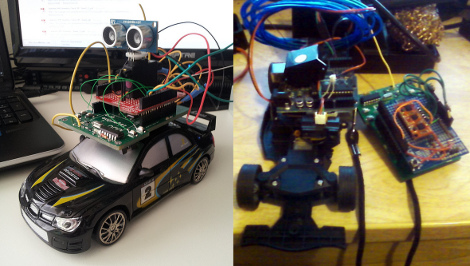
First up, we have the autonomous RC car built by [Arko]. He calls it Stanley Jr. as an homage to the Stanford DARPA Grand Challenge vehicle. It uses an Arduino shield to add a servo with an ultrasonic rangefinder on it. The lets the vehicle drive a bit, stop and scan the horizon, then drive some more. The hope is the rangefinder will keep it from running into anything. There’s a quick test run embedded after the break.

On the right is the badge hack which [Zjpahle] finished up after the contest was already over. He also chose to go with an Arduino shield, this time it’s an IMU board. But he added a standalone Arduino board to the vehicle which drives some EL wire (ground effects) and adds IR sensors to the front of the car. The IR sensors are for obstacle avoidance, and the IMU lets him tilt his badge for direction control.

We looked at the winner of the badge hacking competition on Wednesday. That hack didn’t involve the car, but used the badge as a Morse Code beacon.
Continue reading “LayerOne Badge Hacking Twofer”

Morse Code Beacon Wins The LayerOne Badge Hacking Contest

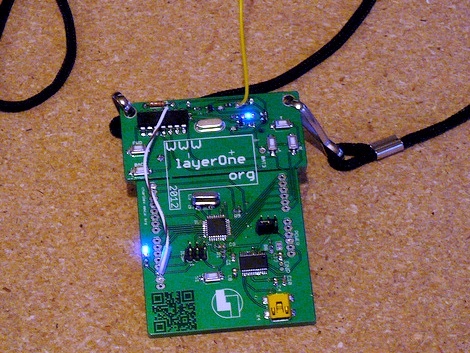
Ham skills prevail in this year’s LayerOne badge hacking contest. [Jason] was the winner with this Morse Code beacon hack.He got a head start on the competition after seeing our preview feature on the badge hardware development. It got him thinking and let him gather his tools ahead of arrival.

The hardware is segregated into two parts of the board. The lower portion is a take on the Arduino, and the upper portion is a wireless transmitter meant to control some cheap RC cars. [Jason] figured this was perfect for conversion as a CW beacon (continuous wave is what Morse Code is called if you’re a ham). The first issue he encountered was getting the badge to play nicely with the Arduino IDE. It was setup to run Slowduino firmware which uses the internal oscillator. [Jason] soldered on his own crystal and reflashed the firmware. He found that the transmitter couldn’t be directly keyed because of the shifting used in the RC car protocol. He cut the power to the transmitter, and found that it could be more accurately keyed by injecting power to one of the other pins. Check out the video after the break for a better explanation of his technique.

Continue reading “Morse Code Beacon Wins The LayerOne Badge Hacking Contest”

LayerOne Badges Stop Bullets; Drive Away

We love badges. And we’ve really got to thank [Charliex] for taking the time to write a huge post about this year’s LayerOne badges, especially since they’ve got their backs up against the deadline for pulling everything together in time.

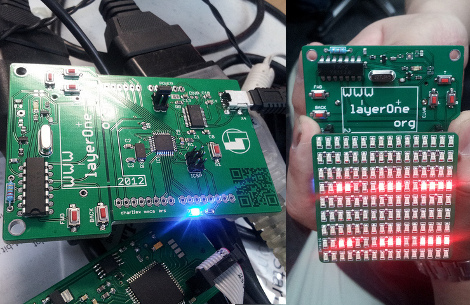
Here it is, the stock badge on the left, with an add-on shield on the right. Now the original intent was to make this badge the chassis of an RC car. [Charliex] chewed through his development time trying to source toy cars that could be gutted for parts that would mount easily on the badge. This looked promising at first, but turned out to be folly. Instead what we have here is an Arduino compatible board with an RF transmitter which can be cut off and used separately if you wish. Attendees will be able to use the badge to take control of the toy cars (cases of them have been shipped to the conference), with the option to use the USB functionality to facilitate automation.

So what about stopping bullets? There is a bug in the module [Charliex] used to export the board design from Eagle. They came back from the fab house as 0.125″ substrate. That’s pretty beefy!

The conference is this weekend… better get on that!

Build Your Own Radar System

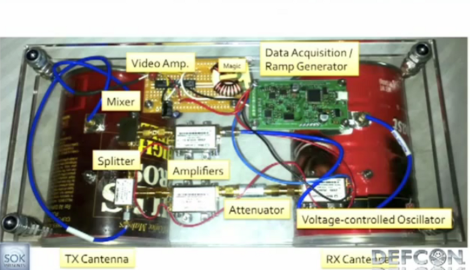
How we missed this one is anybody’s guess, but one of the presentations at DEFCON last year covers a DIY radar build. [Michael Scarito] talks about the concepts behind radar, and then goes on to show that it’s not too hard or expensive to build a setup of your own. We’ve embedded his 45 minute talk after the break.

The two large pieces of hardware above should look familiar. They’re descendents of a favorite hacking project, the cantenna. The can-based long-range antenna is most popular with WiFi applications, but we’ve seen it used for Bluetooth as well and it’s not surprising to see it here. The rest is a lot of sensing hardware and enough math crammed into the coding to make your ears droop.

If you make it far enough (exactly 39 minutes into the talk) [Michael] shares some links for more information on the build. We think living vicariously is enough for us, but if you manage to build your own setup don’t forget to post a project log!

Continue reading “Build Your Own Radar System”

Time To Get Serious About Going To LayerOne

This year’s LayerOne Hacking and Security Conference is right around the corner. But it’s not too late to attend. You can still get a block-rate hotel room if you register by the end of April, and registration for the two-day event only costs a hundred bucks. It’s scheduled for May 26th and 27th in Anaheim California.

As usual, the Speaker lineup is quite impressive. Everything from Android Malware to embedded exploits and botnet adventures will be discussed. And then there’s the perennial favorite lock picking and hardware hacking villages. Did we mention badges? We’d bet it was this pick-and-place machine which helped assemble this year’s pile of badges. We haven’t seen any word on what they might include, but there’s a hacking contest so plan to pack your tools.

Bring Your Own Name Badge

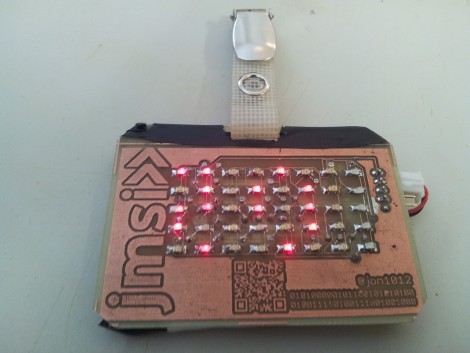
It used to be that the contents of your pocket protector directly mirrored your geek level. But that just doesn’t cut it in our fast-paced digital age. We think [Jonathan] is headed down the right track though, by creating a scrolling LED name badge which he takes to conventions with him. With the right enclosure this could reach the same geek level as Woz’s watch. There’s a lot packed into the little device, but readability at close range doesn’t look like one the features so make sure you glance at the tag before you approach him for a conversation.

As you can see, the PCB for the project is the same form factor as a landscape ID card. It hosts an 8×5 LED matrix, which meshes nicely with the registers of the MSP430 chip which runs it. He admits that the hardware may not last very long as the chip is multiplexing the display directly, with no resistors or LED drivers for current protection. But there is potential in the design. It uses a rechargeable battery (which we like) and he included a QR code in the board artwork for easy exchange of contact information. We’ve embedded his description of the project after the break. Continue reading “Bring Your Own Name Badge”

Watch All Of The Freshly Published Talks From 28c3

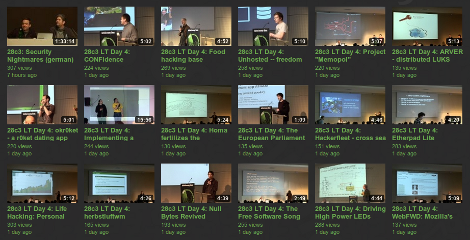
The 28th Annual Chaos Communications Congress just wrapped things up on December 31st and they’ve already published recordings of all the talks at the event. These talks were live-streamed, but if you didn’t find time in your schedule to see all that you wanted, you’ll be happy to find your way to the YouTube collection of the event.

The topics span a surprising range. We were surprised to see a panel discussion on depression and suicide among geeks (hosted by [Mitch Altman]) which joins another panel called Queer Geeks, to address some social issues rather than just hardcore security tech. But there’s plenty of that as well with topics on cryptography, security within web applications, and also a segment on electronic currencies like Bitcoins.

There really is something for everyone and they’ve been thoughtful enough to include playlists for all talks, just the lightning talks, and lightning talks categorized by the day they occurred. Get those links from their YouTube channel description, or find them after the break.

Continue reading “Watch All Of The Freshly Published Talks From 28c3”