Learning About Wearable Engineering While Trying To Un-Taboo A Topic

When you build a machine you can usually count on having precise dimensions for an organized and orderly set of parts, one fitting into the next exactly as you have designed them. You can count on cause and effect — when the user pushes a button or flips a switch a specific behavior will take place. But the She Bon project shows that adding the human body to the mix quickly turns an easy design into a challenging one.

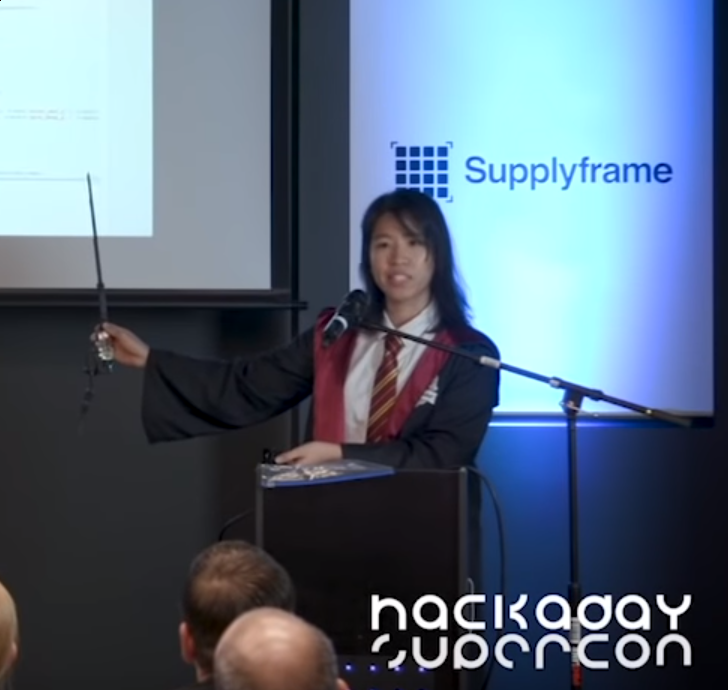
During her Hackaday Superconference talk Sarah Petkus discusses her latest project that uses wearable technology to sense and react to her own body. She Bon is reminiscent of the French for “so good” and is a project whose aim transcends the technical challenges. Sarah uses engineering as a way to facilitate adults having healthy dialogs with one another about sex.

Depending on your profession, this discussion is likely not appropriate for work — it’s not sexual, but it’s fundamentally about sex — so don’t click through the video without thinking twice. But we respect Sarah’s courage for leading a project that wants to make sure there actually are places where it is possible to have these conversations and a way to get them started.

How Do You Begin an Intelligent Conversation?

Mixing an engineering challenge with a somewhat taboo topic works surprisingly well, as you can see in the video below. It’s a technical talk about sensing body temperature, heart rate, galvanic response, blush response, facial expression, and muscle tension. But it’s also a story of her attempt at creating a Suit of Amour, her tongue-in-cheek “Sexual Gundam”. Don’t be fooled, this is no gimmick. The discussions quickly leads to the real life challenges facing prosthetics designers and those developing wearable products. There’s a ton to be learned here.

Join me below for more on the hardware covered in Sarah’s talk. This out-of-the-ordinary hardware creation adventure made it a great entry in the 2018 Hackaday Prize and a particularly delightful talk at the 2018 Hackaday Superconference. We’re once again on the hunt for hardware creators to present at the 2019 Hackaday Superconference — and we can’t do it without you. Submit a talk proposal, or just grab a ticket and join us in Pasadena this November. Bonus points for those who have also entered their projects in the 2019 Hackaday Prize. Okay, now onto the hardware talk.

Continue reading “Learning About Wearable Engineering While Trying To Un-Taboo A Topic”

Teardown 2019: A Festival Of Hacking, Art, And FPGAs

As hackers approached the dramatic stone entrance of Portland’s Pacific Northwest College of Arts, a group of acolytes belonging to The Church of Robotron beckoned them over, inviting them to attempt to earn the title of Mutant Saviour. The church uses hazardous environments, religious indoctrination, a 1980s arcade game and some seriously funny low tech hacks to test your abilities to save humanity. This offbeat welcome was a pretty good way to set the tone for Teardown 2019: an annual Crowd Supply event for engineers and artists who love hardware. Teardown is halfway between a conference and a party, with plenty of weird adventures to be had over the course of the weekend. Praise the Mutant! Embrace Futility! Rejoice in Error!

For those of us who failed to become the Mutant Saviour, there were plenty of consolation prizes. Kate Temkin and Mikaela Szekely’s talk on accessible USB tools was spectacular, and I loved following Sophi Kravitz’s journey as she made a remote-controlled blimp. Upstairs in the demo room, we had great fun playing with a pneumatic donut sprinkle pick and place machine from tinkrmind and Russell Senior’s hacked IBM daisywheel typewriter that prints ASCII art and runs a text-based Star Trek adventure game.

It wouldn’t be much of a hardware party if the end of the talks, demos and workshops meant the end of each day’s activities, but the Teardown team organised dinner and an afterparty in a different locations every night: Portland’s hackerspace ^H PDX, the swishy AutoDesk offices, and the vintage arcade game bar Ground Kontrol. There also was a raucous and hotly-contested scavenger hunt across the city, with codes to crack, locks to pick and bartenders to sweet talk into giving you the next clue (tip: tip).

Join me below for my favorite highlights of this three day (and night) festival.

Continue reading “Teardown 2019: A Festival Of Hacking, Art, And FPGAs”

Brett Smith Makes Your Life Easier With Hidden Microcontroller Features

There was a time when microprocessors were slow and expensive devices that needed piles of support chips to run, so engineers came up with ingenious tricks using extra hardware preprocessing inputs to avoid having to create more code. It would be common to find a few logic gates, a comparator, or even the ubiquitous 555 timer doing a little bit of work to take some load away from the computer, and engineers learned to use these components as a matter of course.

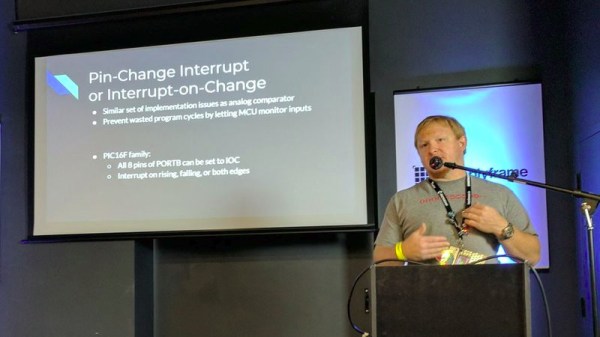
The nice thing is that many of these great hardware hacks have been built into modern microcontrollers through the years. The problem is you know to know about them. Brett Smith’s newly published Hackaday Superconference talk, “Why Do It The Hard Way?”, aims to demystify the helpful hardware lurking in microcontrollers.

Join us below for a deeper dive and the embedded video of this talk. Supercon is the Ultimate Hardware con — don’t miss your chance to attend this year, November 15-17 in Pasadena, CA.

Continue reading “Brett Smith Makes Your Life Easier With Hidden Microcontroller Features”

Bit Preserve: A Sanctuary For Modern Captures Of Vintage Schematics

Vintage parts may be documented, but that doesn’t mean they’re particularly useful or accessible. If the phrase “eyestrain from unsearchable, badly-scanned PDF datasheets” makes your lower eyelid twitch in sympathy, read on.

While [Bald Engineer] was researching how he might make a portable Apple II, he was delighted to find that the vintage components he needed to examine were documented. However, he became frustrated with the seemingly endless number of poor quality PDF scans and the inability to search effectively. He decided to re-create the entire Apple IIgs schematic in KiCad, and in the process the Bit Preserve project was born. The goal is to act as a safe haven for modern and editable versions of vintage electronic schematics. The GitHub repository can be found here.

[Bald Engineer] talks a bit about his Apple II project, as well as the ideas behind the Bit Preserve project in his KiCon 2019 talk “Preserving History with KiCad”. KiCon was wild, and we have loads of photos of the projects and details so be sure to check it out.

The Smallest Hacker Camps Are The Most Satisfying, And You Can Do One Too

Two of my friends and I crammed into a small and aged European hatchback, drove all day along hundreds of miles of motorway, and finally through a succession of ever smaller roads. We were heading for a set of GPS co-ordinates in the north of Scotland, along with all of our camping gear.

There’s nothing like the hacker camp we’re looking for. After heading down a lane barely wider than the car, we drove through a farmyard with a sheepdog lying in the middle of the road (the reclining mutt seemed unconcerned as we edge the car around). We had arrived at GampGND, one of Europe’s smallest hacker camps.

Continue reading “The Smallest Hacker Camps Are The Most Satisfying, And You Can Do One Too”

This British 3D Printing Meetup Is On The Rise

Most people who are serious about designing, building, or improving 3D printers see the Midwest Reprap Festival as the place where the latest and greatest is on show for all to see. But if you live on the other side of the world as I do, chances are slim that you’ll be able to attend.

I live in the UK, and there haven’t traditionally been any events quite like MRRF, but that may be changing. The 3D Meetup UK in Birmingham is a community-organised event bringing together the 3D printing maker and hacker community for a couple of days of talks, demonstrations, and tours. I went along this year to see what was going on, and to take the temperature of the British side of this community.

Continue reading “This British 3D Printing Meetup Is On The Rise”

Hackaday Superconference: Rob Ryan Silva On Designing For Developing Environments

Throughout the six years of the Hackaday Prize we have seen a stream of projects tackling all manner of applications and challenges. Many of them have a goal of addressing issues faced by people in developing countries, and this was the topic upon which Rob Ryan Silva spoke at the Hackaday Superconference.

Rob’s perspective is an interesting one: he runs the maker lab at Development Alternatives Incorporated, or DAI, who are best described as a specialist contractor in the international development sector. Thus while many of the Prize entrants are hardware hackers who have become involved in development related projects, he is a development specialist who has made the opposite journey to becoming a hardware hacker.

Join me below for the video of Rob’s talk and a deep dive into it. Also of note, tickets for the 2019 Hackaday Superconference are now available, the Call for Proposals is now open, and of course, the 2019 Hackaday Prize is ready for your entry! Okay, now onto Rob’s talk.

Continue reading “Hackaday Superconference: Rob Ryan Silva On Designing For Developing Environments”