Copper: Rectifying AC A Century Ago

[Robert Murray-Smith] presents for us an interesting electronic device from years gone by, before the advent of Silicon semiconductors, the humble metal oxide rectifier. After the electronic dust had settled following the brutal AC/DC current wars of the late 19th century — involving Edison, Tesla and Westinghouse to name a few of the ringleaders — AC was the eventual winner. But there was a problem. It’s straightforward to step down the high voltage AC from the distribution network to a more manageable level with a transformer, and feed that straight into devices which can consume alternating current such as light bulbs and electrical heaters. But other devices really want DC, and to get that, you need a rectifier.

It turns out, that even in those early days, we had semiconductor devices which could perform this operation, based not upon silicon or germanium, but copper. Copper (I) Oxide is a naturally occurring P-type semiconductor, which can be easily constructed by heating a copper sheet in a flame, and scraping off the outer layer of Copper (II) Oxide leaving the active layer below. Simply making contact to a piece of steel is sufficient to complete the device.

Obviously a practical rectifier is a bit harder to make, with a degree of control required, but you get the idea. A CuO metal rectifier can rectify as well as operate as a thermopile, and even as a solar cell, it’s just been forgotten about once we got all excited about silicon.

Other similar metallic rectifiers also saw some action, such as the Selenium rectifier, based on the properties of a Cadmium Selenide – Selenium interface, which forms an NP junction, albeit one that can’t handle as much power as good old copper. One final device, which was a bit of an improvement upon the original CuO rectifiers, was based upon a stack of Copper Sulphide/Magnesium metal plates, but they came along too late. Once we discovered the wonders of germanium and silicon, it was consigned to the history books before it really saw wide adoption.

We’ve covered CuO rectifiers before, but the Copper Sulphide/Magnesium rectifier is new to us. And if you’re interested in yet more ways to steer electrons in one direction, checkout our coverage of the history of the diode.

Continue reading “Copper: Rectifying AC A Century Ago”

Commodore C64: The Most Popular Home Computer Ever Turns 40

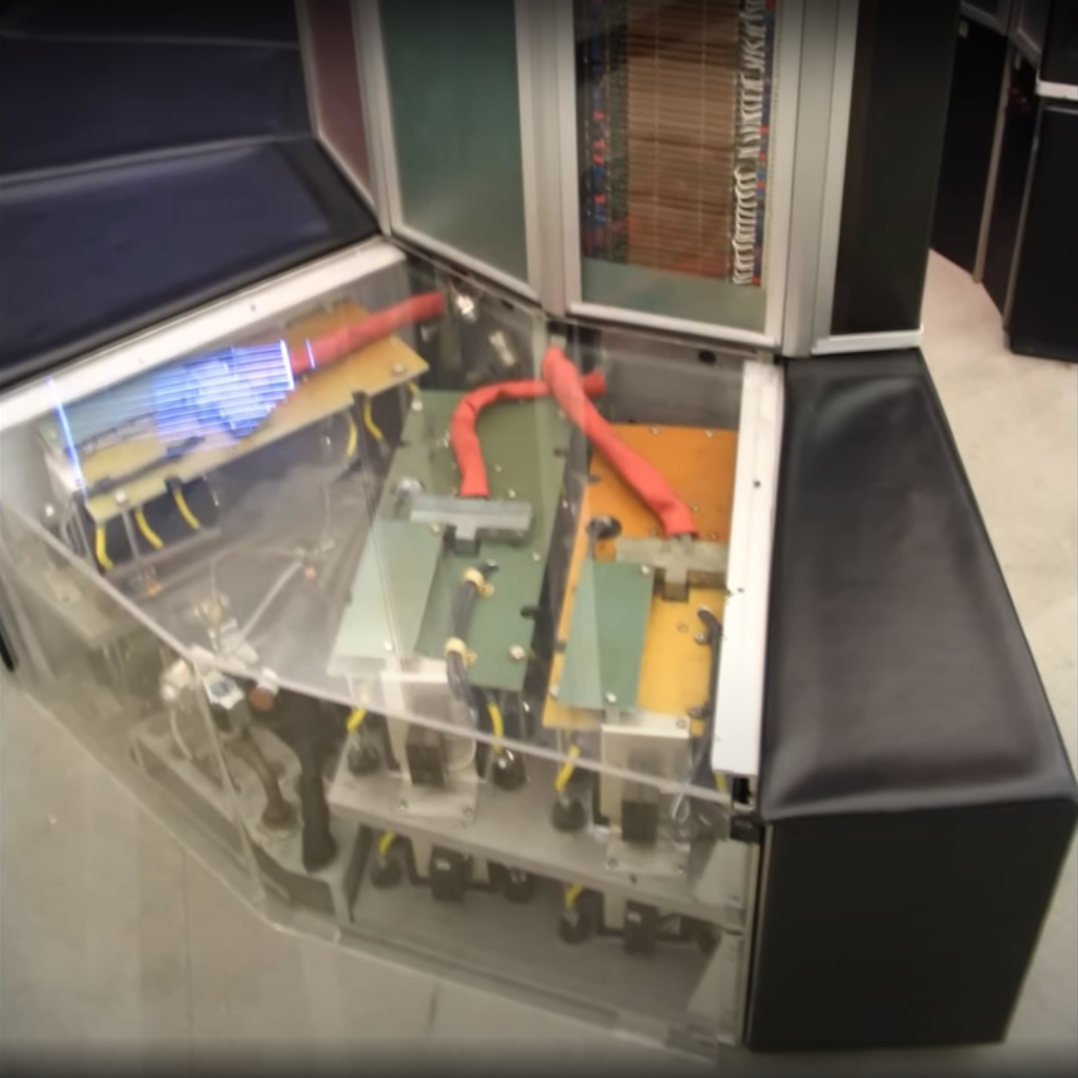
This year marks the anniversary of the most popular selling home computer ever, the Commodore 64, which made its debut in 1982. Note that I am saying “home computer” and not personal computer (PC) because back then the term PC was not yet in use for home computer users.

Some of you have probably not heard of Commodore, which is kind of sad, though there is a simple reason why — Commodore is no longer around to maintain its legacy. If one were to watch a documentary about the 1980s they may see a picture of an Apple computer or its founders but most likely would not see a picture of a Commodore computer in spite of selling tens of millions of units.

To understand the success of the C64 I would first back up and talk about the fabled era of home computers which starts with understanding the microprocessor of the day, the venerable 6502. Check out the video and follow along below.

Continue reading “Commodore C64: The Most Popular Home Computer Ever Turns 40”

Less Is More — Or How To Replace A $25,000 Bomb Sight For 20 Cents

Depending on who you ask, the Norden bombsight was either the highest of high tech during World War II, or an overhyped failure that provided jobs and money for government contractors. Either way, it was super top secret in its day. It was also expensive. They cost about $25,000 each and the whole program came in at well over a billion dollars. The security was over the top. When not flying, the bombsight was removed from the plane and locked in a vault. There was a pyro device that would self-destruct the unit if it were in danger of being captured. So why did one of the most famous missions of World War II fly with the Norden replaced by 20 cents worth of machined metal? Good question.

You often hear the expression “less is more” and, in this case, it is an accurate idea. I frequently say, though, that “just enough is more.” In this case, though, less was actually just enough. There were three reasons that one famous mission in the Pacific theater didn’t fly the Norden. It all had to do with morale, technology, and secrecy.

Continue reading “Less Is More — Or How To Replace A $25,000 Bomb Sight For 20 Cents”

Great Beginnings: The Antikythera Mechanism Gets A “Day Zero”

When an unknown genius sat down more than 2,000 years ago to design and build an astronomical instrument, chances are good that he or she didn’t think that entire academic institutions devoted to solving its mysteries would one day be established. But such is the enduring nature of the Antikythera mechanism, the gift from antiquity that keeps on giving long after being dredged up from a shipwreck in the Aegean Sea.

And now, new research on the ancient mechanism reveals that like other mechanical calendars, the Antikythera mechanism has a “day zero,” or a minimum possible date that it can display. The analysis by a team led by [Aristeidis Voulgaris] gets deep into the weeds of astronomical cycles, which the mechanism was designed to simulate using up to 37 separate gears, 30 of which have been found. The cycle of concern is the saros, a 223 lunar month cycle of alignments between the Earth, Sun, and Moon. The saros can be used to predict eclipses, astronomical events of immense importance in antiquity, particularly annular eclipses, which occur when the Moon is at apogee and therefore eclipses less of the Sun’s surface.

The researchers looked at historical annular eclipse data and found that saros cycle 58 had a particularly long annular eclipse, on 23 December 178 BCE. The eclipse would have been visible at sunrise in the eastern Mediterranean, and coupled with other astronomical goodies, like the proximity to the winter solstice, the Sun entering Capricorn, and the Moon being new and at apogee, was probably so culturally significant to the builder that it could serve as the initial date for calibrating all the mechanisms pointers and dials.

Others differ with that take, of course, saying that the evidence points even further back, to a start date in the summer of 204 BCE. In any case, if like us you can’t get enough Antikythera, be sure to check out our overview of the mechanism, plus [Clickspring]’s exploration of methods perhaps used to build it.

NASA Hardware Techniques: Soldering Space Electronics Like It’s 1958

[PeriscopeFilms] on YouTube has many old TV adverts and US government reels archived on their channel, with some really interesting subjects to dive in to. This first one we’re highlighting here is a 1958 film about NASA Soldering Techniques (Video, embedded below), which has some fascinating details about how things were done during the Space Race, and presumably, continue to be done. The overall message about cleanliness couldn’t really be any clearer if they tried — it’s so critical it looks like those chaps in the film spend far more time brushing and cleaning than actually wielding those super clean soldering irons.

Of particular note are some of the details of wire stripping and jointing with components, such as the use of a hot-wire device to remove the insulation from wire, rather than use the kind of stripper we have lying around that cuts into the insulation and slightly distorts the wire in the process. That just won’t do. If they did have to use a cutting-type stripper, it must be precisely the right size for job, and calibrated daily.

The road to the Moon is paved with calibrated wire strippers.

When soldering a pre-tinned wire to a leaded component, a clamp is required to prevent movement of the wire, as is a thermal shunt on the component lead to protect the delicate component from excess heat. They even specify how much to wrap a wire around a terminal to be soldered, never bending the wire more than 180 degrees.

The bottom line in all this is, is that the work must be as perfect as is possible, as there is very little chance of sending someone up to fix a dodgy soldering job, once the assembly is hurtling around the planet. They call it too much of a science to be called an art and too much art to be called a science, and we can sure appreciate that.

As you would expect (and it’s not exactly a big secret) NASA has some very exacting standards for assembly of all hardware, like this great workmanship standard, which is well worth studying. Soldering is an important subject for many of us, we’ve covered the subject of solder metallurgy, as well as looking at how ancient hardware hackers soldered without the benefit of much modern knowledge.

Continue reading “NASA Hardware Techniques: Soldering Space Electronics Like It’s 1958”

Circuit VR: The Wheatstone Bridge Analog Computer

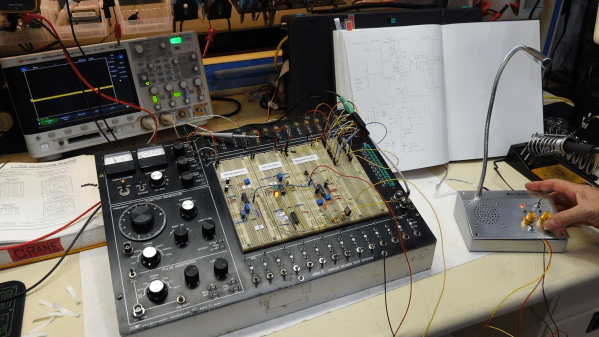
We are always impressed with something so simple can actually be so complex. For example, what would you think goes into an analog computer? Of course, a “real” analog computer has opamps that can do logarithms, square roots, multiply, and divide. But would it surprise you that you can make an analog device like a slide rule using a Wheatstone bridge — essentially two voltage dividers. You don’t even need any active devices at all. It is an old idea and one that used to show up in electronic magazines now and again. I’ll show you how they work and simulate the device so you don’t have to build it unless you just want to.

A voltage divider is one of the easiest circuits in the world to analyze. Consider two resistors Ra and Rb in series. Voltage comes in at the top of Ra and the bottom of Rb is grounded. The node connecting Ra and Rb — let’s call it Z — is what we’ll consider the output.

Let’s say we have a 10 V battery feeding A and a perfect voltmeter that doesn’t load the circuit connected to Z. By Kirchoff’s current law we know the current through Ra and Rb must be the same. After all, there’s nowhere else for it to go. We also know the voltage drop across Ra plus the voltage drop across Rb must equal to 10 V. Kirchoff, conservation of energy, whatever you want to call it.  Let’s call these quantities I, Va, and Vb. Continue reading “Circuit VR: The Wheatstone Bridge Analog Computer”

The Fliegerfaust Roars Back To Life After 77 Years

As their prospects for victory in the Second World War became increasingly grim, the Germans developed a wide array of outlandish “Wonder Weapons” that they hoped would help turn the tide of the war. While these Wunderwaffe obviously weren’t enough to secure victory against the Allies, many of them represented the absolute state-of-the-art in weapons development, and in several cases ended up being important technological milestones. Others faded away into obscurity, sometimes with little more then anecdotal evidence to prove they ever even existed.

One of these forgotten inventions is the Fliegerfaust, a portable multi-barrel rocket rocket launcher designed for use against low-flying attack planes. Although thousands were ordered to defend Berlin in 1945, fewer than 100 were ever produced, and there’s some debate about how many actually survived the war. But that didn’t stop [Jonathan Wild] of Wild Arms Research & Development from building a functional replica of the weapon based on contemporary documentation and blueprints.

Building the launcher was relatively straightforward, as it’s little more than nine tubes bundled together with a handle and a simplistic electric igniter. The trick is in the 20 mm (0.78 inch) rockets themselves, which are spin stabilized by the exhaust gasses exiting the four angled holes on the rear. With no fins or active guidance the path of each rocket is somewhat unpredictable, but this was known to be true of the original as well.

Continue reading “The Fliegerfaust Roars Back To Life After 77 Years”