Hacker Abroad: Visiting Espressif And Surprising Subway Ads

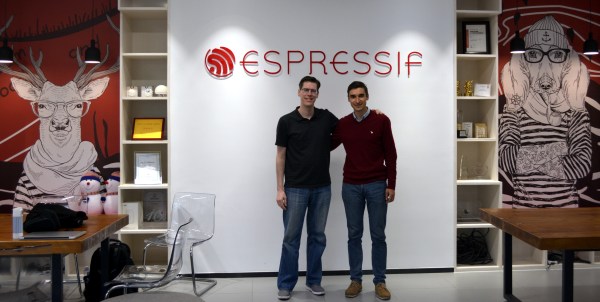
Thursday was my final day in Shanghai. After spending all of Wednesday at Electronica Asia, I headed over to the Espressif Headquarters which is just one subway stop away. This is of course the company behind the well-known ESP8266 and its younger sibling, the ESP32. My host was Ivan Grotkothov, Director of Software Platforms. The backstory on how he found his way to the company is truly interesting, as are the stories he shared on some of the legend and lore surrounding the WiFi capable chips the company makes — and the new one whose existence just leaked out this week.

Join me below for that and few other fun things from my last day in this city of 26 million people.

Continue reading “Hacker Abroad: Visiting Espressif And Surprising Subway Ads”

Retrotechtacular: Nellie The School Computer

When did computers arrive in schools? That should be an easy question to answer, probably in the years around 1980. Maybe your school had the Commodore Pet, the Apple II, or if you are British, the Acorn BBC Micro in that period, all 8-bit microcomputers running a BASIC interpreter. That’s certainly the case for the majority of schools, but not all of them. In early 1969 the BBC’s Tomorrow’s World visited a school with a computer, and in both technology and culture it was a world away from those schools a decade later that would have received those BBC Micros.

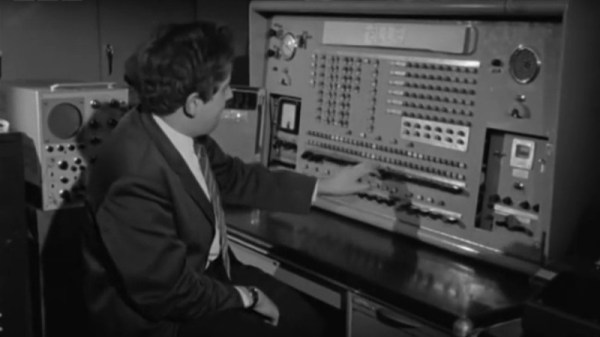
The school in question was The Forrest Grammar School, Winnersh, about 35 miles west of London, and the computer in question was a by-then-obsolete National Elliott 405 mainframe that had been donated four years earlier by the British arm of the food giant Nestlé. The school referred to it as “Nellie” — a concatenation of the two brand names. It seems to have been the preserve of the older pupils, but the film below still shows the concepts of its operation being taught at all levels. We get a brief look at some of their software too — no operating systems here, everything’s machine code on paper tape — as a teacher plays a reaction timer game and the computer wins at noughts and crosses (tic-tac-toe). One of them has even written a high-level language interpreter on which younger children solve maths problems. Of course, a 1950s mainframe with hundreds or thousands of tubes was never a particularly reliable machine, and we see them enacting their failure routine, before finally replacing a faulty delay line.

This is a fascinating watch on so many levels, not least because of its squeaky-clean portrayal of adolescent boys. This is what teenagers were supposed to be like, but by the late 1960s they must in reality have been anything but that away from the cameras. It’s a contrast with fifteen or twenty years later, the computer is seen as an extremely important learning opportunity in sharp opposition to how 8-bit computers in the 1980s came to be seen as a corrupting influence that would rot young minds.

Of course, these youngsters are not entirely representative of British youth in 1969, because as a grammar school the Forrest was part of the top tier of the selective education system prevalent at the time. There would certainly have been no computers of any sort in the local Secondary Modern school, and probably the BBC’s portrayal of the pupils would have been completely different had there been. In 1974 the Government abolished the grammar school system to create new one-size-fits-all comprehensive schools, one of which the Forrest school duly became. Following the vagaries of educational policy it is now an Academy, and there is probably not a room within it that does not contain a computer.

So what of Nellie? Because of the film there are plenty of online references to it in 1969, but we could only find one relating to its fate. It was finally broken up in 1971, with the only surviving component being a delay line. More than one Elliott machine survives in museum collections though, and your best chance in the UK of seeing one is probably at the National Museum Of Computing, in Bletchley.

Continue reading “Retrotechtacular: Nellie The School Computer”

Hackaday Podcast 011: Weird Keyboards, Salvaging LCD Screens, And Mike Interviews Ivan Of Espressif In Shanghai

With our intrepid Editor in Chief Mike Szczys off being kind of a big deal in China, Managing Editor Elliot Williams is joined by Staff Writer Tom Nardi to talk about all the hacks that were fit to print over the past week. Join us as we talk about the wide world of custom mechanical keyboards, reviving a woefully antiquated display technology, building your own RC transmitter out of stuff you have laying around the lab, and the unexpected parallels between Pepto Bismol and rocket fuel. We’ll also look at what it takes to build a robust embedded system, and see if we can’t figure out a way to draw schematics worth looking at. Plus, hang around until the end of the episode to hear Mike interview the man instrumental in getting the ESP8266 to play nice with Arduino, and now running firmware for the ESP32.

Take a look at the links below if you want to follow along, and as always, tell us what you think about this episode in the comments!

Take a look at the links below if you want to follow along, and as always, tell us what you think about this episode in the comments!

Direct download (60 MB or so.)

Continue reading “Hackaday Podcast 011: Weird Keyboards, Salvaging LCD Screens, And Mike Interviews Ivan Of Espressif In Shanghai”

Hacker Abroad: Massive Conference Brings Big News Of Hackaday Prize China

My first full day in China was spent at Electronica, an absolutely massive conference showcasing companies involved in electronics manufacturing and distribution. It’s difficult to comprehend how large this event is, filling multiple halls at the New International Expo Center in Shanghai.

I’ve seen the equipment used for PCB assembly many times before. But at this show you get to see another level below that, machines that build components and other items needed to build products quickly and with great automation. There was also big news today as the 2019 Hackaday Prize China was launched. Join me after the break for a look at this equipment, and more about this new development for the Hackaday Prize.

Continue reading “Hacker Abroad: Massive Conference Brings Big News Of Hackaday Prize China”

First WOPR Summit Finds The Winning Move

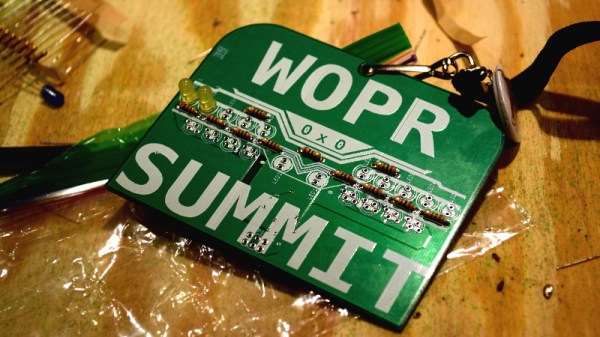
At the climax of 1983’s “WarGames”, the War Operation Plan Response (WOPR) computer famously opines “The only winning move is not to play” when presented with a barrage of no-win scenarios depicting global thermonuclear war. While the stakes aren’t quite as high when it comes to putting on a brand new hacker convention, there’s certainly enough pitfalls that most of us would take WOPR’s advice and never even try. But for those who attended the inaugural WOPR Summit in Atlantic City, it was clear that not only did the team behind it have the tenacity to play the game, but that they managed to prove their supercomputer namesake wrong.

That’s not to say there isn’t room for improvement going forward, but it was hard not to be impressed by such a strong initial showing. The WOPR Summit organizers not only had to contend with the myriad of things that could go wrong, but they had to deal with what actually did go wrong; such as a sizable storm hitting the New Jersey coast just as the event got rolling. Yet from the attendees perspective the weekend-long event went off without a hitch, and everyone I spoke to was excited for what the future holds for this brand-new East Coast event.

It’s never easy to capture 20+ hours worth of talks, workshops, and hands-on projects into a few articles, but we do our best for the good readers of Hackaday. Below you’ll find just a few of the highlights from the first-ever WOPR Summit, but it’s nothing quite like attending one of these events in person. This far out we don’t know when and where the next WOPR Summit will take place, but you can be sure that Hackaday will be there; and so should you.

Continue reading “First WOPR Summit Finds The Winning Move”

Hacker Abroad: A Very Long Way To China

It turns out that Shanghai is a very long way from my home in Wisconsin. I’ve traveled here for Electronica China, and although it made for an incredibly long travel “day”, it turned out to be quite enjoyable. I hacked some hardware on the plane ride, I took a maglev to my hotel, met up with Sophi for drinks, and explored the neighborhood for some Shanghai breakfast. Continue reading “Hacker Abroad: A Very Long Way To China”

Introducing The Shitty Add-On V1.69bis Standard

The last few years have seen a rise of artistic PCBs. Whether these are one-off projects with a little graphic on the silkscreen or the art of manufacturing and supply chains, these fancy PCBs are here to stay. Nowhere is this more apparent than the loose confederation of Badgelife enthusiasts, a hardware collective dedicated to making expressive and impressive electronic baubles for various hacker conferences. Here, hundreds of different hardware badges are created every year. It’s electronic art, supported by a community.

Some of these badges aren’t technically badges, but rather small, blinky add-ons meant to connect to a main badge, and these add-ons are all backed by a community-derived standard. The Shitty Add-On Standard is how you put smaller PCBs onto bigger PCBs. It is supported by tens of thousands of badges, and all of the people who are spending their free time designing electronic conference badges are using this standard.

It’s been more than a year since the Shitty Add-On standard was created, and in that time the people behind the work have seen the shortcomings of the first edition of the standard. Mechanically, it’s not really that strong, and it would be neat if there were a few more pins to drive RGB LEDs. This has led to the creation of the latest revision of the Shitty Add-On Standard, V.1.69bis. Now, for the first time, this standard is ready for the world to see.

Continue reading “Introducing The Shitty Add-On V1.69bis Standard”