Nick Sayer: Making 10ⁿ Isn’t The Same As Building One

Building one of something is tremendously easy. If you’re making one of something, you can cover the insides with hot glue, keep everything held together with duct tape, and mess around with it enough that it mostly works most of the time. Building more than one of something is another matter entirely. This is the thought behind DFM, or Design For Manufacturing. [Nick Sayer] is an experienced seller on Tindie and he’s put together enough kits to learn the ins and outs, rights and wrongs of building not one, but an inventory of things. Check out this last talk of the 2015 Hackaday SuperConference, then join us below for a bit more on the subject.

Continue reading “Nick Sayer: Making 10ⁿ Isn’t The Same As Building One”

Beyond Control: Maths Of A Control System

Control systems are all around us, and understanding them is going to make you much better at hardware design. In the last article — Beyond Control: The Basics of Control Systems — we looked at an overview of what a control systems are in general with the example: “everything in between water and time is a control system”. We also observed control systems in nature, where I described my keen ability to fill a glass of water without catastrophic results. That discussion involved the basic concept of a block diagram (without maths) and we expanded that a bit to see what our satellite dish example would look like (still without maths).

I promised some big ugly maths in this article, and we’ll get to that in a bit, never you fear. First let’s have a look at how some basic elements: resistors, inductors, and capacitors are defined in the time domain. Don’t let these first few definitions turn you off. No matter how you feel about calculus, you don’t necessarily need to fully understand each equation. What’s more important is how the equations themselves combine to solve the circuit. Also important is that I will do everything possible to get out of doing difficult math. So stick with me through the article and you’ll learn that agony-saving trick for yourself!

A quick recap on transfer functions before we get going might be beneficial. A control system is used to define electromechanical behavior. For example: our satellite dish (from the previous article) at some point will need to be moved from one position to another position and as control engineers it is our job to determine just how this action will take place. I’m not talking about setting the mood for the big emotional robotic rotation, more like: not damaging the equipment or any people that might be nearby when moving the dish. For many reasons the dish would need to be moved with extreme care and in a very precise manner. The control system is the mathematical definition of that movement. Often the maths of the definition are nasty differential equations, (remember I’m avoiding any math that can be avoided, right?) so, instead of using differential equations to define the system, the transfer function will define the system with algebra, relating the output of the system to the input.

Continue reading “Beyond Control: Maths Of A Control System”

The Hackaday 2015 Omnibus: A Puzzle So Dense, Even We Don’t Know The Answer

Print is dead, so we put a skull on it. That’s the philosophy behind the 2015 Hackaday Omnibus, the printed collection of the best Hackaday has to offer.

We have a few ideas of where we would like to take the print edition of Hackaday. Mad magazine-style fold-ins are on the list, specifically a fold-in style schematic that does two completely different things. Remember when records were included as a magazine insert? Those are called flexi-discs, and there’s exactly one company that still does it. All of these and more are plans for the future, and for the 2015 Hackaday Omnibus, we chose to include something we’re all very familiar with: a puzzle. This is no ordinary puzzle – even we don’t know what the solution is.

EOT ACK BS
The first clue on the front cover of the 2015 Omnibus

Continue reading “The Hackaday 2015 Omnibus: A Puzzle So Dense, Even We Don’t Know The Answer”

Retrotechtacular: Electronic Publishing In The 1930s

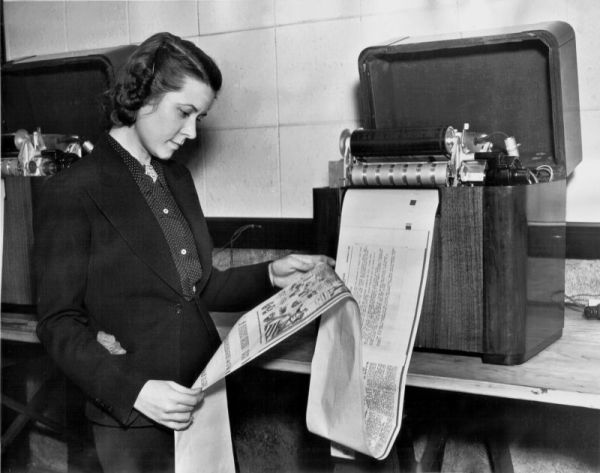
We are living in the age of citizen journalism and the 24-hour news cycle. Reports about almost anything newsworthy can be had from many perspectives, both vetted and amateur. Just a few decades ago, people relied on daily newspapers, radio, and word of mouth for their news. On the brink of the television age, several radio stations in the United States participated in an experiment to broadcast news over radio waves. But this was no ordinary transmission. At the other end, a new type of receiver printed out news stories, line drawings, and pictures on a long roll of paper.

Radio facsimile newspaper technology was introduced to the public at the 1939 World’s Fair at two different booths. One belonged to an inventor named William Finch, and one to RCA. Finch had recently made a name for himself with his talking newspaper, which embedded audio into a standard newspaper in the form of wavy lines along the edges that were read by a special device.

Continue reading “Retrotechtacular: Electronic Publishing In The 1930s”

Calculus Is Not Hard – The Derivative

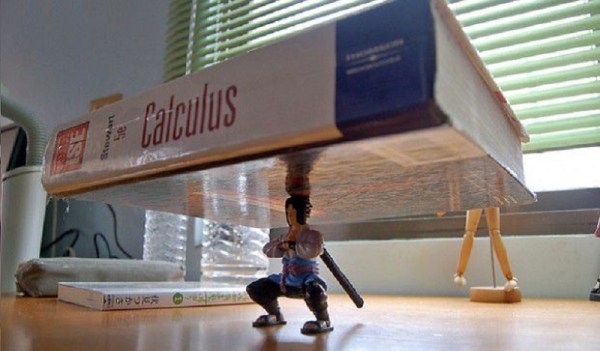
The Calculus is made up of a few basic principles that anyone can understand. If looked at in the right way, it’s easy to apply these principles to the world around you and to see how the real world works in their terms. Of the two main ideas of The Calculus — the derivative and the integral — today we’ll focus on the derivative.

You can enjoy this article by itself, but it is also worth looking back at the previous installment in this series. We went over the history of The Calculus and saw how it arose from two paradoxes put forth by a 4th century philosopher named Zeno of Elea. These paradoxes lead to the derivative/integral ideas that revolutionized mankind’s understanding of motion.

Continue reading “Calculus Is Not Hard – The Derivative”

Fail Of The Week – Steam Cleaner Fix Goes Bad

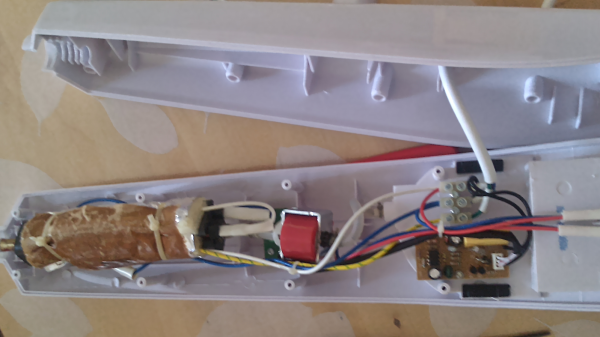
[Sven337] was gifted a steam cleaner, and seemed pretty happy because it helped clean the floor better than a regular mop. Until it fell one day, and promptly stopped working. It would produce steam for a short while and then start spitting out cold water, flooding the floor.

Like any self-respecting hacker, he rolled up his sleeves and set about trying to fix it. The most-likely suspect looked like the thermostat — it would switch off and then wouldn’t switch on again until the water temperature fell way below the target, letting out liquid water instead of steam after the first switching cycle. A replacement thermostat was ordered out via eBay.

Meanwhile, he decided to try out his hypothesis by shorting out the thermostat contacts. That’s when things went south. The heater worked, and got over-heated due to the missing thermostat. The over-temperature fuse in the heater coil blew, so [Sven337] avoided burning down his house. But now, he had to replace the fuse as well as the thermostat.

[Sven337] bundled up all the parts and put them in cold storage. The thermostat arrived after almost 2 months. When it was time to put it all together, a piece of fibreglass tubing that slides over the heater coil was missing. Without the protective sleeve, the heater coil was shorting out with the grounded heater body, blowing out the fuses in his apartment.

That’s when [Sven337] called it a day and threw out the darn steam mop — a few dollars down the drain, a few hours lost, but at least he learnt a few things. Murphy’s Law being what it is, he found the missing insulation sleeve right after he’d thrown it away.


Kate Reed: The Creative Process In Action

Kate Reed is an artist. Kate Reed also builds hand-driven wheelchair accessories that work with any wheelchair. Wait, what? These things don’t have to be separate skills. We’re living in the age of artisanal creation and Kate is a perfect example that you need to embody all skills. She’s an artist who follows a creative idea from inception through to implementation. Check out her talk on the Creative Process in Action from the Hackaday SuperConference, then jump past the break for some more details on what she’s been building and how she build her diverse set of skills.

Continue reading “Kate Reed: The Creative Process In Action”