Hoisting A Laser Cutter To The 3rd Floor (and Other Fun You’ll Probably Never Have)

The folks at Null Space Labs bought a 40W CO2 laser tube in order to build their own laser cutter. Unfortunately nobody really wants to build a laser cutter; they just want to play with a laser cutter. So they ended up biting the bullet and ordering a $4000 model from China. That’s it hovering in midair. This is the story of acquiring the unit and playing around with it once it arrived.

Check out those orange cones in the picture. Hackerspace members put them out to keep the parking spots clear so no damage was caused in the event of an accident. But since they’re located in Los Angeles some of the road warriors didn’t really care and just moved the cones anyway. Luckily the crane hoist to the third floor (they removed one of the windows) ended up going rather well.

So what do you do with a laser cutter like this one? Crack it open and make some improvements. The manufacturer says it can’t cut through steel. Well that’s only if you don’t add some O2 to the cutting process. And the stock mirrors… they’ve got to go. Turns out a simple upgrade boosted the power by about 20% (we’re wondering how they measured that). While we’re talking about optics, might as well upgrade the lens as well. You can see where they’re going with this, and [CharlieX] tells us it is just the first in a series of posts he’ll be working on.

Bending Laser Cut Wood Without Steam Or Forms

If you want to pretty up your project boxes, we can’t imagine anything better than [Shaun]’s walnut plywood, laser-cut, kerf bent Arduino case. Instead of the slot-and-tab construction of traditional laser-cut enclosures, [Shaun] used a technique to bend plywood without steaming, heating, and eventually scorching his somewhat expensive plywood.

This isn’t the first time we’ve seen this accordian style laser-cut kerf bend. By alternating laser cuts along the desired radius, the plywood can be bent by hand. The technique is called kerf bending and is perfect for putting an organic touch on the usual 90° angle project boxes we see.

[Shaun] has an Instructable for the smaller boxes that are part of his Arduino powered wireless sensor network. This Instructable goes over the pattern of laser cuts required to get a nice, smooth kerf bend, and also shows off how beautiful a laser-cut project box can be when cut out of aromatic cedar.

Incredible Home Made Low Cost CO2 Laser

[LokisMischief] wrote in to the tip line to let us know about this incredible home made CO2 laser. This thing is a complete DIY beauty, from the PVC cooling jacket to the toolbox based controller.  The whole thing is essentially built from DIY parts,  hand blown glass for the laser tube, plumbing store mirror mounts,  a PVC cooling jacket with a caulked glass viewing window, and a neon sign transformer with a variac to control output. Even the optics are completely DIY, a hand drilled gold mirror and a NaCL window made from a polished chunk of  icecream salt! [ThunderSqueak] says the control box only cost 60 bucks, and the rest of the parts don’t look too terribly expensive.

We could only find one video of the setup in the variac section of the site, and it was just a test the amp meter in the controller (no lasing anything at all).  [ThunderSqueak] does make a note on the to do list about doing a good laser-y demonstration video, which we are looking forward to.

If you want more DIY CO2 laser action check out this other one or some plans for one.

Laser Cutting In 3D

Everyone in the world suffers from some degree of functional fixedness, a proclivity to use tools only how they were meant to be use. A laser cutter, for example, is usually used to make flat, two-dimensional parts. [Seeker] broke out of this cognitive lock when he decided to create an illuminated 3D object with a laser cutter and a dozen acrylic sheets.

[Seeker]’s project is inspired by acrylic edge-lit LED signs. In these signs, a pattern is engraved on an acrylic sheet and a LED illuminates the panel from the side. When the light from the LED hits the engraving, it’s refracted and produces a wonderful colorful pattern.

To make a 3D version of an edge lit display, [Seeker] subtracted a 3D model of a virus from a cube in Sketchup. This resulted in a hollow cavity that would refract light. After slicing up the model of the 3D cube, [Seeker] sent the files over to the laser cutter to produce a few dozen custom panels. [Seeker] glued them together, put the entire assemblage in front of a LED light, and admired the beauty of his new laser cut 3D virus.

Visualizing Sound Without A Computer

[Emre] sent in a cool art piece he’s been working on that visualizes your voice without the use of a microcontroller.

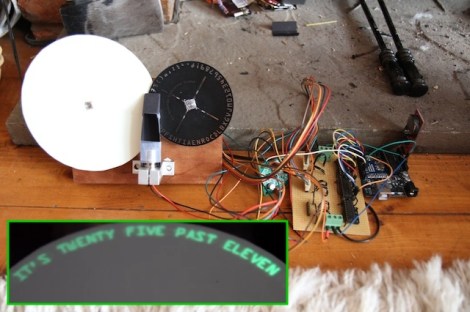
The project is called Visible Voice only consists of a laser, mirror, audio speaker and a phosphorescent disk. The laser shines onto a mirror mounted on the speaker and is reflected onto the disk. When an audio signal is played through the speaker, the light bounces off the mirror and produces a waveform on the disk. Think of it as the lowest tech way of building a model of a CRT; the laser is the electron gun and the speaker is a deflection coil.

Right now, [Emre]’s project displays a waveform along a circular path on the slowly rotating phosphorescent disk. Anyone wanting to copy this project could use a moving belt of the same material giving a much more linear (and straighter) waveform trace.

After the break you can see [Emre]’s friend [Ivan] testing out the glowing laser waveform visualizer.

Continue reading “Visualizing Sound Without A Computer”

Tornado Lamp Made With Lasers

[Styropyro] did a great job of taking common parts and making an interesting item. He calls this his Tornado lamp, and it’s made with stuff you probably have around the house — well you might have to substitute more common glassware for that Erlenmeyer flask.

The bulk of the hack is in the base. You’ll find a laser diode pointed at a small scrap of mirror. That mirror is mounted on the center of a small case fan, giving the tornadic effect when spinning. To make everything fit just right, the laser is pointed horizontally, with the fan/mirror at a 45 degree angle. The beam points up through a hole in the project box and illuminates the liquid in the flask. That liquid is water doped with a substance that fluoresces. In this shot it’s some fluorescein, but we did mention you can do this with stuff from around the house. [Styropyro] demonstrates the use of liqud from some highlighting markers as a substitute.

If you’re decoration a mad scientist’s lab this is a perfect companion for a Jacob’s ladder.

Continue reading “Tornado Lamp Made With Lasers”

Laser So Easy To Build Anyone Can Burn Their Eyes Out

The boys over at North Street Labs built a handheld burning laser and made it look super simple. Well it’s not. We don’t think it’s hard either, but the only reason it looks so easy is because they really know what they’re doing.

The first step was to source the best parts for the application. They’re using a handheld flashlight body which is small but still leaves plenty of room for the components. Next they ordered a quality lens made for the wavelength of the diode, as well as a prefab driver board.

Now the real build starts. They hit the metal lathe and machined a housing for the diode out of some aluminum stock. To marry the parts together they applied some thermal paste, and used a wrench socket to protect the diode from the pressure the vice jaws exert. It slid into place and the whole thing fits perfectly in the flashlight housing. The project wouldn’t be complete without video proof of it burning stuff. You’ll find that after the break.

Continue reading “Laser So Easy To Build Anyone Can Burn Their Eyes Out”